


Highland Cross Cattle: The Hardy Crossbred Explained
Author: Elliott Garber, DVM
A Highland cross is a beef animal produced by crossing a Scottish Highland with another cattle breed, most often a Beef Shorthorn, Angus, Hereford, or a larger Continental breed such as Limousin or Charolais. The point of the cross is simple: keep the Highland’s legendary hardiness, easy calving, and good mothering, and add the size, growth rate, and carcass shape of a more commercial breed through the boost of hybrid vigour. The result is a hardy, low-input beef animal that does well on rough ground, plus, on the homestead side, a growing interest in mini Highland crosses kept as small, manageable family cattle. Below is what the cross actually is, the classic Highland-Shorthorn history behind it, how these animals look and behave, what they are used for, and what to check before you buy one.
What is a Highland cross?
A Highland cross is exactly what it sounds like: an animal with Scottish Highland breeding on one side and another cattle breed on the other. It is not a separate, standardized breed with a fixed look. It is a crossbreeding strategy, and the results vary depending on which breeds are combined and in what proportion.
The usual recipe is a purebred Highland cow bred to a bull of a more commercial breed. According to the Highland Cattle Society, sires that have been used successfully include Beef Shorthorn, Whitebred Shorthorn, Angus, Limousin, Charolais, Blonde d’Aquitaine, and British Blue. The thinking is consistent across all of those pairings: start with a hardy, low-maintenance Highland mother, and use the sire to add growth, frame, and a more commercial carcass shape to the calf.
The reason this works is hybrid vigour, also called heterosis. When you cross two distinct breeds, the first-generation offspring often outperform the average of their parents on traits like vigour, fertility, growth, and resilience. The Highland Cattle Society describes the cross Highland cow as one that “retains the inherent hardiness from the pure Highlander plus that vital ingredient, hybrid vigour.” That combination of a tough, thrifty foundation plus a growthier calf is the entire appeal of the cross. If you are still comparing the purebred against the crossbred, the Creatures Highland cattle page is a good place to read up on the pure breed first, the Highland cow cost guide covers what the purebred sells for, and the broader cattle species page lets you compare other breeds side by side.
It helps to be clear about what a Highland cross is not. It is not a fixed type you can predict exactly, the way you can with a purebred. Two Highland crosses can look quite different, especially across different sire breeds and across first crosses versus later generations. So when someone says “Highland cross,” the honest follow-up question is always: crossed with what?
The classic Highland-Shorthorn cross and its history
The most historically important Highland cross is the Highland-Shorthorn. For generations, Scottish hill farmers have crossed Highland cows with Shorthorn bulls, particularly the Beef Shorthorn and the Whitebred Shorthorn, to produce a hardy crossbred suckler cow that could thrive on tough upland ground while raising a more commercial calf.
This is also the cross behind one of the few cases where a Highland cross was formalized into a recognized breed of its own: the Luing. According to the Luing Cattle Society, the Cadzow brothers began the project in 1947 on the island of Luing in the Inner Hebrides, starting from Beef Shorthorn x Highland first-cross cows. By breeding selected Shorthorn bulls back over those crosses across several generations, they stabilized the Luing as a predominantly Beef Shorthorn breed carrying a Highland foundation (commonly described as around one-quarter to three-eighths Highland), and the breed was officially recognized by the British government in 1965. The goal, in plain terms, was a good beef cow that could raise a calf under harsh weather, which is the same logic behind Highland crossing in general.
The Luing is the exception rather than the rule. Most Highland crosses are not bred toward a new fixed breed at all. They are working first crosses, made on purpose each generation to capture hybrid vigour and then either kept as hardy suckler cows or finished for beef. The Highland’s role in all of this is well earned: it is one of the oldest registered cattle breeds, with the Highland Cattle Society founded in 1884 and its first herd book published in 1885.
What a Highland cross looks like
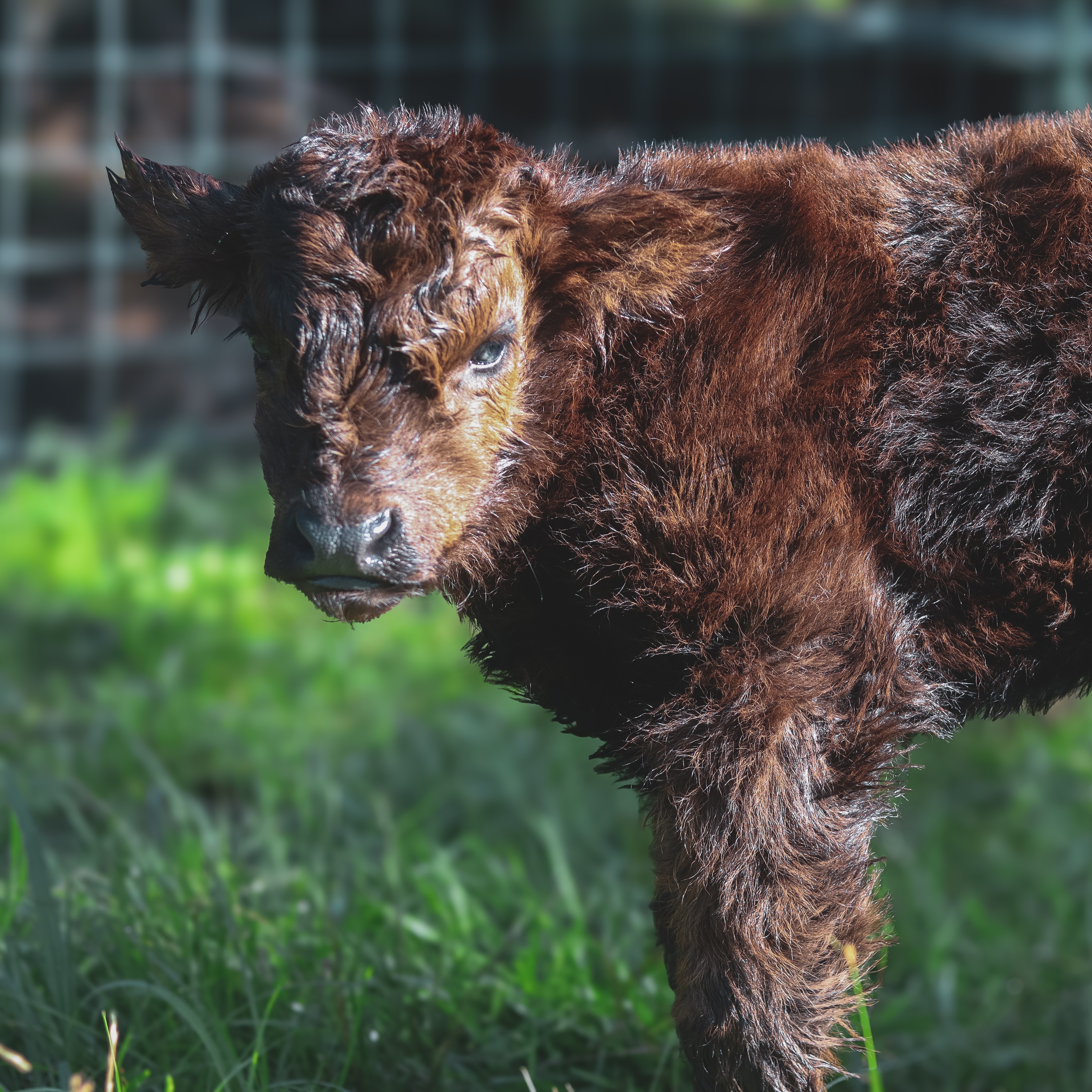
Appearance is the part buyers most often get wrong, because they expect every Highland cross to be a slightly less fluffy version of a purebred Highland. In reality, the look is a spectrum.

- Coat. Many Highland crosses keep a shaggy, weatherproof coat, often shorter and less dramatic than a purebred Highland’s long fringe, but some, especially crosses with smooth-coated breeds, come out closer to a normal beef coat. Red and dun are common, but color follows whatever the two parents bring.
- Horns. Highlands are horned, but horns are not guaranteed in the cross. When a Highland is crossed with a naturally polled breed such as Angus, the polled trait is dominant and the calves are typically born hornless. Cross with another horned breed and you will usually get horns. So a Highland cross may be horned, polled, or dehorned depending entirely on the other parent.
- Frame. This is the headline difference. Crossing a Highland with a larger or growthier breed produces a bigger, beefier, faster-growing animal than the purebred Highland, which is slow-maturing and moderately sized. The cross is meant to add commercial size while keeping the Highland’s efficiency on rough feed.
The practical takeaway: do not assume a Highland cross will look “mostly Highland.” Ask what it is crossed with, look at the actual animal, and judge it on its own merits rather than on the purebred picture in your head.
Hybrid vigour, hardiness, and temperament
The whole reason the Highland cross exists is to stack desirable traits, and the breed’s documented strengths are worth understanding.
Hardiness and foraging. Highlands are exceptionally good at converting rough, low-quality forage. They browse shrubs, heather, gorse, and woody plants and thrive on marginal land where many beef breeds struggle, which is well documented by breed authorities and conservation groups. A Highland cross inherits a good share of that thrift, which is why these animals are valued for low-input systems and for grazing ground that would not support a more conventional herd.
Easy calving. Highland cows are known as easy, unassisted calvers, helped by low birth weights commonly cited at roughly 50 to 75 lb and a calf with a slim, well-shaped frame. That calving ease carries into the cross and is one of its most valued traits, since it lowers labour and loss at the most vulnerable point of the year. Even so, no calving is risk-free, so plan to monitor and have a veterinarian’s number ready.
Mothering and longevity. Highland and Highland-cross cows are noted for strong maternal care and long productive lives. Highland cows commonly breed well into their teens, and the cross cow is prized as a hardy, long-lived suckler dam that quietly raises a good calf year after year.
Temperament. Highlands are generally docile, and Angus, another common cross partner, is also a calm breed, so many Highland crosses are easygoing. That said, temperament varies with the individual, the cross, handling, and especially with horns present, and an intact bull is always a different proposition from a cow or steer. Treat any large horned animal with respect regardless of breed.
What Highland crosses are used for
Highland crosses fill a few distinct roles, and which one you want changes what you should buy.

Hardy beef on rough ground. The most common commercial use is producing hardy beef from low-input, marginal land. A Highland or Highland-cross suckler cow raises a crossbred calf that grows faster and carries more commercial muscle than a purebred Highland calf, while still thriving outdoors with minimal grain. Highland and Highland-influenced beef is typically lean, well marbled, and slow-matured, qualities the breed is known for, and the cross aims to deliver more of it per animal.
Conservation grazing. Highlands and their crosses are widely used as conservation grazers. Their willingness to eat coarse, woody, and invasive vegetation makes them useful for managing scrub, maintaining habitat, and grazing nature reserves, and conservation bodies in the UK and North America use Highland-type cattle specifically for this work. A hardy Highland cross can do the same job while putting more beef on the same rough acres.
Homestead and hobby cattle, including mini Highland crosses. On the smaller end, Highland crosses have become popular homestead animals, valued for a calm temperament and a hardy, easy-keeping nature. This is also where the “mini Highland cross” comes in. Miniature Highland-type cattle are generally not a separate ancient breed but modern small cattle, often produced by crossing Highlands with smaller breeds such as Dexters, or by breeding standard Highlands down in size. People keep them as small family beef animals, occasional house cows, and pets. If you are drawn to a tiny fluffy cross as a milk animal, read our companion guide Can you milk a mini Highland cow? first, because Highlands are a beef breed and milk volume is modest.
Buyer considerations
Because “Highland cross” covers such a wide range, buying well is mostly about pinning down exactly what is in front of you.
- Ask what it is crossed with, and in what proportion. A first-cross Highland-Shorthorn, a Highland-Angus, and a mostly-Highland mini cross are very different animals. Get the breeding on both sides, and whether it is an F1 first cross or a later generation, before you judge the price.
- Buy for your actual purpose. For hardy hill beef, prioritise a sound, well-grown crossbred suckler cow with good feet, udder, and mothering history. For a homestead pet or a small family beef animal, temperament, size, and easy handling matter more than carcass figures.
- Decide about horns up front. Confirm whether the animal is horned, polled, or dehorned, and make sure that matches your handling facilities and comfort level. Remember that crossing with a polled breed like Angus usually yields polled calves, which some buyers prefer.
- Mind the “mini” and “teacup” labels. Very small Highland crosses command premiums, and size claims for young calves can be optimistic, since a calf’s mature size is not guaranteed. Treat dramatic miniature and “teacup” marketing with healthy skepticism, and ask about the sizes of the actual parents.
- Get records and ask about temperament. Birth and weaning weights, calving history, health treatments, and honest notes on temperament tell you far more than a single photo. A good seller will have them.
- Check provenance. A Highland cross is not a registered purebred, so there is no herd-book pedigree to lean on the way there is with a pure Highland. That makes the seller’s records and reputation the thing you are really buying.
You can browse current Highland cross listings on the Creatures marketplace and look for farms and breeders in the Creatures directory. If nothing local is listed today, a saved listing alert (below) is the simplest way to catch one when it appears.
Frequently asked questions
What is a Highland cross?
A Highland cross is a beef animal produced by crossing a Scottish Highland with another cattle breed, commonly a Beef Shorthorn, Angus, Hereford, or a larger Continental breed. It is a crossbreeding strategy rather than a separate registered breed, done to combine Highland hardiness and easy calving with more size and growth through hybrid vigour.
What is the most common Highland cross?
Historically the Highland-Shorthorn cross is the classic one, used for generations to make hardy hill suckler cows. The Highland-Angus cross is also very popular, partly because polled Angus genetics usually produce hornless calves. The Beef Shorthorn x Highland cross is also the foundation of the Luing, a cross that was developed into its own recognized breed in 1965.
Are Highland cross cattle hardy?
Yes. They inherit a good share of the Highland’s hardiness, thrift, and ability to do well on rough, low-quality forage, which is the main reason farmers make the cross. They are widely used in low-input beef systems and for conservation grazing.
Do Highland cross cattle have horns?
It depends on the other parent. Highlands are horned, but the polled trait is dominant, so crossing with a naturally polled breed such as Angus typically produces hornless calves. A Highland cross may be horned, polled, or dehorned.
Is a mini Highland cross a real breed?
Not a separate ancient breed. Mini Highland crosses are generally modern small cattle, often produced by crossing Highlands with smaller breeds such as Dexters or by breeding standard Highlands down in size. They are popular as small homestead and hobby cattle. Remember Highlands are a beef breed, so milk volume from a mini cross is modest.
Is Highland cross beef good?
Highland and Highland-influenced beef is generally lean, well marbled, and slow-matured, qualities the breed is valued for. The point of crossing is to keep much of that quality while gaining the size and growth of a more commercial breed, so you get more beef per animal from hardy, low-input cattle.
Do this next on Creatures
Whether you are researching the cross, hunting for hardy stock, or already running Highland crosses, Creatures is the records, marketplace, and directory layer to do it in one place.
Find stock. Browse Highland cross cattle on the marketplace and search trusted farms and breeders in the Creatures directory.
Get alerted. Good Highland crosses sell locally and fast, so set a free Highland cross listing alert and we will tell you when one is posted. No account needed to start. New to this? See saving searches and using your watchlist.
Add your animal. Already keeping Highland crosses? Create a free animal profile in a few minutes. No account needed to start, and the full walkthrough is in adding an animal to Creatures.
Track weights and health. Track weights, calvings, and health records on Creatures. The record sheet opens for any visitor to look around, and a free account saves what you enter. See adding a record for the full how-to.
List your farm. Run a herd or farm? Add your operation so buyers can find you, then get listed in the breeder directory and read creating an organization and adding your team if you manage your operation with others.
Sell with confidence. Planning to sell stock? Learn how seller payout works before you list.