

Chortai
The Chortai is a short-coated sighthound from the steppe country of Ukraine and southern Russia, bred to course hare and fox across open ground. Its Russian name is Хортая борзая, the Hortaya Borzaya, and Chortai, Chortaj, Khortaj and Khortay are all the same word reaching English by different transliteration routes. The single most useful thing to know about the breed is that it is the smooth one: in a family of eastern sighthounds that includes the Borzoi, the Saluki, the Kazakh Tazy, the Kyrgyz Taigan and the South Russian Steppe Hound, the Chortai is the one whose standard puts it in the short-haired section with no fringing on the ears, legs or tail.
That matters because almost every confusion around this breed is a coat-and-country mix-up, and because the papers a seller shows you mean different things depending on which of those dogs is actually in front of you. Below is what the breed is, where the name comes from, how to tell it from its look-alikes using the registries’ own published standards, what it was built to do, how the law treats coursing live game and where it is a criminal offence, and the sighthound-specific health facts worth raising with your veterinarian. If you are working out where the breed sits among other dogs, the Creatures dog species page is the place to compare, and the Chortai listings page shows what is currently on the market.

Browse listings, public profiles, breeders, or add your animal.
What a Chortai actually is
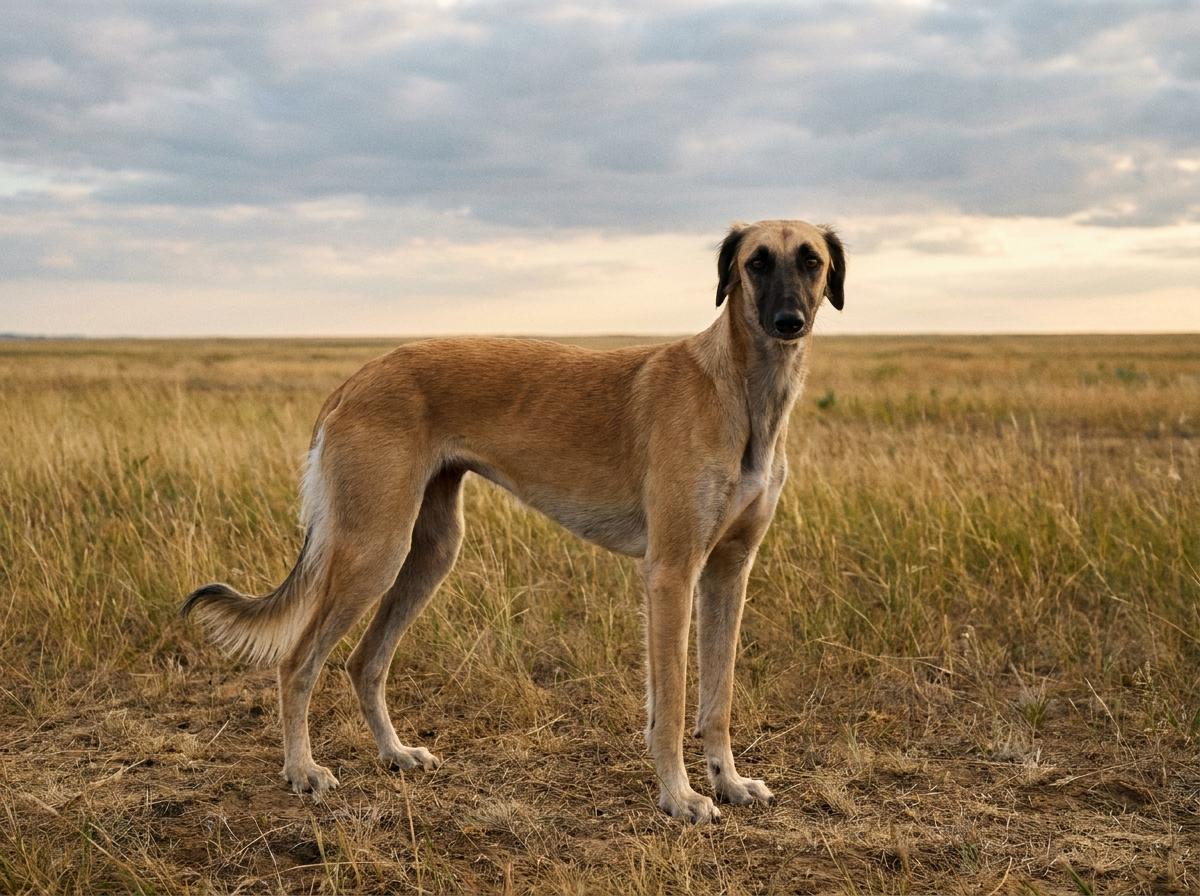
The working definition comes from the breed’s own standard, held by the Russian Kynological Federation, whose current edition was approved by the RKF Presidium on 14 September 2022. It describes a dog of above-average to large size, square or slightly elongated in outline, dry and strong in build, with long rather than round muscling and flattened leg bones. The head is dry, wedge-shaped and long, the eyes are large and obliquely set, the loin is broad and arched, the chest drops nearly to the elbows, and the belly is well tucked up. The RKF standard for the Hortaya Borzaya sets height at the withers at 65 to 75 cm for males and 61 to 71 cm for females.
Two details in that standard do more work than any photograph. The first is the coat: springy, straight guard hair up to about 2.5 cm on the body, with only a sparse trace of longer hair permitted behind the thighs and under the tail, an undercoat that is invisible in summer and barely developed in winter. The second is the ear: medium sized, thin, narrow and slightly pointed, set at or a little below the level of the outer corner of the eye, long enough to be roughly the length of the muzzle, and carried drawn back along the neck. Most dogs raise the ears on the cartilage when something catches their attention, with the tips turning forward and out. The standard rules out a tight rose-petal ear, and lists ears that stand away from the head when the dog is calm as a fault.
The standard also describes the skin as thin and elastic, without folds and without marked subcutaneous fat, and it treats noticeable body fat as a fault. That single line explains most of the “is that dog underfed” conversations Chortai owners have with strangers, and it is worth reading before the first one.
Colour is wide open. Fawn and cream shades, red, grey from ash to yellowish, grey with tan, black with tan, black, black with a reddish cast, and white are all listed, along with brindle, dark masks, light masks, solid coats, white markings and piebald patterns. A Chortai is not identified by its colour, and any seller who tells you a colour proves a breed is telling you nothing.
Where the name comes from, and why the naming is tangled
The word does most of the confusing. The RKF standard’s own history notes that in the seventeenth century “хорть” meant a sighthound-shaped dog in the most general sense, without reference to any particular breed, and that “хортая” was first applied to smooth-coated sighthound types in a list of the dogs of Empress Anna Ioannovna’s kennels, dated 1739 and reproduced in the third volume of a history of royal and imperial hunting in Russia. The first zootechnical description of the breed came from P. M. Machevarianov in 1859, and the first official Soviet standard was adopted in 1951.
Two things follow. First, cognates of that root run right across the region: chart in Polish, chrt in Czech, хорт in Ukrainian and Russian. In several of those languages the word still means “sighthound” generically, so a text calling a dog a khort may not be naming this breed at all. Second, the Cyrillic Х has no single English equivalent, so the same breed arrives in English as Hortaya, Khortaya, Chortaj and Chortai depending on which language the translator came through. They are one dog, not four.
The standard also names the breed’s own ancestry: the Gorskaya and Krymskaya sighthounds, two old regional types that no longer exist as separate registered breeds, with a smaller contribution from the Russian Hunting Sighthound, the dog English speakers call the Borzoi. That inheritance is why a Chortai can look like a plainer, shorter-coated relative of a Borzoi, because in part that is exactly what it is.
Telling a Chortai from a Taigan, Tazy, Saluki or Borzoi
Start with one rule that settles most cases before you look at anything else. The Chortai is classified with the short-haired sighthounds. The eastern breeds it gets mistaken for, the Borzoi, the Saluki, the Kazakh Tazy, the Taigan and the South Russian Steppe Hound, are classified with the long-haired or fringed sighthounds, and fringing is visible from across a field: soft feathering hanging below the ear leather, along the backs of the legs, and under the tail. All of these lookalikes except the smooth Saluki usually separate on furnishings alone, so if a dog carries that feathering, it is not a Chortai. The smooth Saluki is the one the rule cannot reach, and the Saluki entry below explains why.

Borzoi, the Russian Hunting Sighthound. The FCI standard for the Borzoi (breed 193) calls for hair that is long, supple, silky and wavy or forming large curls, with feathering forming a muff on the neck and running along the chest, belly, the backs of the forelegs and thighs, and under the tail. It is also a substantially taller dog, at a desirable 75 to 85 cm for males and 68 to 78 cm for females, a range that starts where the Chortai’s ends. A smooth coat is not a badly grown Borzoi coat, and a male standing 68 cm is well below what the Borzoi standard asks for.
Saluki. The FCI Saluki standard (breed 269) gives a Middle Eastern origin, ears “long and covered with long silky hair”, feathering on the legs and the backs of the thighs, and an average height of 58 to 71 cm. The catch is that the standard also recognizes a smooth variety with no feathering at all, and a smooth Saluki is the genuine look-alike in this group. There is no coat shortcut for that one. You separate them on origin and paperwork, on the ear, which the Saluki carries hanging close to the skull rather than drawn back along the neck, and on the fact that the Saluki has an international studbook the Chortai does not.
Kazakh Tazy. The Tazy is the Central Asian sighthound of Kazakhstan, and it is the only breed in this comparison to have gained ground at the FCI recently. The FCI published its standard in September 2024 with Kazakhstan as the standard holder, and the RKF’s own Group 10 index records it as recognized by the FCI on a preliminary basis, which is a real step none of the others have taken. The FCI Kazakh Tazy standard (breed 372) describes hanging ears carrying soft wavy fringes, the so-called burka, covering the ear leather and extending 5 to 6 cm below it, plus feathering on the legs and a long-haired tail, with height at 63 to 70 cm for males and 58 to 65 cm for females. Hanging fringed ears against ears carried back along the neck is the fastest tell.
Taigan. The Taigan is the Kyrgyz sighthound, formed in the Tien Shan mountains and, as the RKF Taigan standard puts it, adapted for work in broken mountain country at 2,000 to 4,000 metres. Its coat is soft, elongated and dense with a winter undercoat, its furnishings run to about 7 cm and more, and its ear fringes hang 5 to 8 cm below the edge of the ear. It stands 65 to 70 cm for males and 60 to 65 cm for females, and the quarry list is different too: fox, corsac fox, marmot, badger and wildcat, work alongside a golden eagle, and, the standard notes, hares are generally not hunted with taigans. A mountain dog with a woolly coat and fringed ears is not a steppe dog with 2.5 cm of hair.
South Russian Steppe Hound. This is the confusion nobody warns you about, because it shares the steppe, the history and much of the outline. The RKF standard for the Yuzhnorusskaya Stepnaya Borzaya records a straight, slightly harsh guard hair running from 2.5 cm in summer to 4.5 cm in winter, longer on the ears and under the tail with small feathering behind the thighs, ears carried on the cartilage and standing somewhat away from the head, triangular with bluntly rounded tips, and heights of 62 to 70 cm for males and 59 to 67 cm for females. Its standard was adopted in 1951, the same year as the Chortai’s, and it lists the Hortaya among its own ancestors. It also does something standards rarely do and corrects a myth directly, stating that despite the widespread belief, the breed is not descended from and not related to the Persian Saluki.
The Greyhound belongs in the same mental bucket for a different reason. It is a separate western breed with its own long-established studbook and its own conformation, and a Chortai is not a Greyhound with an eastern name. If a seller uses the two words interchangeably, treat that as a signal about the seller.
One more honest caveat. All of the above describes the standards. Real dogs in the breed’s home range vary, some are unregistered, and a photograph on a phone screen is a poor instrument. Where it matters, ask for the registry and the pedigree, not the label.
What the breed was built to do
The RKF standard states the purpose plainly: the Hortaya is used to take hare, fox and small hoofed game, and more rarely wolf. It describes a versatile dog combining speed with endurance and the ability to actually catch, and it notes something unusual for a sighthound, that the breed characteristically uses scent during the search. The typical gait is an unhurried trot, or even a walk, until game is put up, and then a flat gallop.
Temperament in the same document is described as calm, with a strongly expressed visual reaction, and a neutral to friendly attitude toward people and domestic animals. That is a description of a working hunting dog at rest, not a promise about how any individual will behave around your cat.
The classification line in the standard also carries a practical detail for anyone reading a pedigree: the breed is judged with working trials. Field results are part of how these dogs are assessed in their home registries, so a seller who has them can show them, and a seller who has none has told you something too.
Coursing, the law, and legal outlets
The breed standard still records live quarry and working trials, so pursuit of live game is part of what this dog was built for and part of how it is assessed in its home registries. That tells you nothing about what is lawful where you live. Hunting a wild mammal with a dog is a criminal offence in some countries and is governed by local statute in others, and none of it travels with the dog, so the only safe approach is to check the law where you actually live and hunt rather than assume the practice you read about in a breed history is available to you.
The clearest illustration is the United Kingdom, where the answer changes depending on which jurisdiction you are standing in. In England and Wales, section 1 of the Hunting Act 2004 makes it an offence to hunt a wild mammal with a dog unless the hunting is exempt, and section 5 makes it a separate offence to participate in, attend, knowingly facilitate, or allow your land to be used for a hare coursing event. The Police, Crime, Sentencing and Courts Act 2022 added trespass offences aimed at hare coursing and gave courts power to disqualify a convicted person from owning or keeping dogs. In Scotland, the Hunting with Dogs (Scotland) Act 2023 replaced the earlier 2002 statute, keeping an offence of hunting a wild mammal using a dog and adding provisions on trail hunting.
In the United States there is no single national rule, and live coursing is governed by a patchwork of state and local law that varies enough that you should confirm your own before running a dog on game. What exists nationally is the artificial-lure version of the sport, where dogs chase a plastic lure pulled along a line. Two eligibility facts are worth knowing before you buy a Chortai for sport. The AKC lure coursing regulations open those trials to eligible sighthound breeds from one year of age, and require each dog to be registered with the AKC, recorded in the Foundation Stock Service, registered with a foreign or domestic registry whose pedigrees are acceptable for AKC registration, or granted a Purebred Alternative Listing. The Chortai is neither an AKC-recognized breed nor recorded in the Foundation Stock Service, so that door is effectively shut. The AKC Coursing Ability Test and Fast CAT regulations are much broader: those events are open to all dogs at least 12 months old, including dogs enrolled in the AKC Canine Partners program. In practice that is the route most owners of an unrecognized sighthound in the United States will use to give the dog a legal, safe run at speed.
Wherever you are, the ordinary rules still apply on top of the hunting statutes: permission from whoever owns the land, livestock and wildlife protection law, and control of your dog around roads and other people’s animals.
Living with a Chortai: prey drive, recall and containment
A dog selected for centuries to spot a hare at distance and run it down does not stop being that dog because the fence is nice. The standard’s phrase for it is a strongly expressed visual reaction, and the gait description tells you the rest: a quiet trot until something moves, then a full gallop. Recall competes against that instinct, and at the moment it matters most, the instinct usually has the head start.
The practical consequences are the ones every sighthound owner learns, and they are worth planning for before the dog arrives rather than after the first chase.
- Fence for the dog you have. A large sighthound needs secure, high, dug-in fencing with gates that latch positively, because a dog that leaves at a gallop is out of your reach immediately and can cover ground fast.
- Treat off-lead space as a decision, not a default. Enclosed fields, hired secure paddocks and long lines are the everyday tools. Open parkland next to a road, livestock or wildlife is a different proposition.
- Introduce cats and small pets slowly and supervise honestly. Many sighthounds live peacefully with household cats. Some never can. Decide on the dog in front of you, not on a breed description, and do not leave the outcome to chance.
- Train the sit-and-watch skills that actually work. Solid lead manners, a strong recall practised at low arousal, and a reliable “leave” earn their keep more than distance work does.
- Give the speed somewhere legal to go. Sprinting in a safe enclosure, lure work where it is available, and long, varied walks suit the breed better than long-distance jogging beside a bicycle.

Indoors, the picture is usually the calmer half of the standard’s description. Sighthounds in general are quiet, low-fuss housemates who sleep a great deal between bursts of activity, and this breed’s own standard describes a calm temperament. Provide a soft bed. A dog with thin skin and little body fat is uncomfortable on hard floors, and the padding is not a luxury.
Body condition: why a healthy Chortai looks thin to strangers
This is the question new owners get asked in car parks, and the answer is in the standard: thin, elastic skin without marked subcutaneous fat, with noticeable fat listed as a fault. A fit sighthound shows a waist, a deep tuck-up, and often the last rib or two. That is the working shape of the type, not neglect.
The line between correctly lean and genuinely underfed is a veterinary judgment, and the useful framework is the one in the AAHA nutrition and weight management guidelines, which score body condition and muscle condition separately, precisely because a very lean dog can carry good muscle while a heavy dog can be losing it. Ask your veterinarian to score both at each visit and to record the numbers, so you are tracking a trend rather than reacting to a stranger’s opinion. Do not fatten a sighthound to look like a retriever, and do not ignore real weight loss because the breed is supposed to be lean.

Feeding follows from that. A dog carrying little fat has a smaller energy buffer, so intake needs to move with workload and weather, fresh water needs to be constantly available, and hot-weather work needs shade and rest as much as it needs water. The short coat with almost no undercoat cuts the other way in winter: a wet, cold, windy day is genuinely hard on this build, and a coat and dry shelter are reasonable equipment rather than indulgence.
Health and veterinary care for a sighthound
There is no published breed-specific health survey for the Chortai, and pretending otherwise would be inventing data. What exists is a solid body of veterinary literature on sighthounds as a group, most of it built on Greyhounds. Treat it as the sensible starting point for conversations with your vet, not as measured fact about this breed.
Anaesthesia is the one to raise before you need it. A review of anaesthesia of the sighthound in Clinical Techniques in Small Animal Practice sets out why these dogs differ: a nervous demeanour that can produce stress-related complications, a lean body conformation with a high surface-area-to-volume ratio that predisposes to hypothermia under anaesthesia, haematological differences including a higher packed cell volume and lower serum protein that complicate pre-anaesthetic bloodwork, and impaired hepatic biotransformation that prolongs recovery from certain intravenous anaesthetics, thiopental in particular. Later work has looked at the mechanism directly: a study in Scientific Reports on the pharmacogenomics of poor drug metabolism in Greyhounds found that Greyhound livers metabolised cytochrome P450 2B11 substrates more slowly and carried less of the enzyme, and traced it to variants in the gene that cut its expression, with Greyhounds carrying the highest frequency of the low-expression version among the 64 breeds compared. Tell any veterinarian, and especially any emergency clinic that has not met your dog, that it is a sighthound before an anaesthetic is chosen. Your veterinarian makes the drug decisions.
Bloodwork can look abnormal when it is not. A veterinary clinical pathology review of Greyhounds and other sighthounds describes higher red cell mass, creatinine, glomerular filtration rate and hepatic enzyme activity, with lower white cell, neutrophil and platelet counts, and notes that many of these haematological differences have also been described in other sighthounds. A separate study comparing eight sighthound breeds, among them the Borzoi and the Saluki, found significant differences between them and concluded that applying the Greyhound laboratory profile to other sighthounds is not recommended. So the practical step is not to hand your vet a Greyhound chart, it is to make sure they know the dog is a sighthound and to keep your own dog’s results over time as its personal baseline.
Deep chests and bloat. Gastric dilatation and volvulus is an acute, life-threatening emergency in which the stomach distends and twists, and the Merck Veterinary Manual’s account of GDV names deep and narrow thoracic conformation among the proven genetic risk factors, with duration of clinical signs itself a risk factor for death. No incidence figure exists for this breed, so the honest framing is a conformation-linked risk rather than a breed statistic. Learn the early signs, which include unproductive retching, drooling, restlessness and a swelling abdomen, and treat them as an emergency call, not a wait-and-see.
Skin, feet and the cost of running. Thin skin is written into the standard, and thin skin over hard-running muscle tears more easily than a thick-coated dog’s does. Anyone running a sighthound in rough country should expect the occasional laceration, check feet and legs after work, and have a plan and a vet’s number rather than a guess. Toes, pads and tail tips take the wear.
Beyond that, the ordinary programme applies: parasite control suited to your area, dental care, and the vaccination schedule your veterinarian recommends. Every medical decision here belongs to a veterinarian who can examine the animal.
Buying a Chortai, and what to ask
Outside the former Soviet states this is a rare dog with no international studbook behind it, which changes what due diligence looks like.
- Ask which registry issued the papers, and see them. A national kennel federation pedigree, a hunting-club registration and a handwritten note are not the same document. If the dog is presented as registered, get the registry name and the registration number in writing.
- Ask for working results if the seller trades on them. The breed is assessed with working trials in its home registries, so field diplomas exist for dogs that have earned them.
- Confirm what the dog actually is. Given how many eastern sighthounds are sold under loose names, satisfy yourself that you are buying a Chortai and not a smooth Saluki, a Tazy, a steppe hound of another type or a local crossbred. Coat, ear carriage and paperwork together, not a photo and a label.
- Ask about the parents and the relatives. Longevity, temperament, working soundness and any health problems in close relatives are more informative than anything on a website, and a seller who keeps records can answer.
- Get the health history in writing. Vaccinations, parasite treatment, any veterinary events, and the exact date of birth. Then keep adding to that record yourself, because with a breed this thinly documented, your own notes are the best data anyone will have on the dog.
You can watch for animals on the Creatures marketplace and look for breeders and rescues in the Creatures directory. Because listings for the breed are uncommon, a saved alert is usually the practical way to hear about one. If you are weighing up other regional working dogs with the same paperwork problem, two are worth reading next: the Gull Terrier, a Punjabi bull and terrier type with no registry behind it at all, and the Nureongi, a Korean landrace type with no international standard either. Picking a name is the fun part, and the dog name generator will give you somewhere to start.
Frequently asked questions
Is the Chortai the same dog as the Hortaya Borzaya?
Yes. Chortai, Chortaj, Khortaj, Khortay and Hortaya Borzaya are transliterations of the same Russian name, Хортая борзая. The word “хорт” historically meant a sighthound in general, which is part of why the naming is so tangled across languages.
Is the Chortai recognized by the FCI, the AKC or the UKC?
No. The breed’s standard is held by the Russian Kynological Federation, which states in the standard itself that the Fédération Cynologique Internationale has not recognized the breed. It does not appear in the FCI’s Group 10 sighthound nomenclature, it is not an AKC-recognized breed and is not listed in the AKC Foundation Stock Service, and it is not on the United Kennel Club’s list of recognized breeds. Of its close relatives, only the Kazakh Tazy has FCI status, and that is preliminary recognition granted in 2024.
What is the difference between a Chortai and a Borzoi?
Coat and size, mainly. The Borzoi standard calls for long, silky, wavy hair with pronounced feathering, and a desirable height of 75 to 85 cm for males. The Chortai has straight guard hair up to about 2.5 cm with no fringing, and stands 65 to 75 cm for males. The Borzoi is also one of the Chortai’s own ancestors, according to the Russian standard, which is why the outline can look familiar.
How do I tell a Chortai from a smooth Saluki?
This is the hardest pair, because a smooth Saluki has no feathering either. Look at ear carriage, where the Saluki standard describes ears hanging close to the skull while the Chortai’s are carried drawn back along the neck, and then go to paperwork and origin, since the Saluki is an internationally registered breed and the Chortai is not.
Is a Chortai a good family dog?
It can be, for the right household. The breed’s standard describes a calm temperament with a neutral to friendly attitude toward people, and sighthounds are generally quiet indoors. The demands are secure fencing, honest management of prey drive around small animals and livestock, and safe outlets for speed. It is not a dog for casual off-lead walks in open country.
Is coursing live game with a Chortai legal?
It depends entirely on where you are. The breed standard still records live quarry and working trials, but that describes what the breed was built to do, not the law in any country you happen to be standing in. It is a criminal offence in England and Wales under the Hunting Act 2004, with further hare-coursing offences added in 2022, and in Scotland under the Hunting with Dogs (Scotland) Act 2023. In the United States it is a matter of state and local law. Check your own jurisdiction before you plan anything, and remember that land permission and livestock law apply on top.
My Chortai looks too thin. Is that normal?
Often, yes. The standard describes thin skin with no marked subcutaneous fat and treats visible fat as a fault, so a fit dog of this type shows a waist, a deep tuck-up and often the last rib. Real weight loss is a different thing, which is why the AAHA guidelines score body condition and muscle condition separately. Have your veterinarian score both and track them over time.
Do this next on Creatures
Whether you are trying to identify a dog, hunting for a rare litter, or already living with one, Creatures is the records, marketplace and directory layer to keep it all in one place.
Add your dog. Already living with a Chortai? Create a free animal profile in a few minutes, no account needed to start. The walkthrough is in adding an animal to Creatures, and the profile page tabs explains what each section is for.
Keep the health record a rare breed deserves. Add a health or care record. The record sheet opens for any visitor to look around, and a free account saves what you enter. See adding a record and health and medical records for the detail, including where to note that your dog is a sighthound before any anaesthetic.
Get alerted when one is listed. Chortais come up rarely, so set a free Chortai listing alert and we will tell you when one is posted. No account needed to start, and saving searches and using your watchlist covers how the alerts work.
Browse what is available now. Check Chortai listings on the marketplace and search trusted breeders and rescues in the Creatures directory.
List your kennel or rescue. Breeding or rehoming eastern sighthounds? Create a free organization profile, then read getting listed in the breeder directory so buyers searching for a breed this scarce can actually find you.