

Volkosob
A volkosob (Russian: волкособ, literally “wolf dog”) is a wolf and German Shepherd Dog hybrid associated with a kennel program run at a military institute in Perm, Russia. It is not a breed. There is no breed standard, no herdbook, and no kennel club anywhere that registers volkosobs, so the word describes an animal’s parentage and its origin story rather than a recognized type you can buy, register, or show.
Almost everything written about the volkosob in English comes from press coverage rather than from published research, and the coverage is dramatic: extraordinary scent detection, elite border units, animals that outperform ordinary working dogs by an order of magnitude. This page separates what is actually on the record from what is only in the press, and then covers the part that matters far more to anyone who finds this page while thinking about owning one: in the United States, wolf-dog hybrids are banned or restricted in many states and localities, no rabies vaccine is licensed for them, and a single bite can end very differently than it would for a dog.
If you are here to compare unusual and often misunderstood dog types rather than to acquire one, the Creatures dog species page is the place to browse from, and two companion pages cover similar territory: the Gull Terrier, an unregistered Punjabi landrace, and the Nureongi, a Korean native type that is also a description rather than a breed.

Browse listings, public profiles, breeders, or add your animal.
What a volkosob is, and what the word covers
The Russian word volkosob is a compound of volk (wolf) and sobaka (dog). In ordinary Russian usage it is a generic term for any wolf-dog cross, the same way “wolfdog” or “wolf hybrid” works in English. Applied narrowly, it refers to the animals bred in a specific program at the Perm Institute of Internal Troops of the Russian Ministry of Internal Affairs, and that narrow sense is what most English coverage means.
Both senses matter, because they get conflated constantly. A dog advertised as a volkosob outside Russia is essentially never an animal from the Perm program. It is a wolf-dog cross of unknown parentage that has borrowed the name, and the name carries no verification of anything.
The American Veterinary Medical Association defines a canine hybrid broadly, and the definition is the one that governs in practice. Its policy on canine hybrids covers “the offspring of wild canine species (e.g., wolves, foxes, coyotes, jackals, and dingoes) crossbred with domestic dogs,” plus the offspring of those hybrids bred back to dogs, and the offspring of those hybrids bred back to wild canines. Under that definition, a fourth-generation animal with one wolf great-great-grandparent is still a canine hybrid. Many laws follow the same logic, which is why “it is mostly dog” is not the legal defense people expect it to be.
The Perm program: what is on the record
The most substantial first-hand account in the public record is an interview with Vyacheslav Kasimov, a professor in the cynology department at the Perm Institute of Internal Troops, published in March 2016 by the Perm edition of the Russian newspaper Argumenty i Fakty. It is journalism, not a peer-reviewed paper, but it is on the record, attributed, and specific, which puts it well ahead of the aggregator blogs that most English coverage rests on.
In that interview Kasimov describes the program this way. He became interested in whether individual wolves existed that could come under human control, drawing on the Novosibirsk silver fox selection work as a precedent. The foundation animal was a she-wolf named Naida, kept by an acquaintance, whose behavior was unlike a typical wolf’s: reduced wariness of people, and what he described as a willingness to work with them. His premise was that earlier Soviet attempts had failed because they started with ordinary wolves, and that success required a wolf with an atypical behavioral trait. He brought Naida to the institute and paired her with a German Shepherd male.
He also describes the difficulties plainly, which is the part the viral write-ups leave out. The team had to work out how to feed hybrid pups by trial and error. Cadets were bitten during the program, which he characterizes as occasional and minor. And by the time of that interview the project had been closed, with around 50 animals raised across its life. Later Russian write-ups put the program at roughly 16 years from a 1999 start and around 46 animals. Treat the exact count as press-reported rather than official; the range is consistent, the precision is not.
Individual animals were reportedly dispersed to units in Chelyabinsk, Samara and Gelendzhik, with one serving on the border with China. That is a modest institutional footprint, not a standing elite unit, and it is the single most useful correction to the English-language story.

The claims that exist only in press coverage
The following claims circulate widely and should be read as media reporting, not as established fact. None of them has a published protocol, a sample size, a control group, or an independent replication behind it, and we could find no peer-reviewed comparison of volkosob and dog detection performance.
- “Finds a hidden person in 15 to 20 seconds where a German Shepherd needs about four minutes.” This figure, and the related “ten times more effective than a German Shepherd,” appear across English aggregator sites with no traceable primary source. What Kasimov himself says in the 2016 interview is more modest and more honest in form: that in the institute’s own experiments the hybrids were stronger and hardier than dogs and had a better developed sense of smell. That is an investigator describing his own unpublished work, which is a reasonable thing for him to say and a poor thing for a reader to treat as a measurement.
- “Can follow a trail three days old, where a dog is limited to six to eight hours.” Same status. Trail age performance in real detection dogs depends heavily on surface, weather, contamination and training, so a single headline number with no conditions attached tells you almost nothing even when it is true.
- “A secret elite Russian border unit is fielding them.” The 2016 interview describes a closed program, animals scattered across a handful of postings, and an investigator who says he has lost track of what became of most of them. That is not consistent with a standing elite unit.
- Specific dollar valuations, and claims that the animals are leased rather than sold. These trace to English aggregator blogs rather than to any Russian institutional statement, so we will not repeat the numbers as fact.
- Any specific “percentage wolf” figure for a named animal. See the next section. Percentages quoted for hybrids are not measurements.
Naming this honestly is not pedantry. Every one of these claims is the kind of thing that persuades somebody to acquire a wolf-dog hybrid, and the consequences of that decision fall on a real animal.
Wolf content, and why the percentage you are quoted is not a fact
Sellers of wolf-dog hybrids routinely quote a wolf percentage: 50 percent, 75 percent, “high content.” Those numbers are almost always guesses derived from a claimed pedigree, and the pedigree is usually unverifiable. Genetic testing does not settle it the way people assume, for two reasons worth understanding before you believe any number.
First, the tests on offer answer two different questions, and neither one certifies a pedigree. The wolf-dog hybrid test offered by the Veterinary Genetics Laboratory at the University of California, Davis is a forensic test, and it returns categorical results, not fractions: Y and X chromosome haplotypes reported as dog, wolf, hybrid or inconclusive, and wolf-specific markers reported as present or not detected. The laboratory states that the test is powerful enough to detect hybrids within three generations, and it says plainly that because dogs and wolves share most alleles at these markers, and because the wolf-specific variants are themselves uncommon in wolves, “absence of wolf-specific alleles is not a guarantee that there is no wolf ancestry.”
Consumer ancestry panels are built for a different job, and they do produce a number. Embark’s reference panel includes gray wolf among the types it tests, and the company describes working out what percentage of a dog’s ancestry came from each breed by matching long stretches of shared DNA, so a consumer test can return a wolf percentage. Embark also publishes the horizon on that kind of result, stating that genetic ancestry testing can typically inform four to five generations with confidence. Read that number for what it is: a statistical estimate of ancestry from marker sharing, not a verified pedigree, not an exact generation, and not a legal classification. One trap is worth naming, because it is the figure people misread most often. Embark also reports a separate “wolfiness” score, and it states that the score “is not representative of recent wolf ancestry”: it tracks ancient variants that run high in ordinary northern and ancient breeds, so a Siberian Husky can post one without a wolf anywhere in its pedigree.
Second, the research literature agrees about the horizon. A widely cited marker panel developed by vonHoldt and colleagues, published in Mammalian Genome in 2013, detects mixed ancestry within up to four generations of dog and wolf hybridization, and it assigns animals to genealogical classes rather than to percentages. First and second backcross generations were the most distinguishable, with more than 90 percent correctly assigned. Beyond that horizon the signal fades into the background wolf ancestry that is scattered through ordinary dog breeds anyway.
The practical consequences are worth stating directly. A test can tell you that recent wolf ancestry is present, and a consumer panel can attach an estimated percentage to it. Neither certifies that a seller’s “75 percent wolf” claim is true, neither fixes the exact generation or the legal classification that a permit or an ordinance turns on, and no test can prove the negative that a wolf-free label is accurate. Rescues and sanctuaries that test intake animals report the mismatch running in both directions: animals sold at a high advertised wolf content that testing does not support, and northern-breed dogs mislabeled as wolfdogs, which is its own serious problem because the label alone can close off rescue options for an animal that was never a hybrid at all. Treat any percentage a seller quotes you as a sales claim.
The law comes first, and it is not a formality
For most readers this is the section that decides the question, so it comes before temperament, care or anything else.
In the United States there is no single national rule. The Animal Legal and Historical Center at Michigan State University College of Law, in its survey of exotic pet laws, counted 12 states banning ownership of at least wolf hybrids outright, with others requiring a state permit. It also describes the structural problem that catches people out: some states classify these crosses as wild animals, so an owner must comply with the state’s law as though the animal were entirely wolf, while other states treat them as dogs requiring only ordinary licensing and vaccination. The same animal can be a wild animal in one state and a dog across the line. Laws also change, so treat any published survey as a starting point and confirm the current text yourself.
Generation matters in some jurisdictions and not in others. Where it matters, statutes distinguish first-generation crosses from later backcrosses, and permits may attach only to particular generations or to animals owned before a cutoff date. Where it does not matter, every generation is covered no matter how distant the wolf ancestor, and some municipal ordinances take exactly that position. Local rules stack on top of state rules rather than replacing them, so a state that permits ownership can still contain counties and cities that prohibit it.
Michigan is a useful worked example because the statute is short, blunt and easy to read. The Wolf-Dog Cross Act (Act 246 of 2000) defines a wolf-dog cross to include a wolf bred with a dog, a wolf-dog cross bred with a wolf, a wolf-dog cross bred with a dog, and a wolf-dog cross bred with another wolf-dog cross. Section 3 then prohibits breeding one, transferring or receiving one with or without payment, and even advertising a canid as a wolf-dog cross. Section 4 allows possession only for animals already owned on the act’s effective date in June 2000, under a permit applied for within four months. In practical terms, there has been no lawful route to acquire a new wolf-dog cross in Michigan for a quarter of a century, and the prohibition on advertising means that a listing offering one is itself unlawful there.
Outside the United States the picture varies just as much. In England and Wales, wolves are listed under the Schedule to the Dangerous Wild Animals Act 1976 while the domestic dog is excepted, and the Schedule’s separate hybrid entry covers “a hybrid of a mammal specified in the first column of this Schedule where one parent is, or both parents are, of a kind so specified”. A cross with a wolf as one parent therefore sits inside the licensing regime. Where the wolf sits further back in the pedigree, the answer turns on the parentage of the individual animal rather than on any percentage, which is precisely the sort of detail to settle against the current statute and with your local licensing authority rather than against a summary.
Whatever your jurisdiction, do the legal check first, in writing, with your state or national authority and your local animal control office, before an animal exists to be affected by the answer.
The rabies problem, and why a bite ends differently
This is the specific veterinary complication that surprises people, and it is the strongest single practical argument in the whole subject.
No rabies vaccine is licensed in the United States for wolf-dog hybrids. The Compendium of Animal Rabies Prevention and Control, the national reference produced by the National Association of State Public Health Veterinarians and published in 2016, states that “the safety and efficacy of parenteral rabies vaccines in wildlife and wild animal hybrids have not been established, and no rabies vaccines are currently licensed for use in these animals,” and that any use of rabies vaccine in them is therefore extralabel. The same document says wild animals and wild animal hybrids should not be kept as pets.
Vaccinating anyway does not restore the normal outcome. The Virginia Department of Health’s rabies guidelines put the situation in the plainest terms we found: USDA has not labeled any vaccine for use in hybrid animals, a veterinarian who vaccinates one is making an extralabel use of a biologic, and the veterinarian should tell the owner that “public and animal health officials may consider a wolf hybrid unvaccinated for the purposes of rabies exposure.” Virginia’s guidance recommends documenting that conversation with a signed consent form.
The consequence lands at the worst possible moment. A healthy dog, cat or ferret that bites a person is confined and observed for 10 days, regardless of its vaccination status. That familiar rule does not extend to hybrids. The compendium’s wildlife section says wild mammals and wild animal hybrids that expose people, pets or livestock “should be considered for euthanasia and rabies testing,” and rabies testing requires brain tissue, which means the animal cannot survive the test. The AVMA policy says the same thing in operational language: data on the pathogenesis of rabies in canine hybrids are insufficient to build evidence-based quarantine policy, so public health officials may refuse a 10 day post-bite quarantine and require euthanasia and testing instead, and may require euthanasia of a hybrid merely exposed to a potentially rabid animal, whether or not it was vaccinated with a vaccine labeled for dogs.
Michigan again shows how this reads in black-letter law. Section 10 of the Wolf-Dog Cross Act requires the owner to report a potential human exposure within 24 hours and provides that the animal “shall be humanely euthanized by a veterinarian” and examined for rabies. The one exception is for an animal vaccinated at least 30 days earlier with a rabies vaccine approved by the United States Department of Agriculture, which permits a 10 day quarantine instead. Because no such approved vaccine exists for wolf-dog crosses, that exception is currently unreachable in practice; a separate section of the same act simply says that if a vaccine ever becomes federally approved, owners must use it.
One more consequence follows from the AVMA policy and catches owners off guard: providing veterinary care to a canine hybrid may itself be an illegal act in a jurisdiction where owning one is illegal, and in permitted jurisdictions a veterinarian may need to verify lawful ownership before accepting the animal as a patient. Routine veterinary access, the thing every other pet takes for granted, is not guaranteed. Every medical decision for an animal like this belongs with a veterinarian who knows the local law, and that conversation should happen before acquisition rather than after.
Containment, welfare, and an honest read on suitability
The AVMA position is unambiguous. It strongly opposes the ownership of canine hybrids for companionship, personal use, breeding or commercial interests, and supports prohibiting their sale, trade, exchange or transfer for those purposes, on the grounds that canine hybrids may be a significant hazard to human health, to other animals and to the environment, and that there is insufficient evidence supporting their suitability as companion animals. It also states that there is strong evidence canine hybrids can behave unpredictably and pose a significant threat of injury to household members, other pets and the wider community, and that owners are responsible for containing them adequately and humanely.
Part of the reason sits in development rather than in training. Kathryn Lord, working at the University of Massachusetts Amherst, compared sensory development in seven wolf pups and 43 dog pups in a study published in Ethology in 2013. Both develop smell by about two weeks, hearing by about four and vision by about six, but wolves begin to explore their surroundings roughly two weeks earlier than dogs do. The consequence is that a wolf pup starts exploring while still blind and deaf, navigating by smell alone, where a dog pup begins the same exploration with its senses already working. Lord’s conclusion is that this significantly changes how the two experience their environment during the critical period of socialization, and offers an alternative explanation for why dogs form attachments across species so much more readily than wolves.
The practical corollary is the one that matters to a keeper. Institutions that raise tractable wolves and high-content crosses hand-rear them from far earlier and far more intensively than anyone does with a dog puppy. Ordinary household socialization starting at eight weeks is not the same intervention, and it does not produce the same animal.
Containment is the other half, and it is not a garden fence. The Michigan statute gives a concrete picture of what a legislature considered adequate: an enclosure of at least 900 square feet for one animal, plus 450 square feet for each additional one, securely constructed and anchored, with a locked entrance, surrounded by a secondary fence standing at least three feet outside the first, plus posted warning signs and a subcutaneous microchip. The same act forbids tethering the animal outdoors and requires that conditions be safe, comfortable and conducive to normal behavior. Whether or not you live in Michigan, that is a fair description of the scale of the commitment.

Wolf and wolfdog sanctuaries and rescues consistently report the same pattern: animals surrendered by owners who were sold on the romance and were not prepared for the containment, the escape attempts, the destructiveness indoors, the difficulty of finding boarding or veterinary care, or the legal exposure. Placement is hard because the pool of lawful, competent homes is tiny, and because the label alone can disqualify an animal from ordinary rescue routes. We are not going to attach a percentage to that, because the reliable numbers do not exist, but the direction of the reporting is not in dispute and it is consistent with the AVMA’s assessment of suitability.
Kasimov’s own view in the 2016 interview is worth recording alongside all of this, precisely because it disagrees. He said he sees no difference between keeping a volkosob and keeping a dog, and that he keeps a pack of five at his home. He also said they live outdoors and are not allowed in the house. That is one experienced handler describing animals he bred, raised and selected for tractability from a foundation wolf chosen specifically for atypical behavior, working inside an institution built around handling working canines. It is not a claim that generalizes to a family home.
Wolf crosses that did become breeds
The contrast with the volkosob is instructive, because it shows what a documented, sustained wolf-cross program actually produces.
The Czechoslovakian Wolfdog began as a 1955 biological experiment crossing a German Shepherd Dog with a Carpathian wolf. According to the FCI breed standard, the experiment ended in 1965 with a plan to breed the results as a new breed combining usable wolf qualities with favorable dog qualities, national recognition followed in 1982, and the current standard was published in 1999. It sits in FCI Group 1 as a working breed, and it is also recognized by the United Kennel Club as the Czechoslovakian Vlcak.
The Saarloos Wolfdog took a longer route to the same place. Its FCI standard records that Leendert Saarloos crossed a German Shepherd Dog male with a female wolf in 1932 and then bred back to the father, producing a base population at about one quarter wolf ancestry. The standard is unusually candid about how that turned out: as the proportion of wolf ancestry rose, the working ability inherited from the German Shepherd side was gradually lost, and the breed proved suited to neither working nor guide work. It was recognized in 1975 as what the standard calls a dog with attributes close to nature rather than a working dog.
That Saarloos history is worth sitting with, because it is the closest thing to a documented outcome anybody has for the premise the volkosob story rests on. Adding wolf to a working breed was supposed to produce a better working dog. In the one case where a registry recorded what happened over decades, more wolf ancestry made the animal less useful for work, not more. That is a single case rather than a general law, but it is a documented single case, which is more than the performance claims circulating about the volkosob can offer.
Both breeds took decades of deliberate breeding, a written standard, a herdbook, and a registry willing to record pedigrees. The volkosob has none of those things. That is not a criticism of the Perm work, which had an entirely different purpose, but it does mean the two are not comparable objects. One is a breed you can research, register and verify. The other is a program that ran, produced a few dozen animals, and closed.
Recognition is not the same as suitability, though, and it is not an automatic answer to your local law either. The FCI standard for the Czechoslovakian Wolfdog describes a lively, very active, enduring dog that is fearless, courageous and suspicious, which is a demanding profile in an ordinary household. And because the AVMA definition of a canine hybrid reaches the descendants of wild-canine crosses with no generational cutoff, a recognized wolfdog breed is not automatically outside the discussion this page has been having. Recognition tells you the pedigree can be checked. It does not tell you the animal is easy.
What a volkosob looks like
Because there is no standard, there is nothing to measure an individual against, and any description is a description of a type rather than a specification.
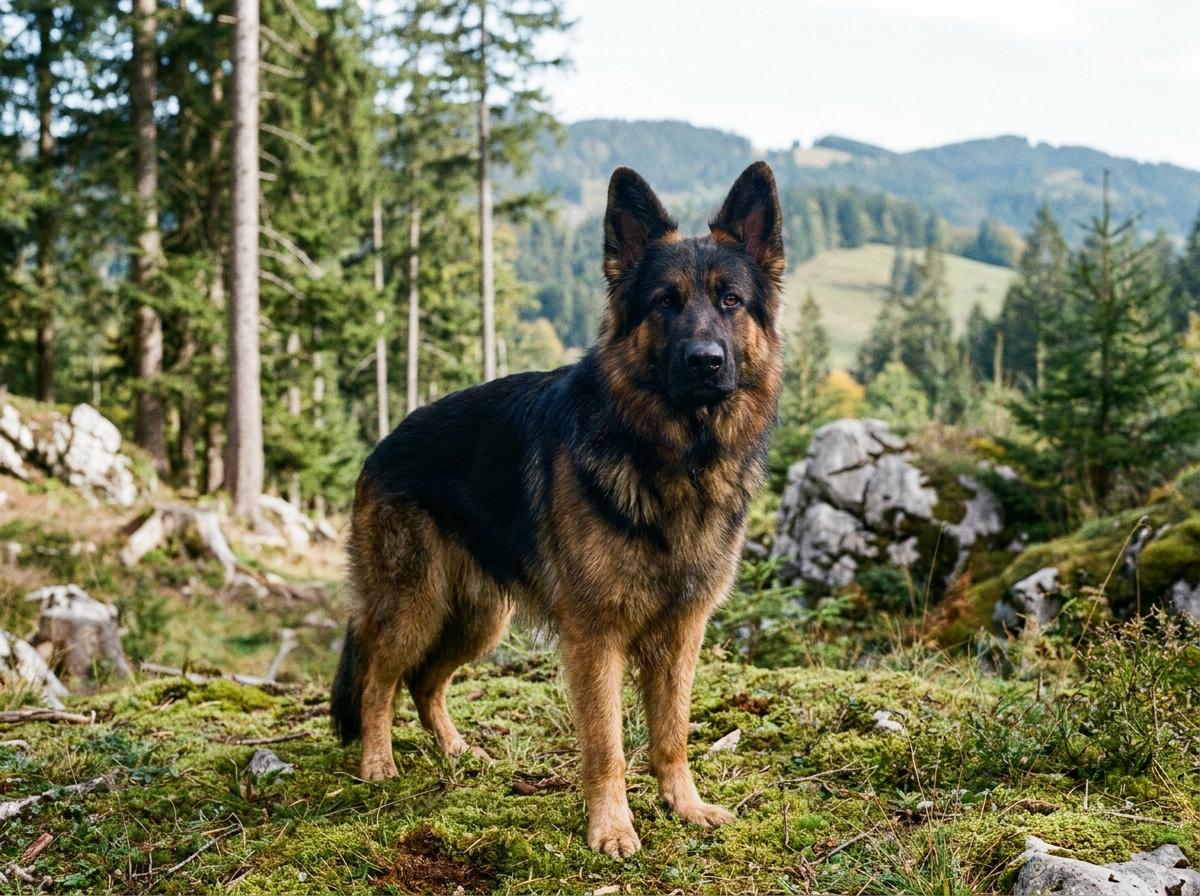
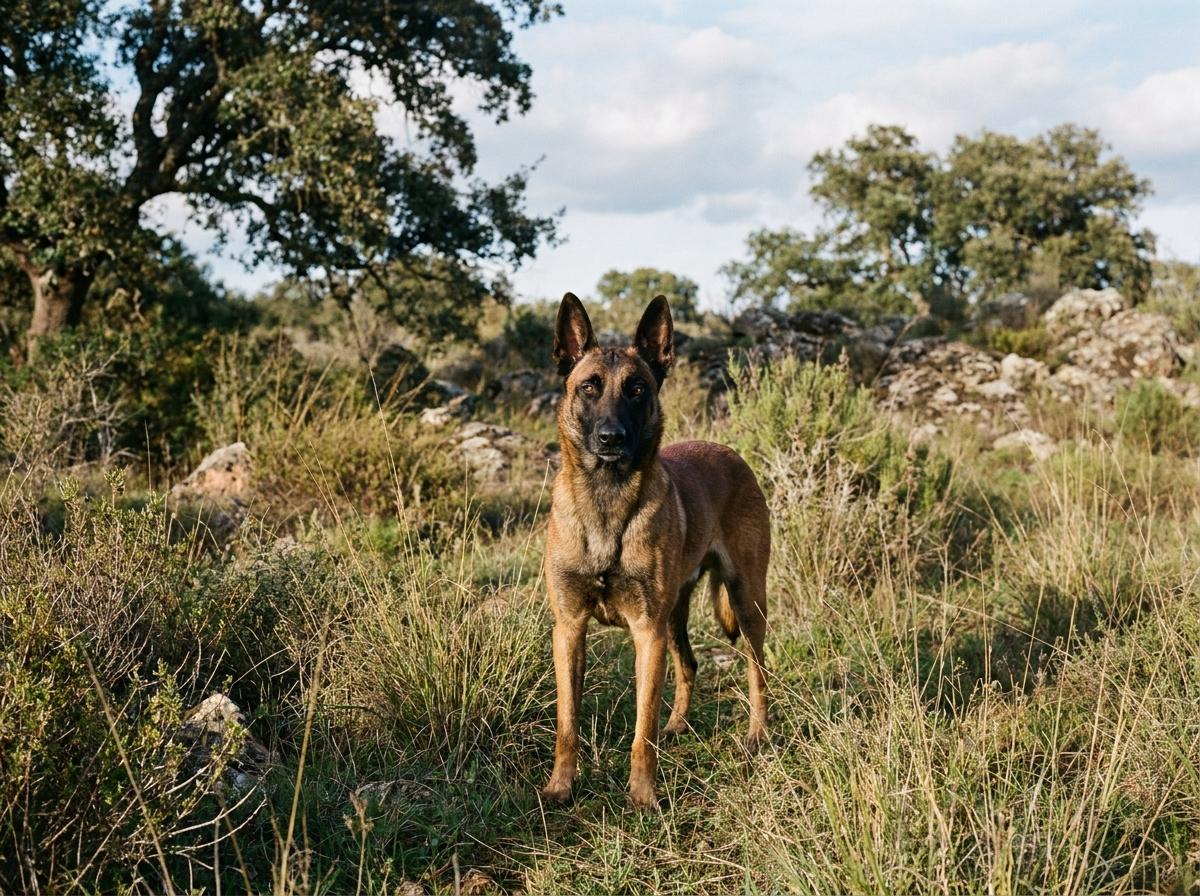
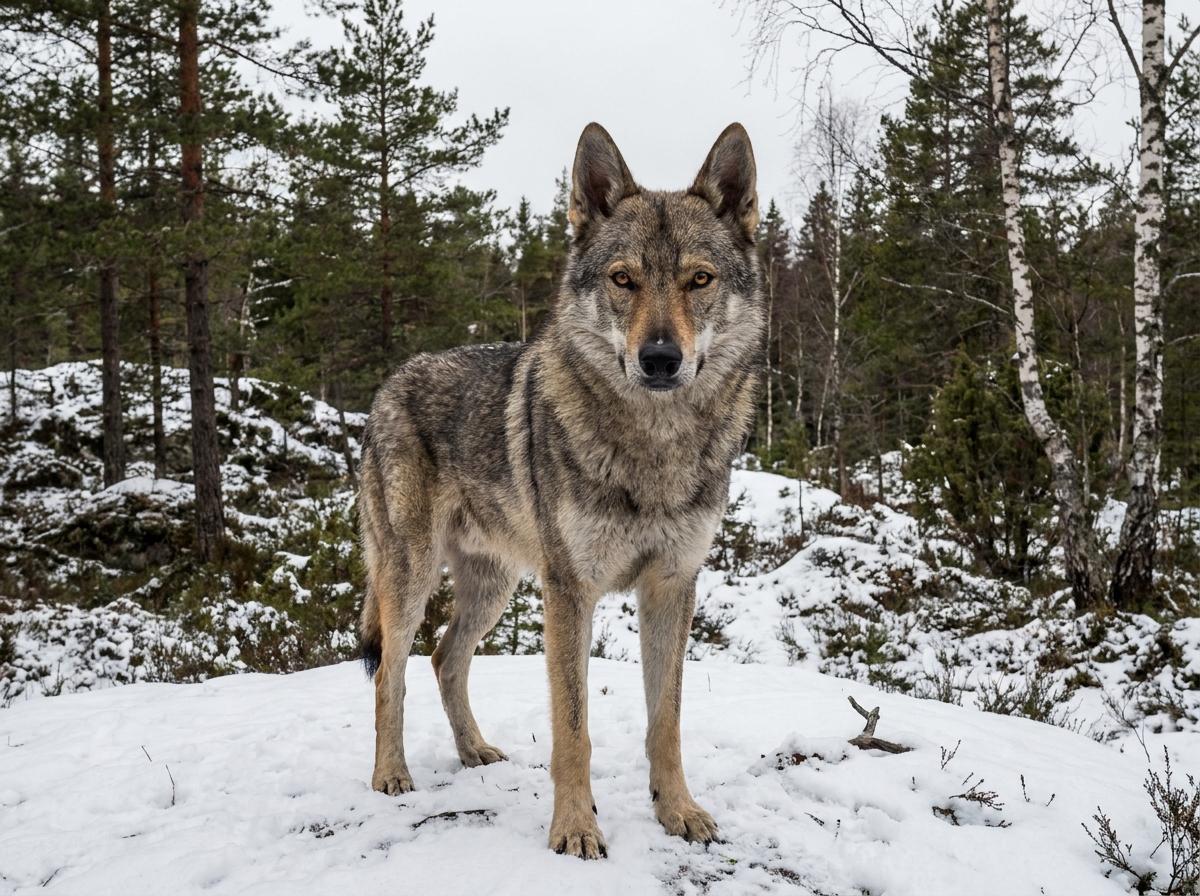
Photographs from the Perm program, and wolf and German Shepherd crosses generally, show an animal of intermediate character: large and long-legged, more lightly built through the body than a heavy show-line shepherd, with a broad wedge-shaped head, a long straight muzzle, light eyes, and large erect triangular ears. The coat is typically a dense double coat in grey sable or grizzled agouti with paler cheeks, underparts and legs, though darker and more reddish animals are also reported. The back is straight and level, without the sloping, roached topline that modern show-line German Shepherds have been bred toward, and the tail is long and bushy and carried low rather than curled over the back.
Two cautions. First, appearance is not evidence of ancestry. Plenty of northern-breed dogs, and many mixed-breed dogs, look far more wolf-like than a genuinely low-content hybrid does, which is exactly why the misrepresentation problem runs in both directions. Second, a wolf-like appearance is what gets an animal into legal trouble in the first place, because animal control officers and courts often work from an assessment of type when no verifiable pedigree exists.
If you already live with one
Some readers arrive here already responsible for a wolf-dog hybrid, lawfully, or as a rescue, sanctuary or foster placement. The honest advice for that situation is administrative rather than aspirational, and records do most of the work.
Keep the paperwork in one place and keep it current: the permit or license and its renewal date, the microchip number, the enclosure specification and any inspection, the signed consent form covering extralabel rabies vaccination, every vaccination date and product, and the name and contact details of the veterinarian and the local health department. If an incident ever occurs, that file is what a health officer will ask for, and reconstructing it from memory under pressure is not a plan.
Record the ordinary animal husbandry too: weights, parasite treatments, diet changes, behavior notes, escape or containment incidents and what you changed afterward, and anything a future carer would need if the animal is ever placed. A hybrid’s file follows it between homes and sanctuaries far more often than a pet dog’s does, which makes the file unusually valuable.
You can keep all of that on Creatures as a free animal profile with a full record history, and the hub below links the relevant walkthroughs.
Frequently asked questions
Is the volkosob a real breed?
No. It is a wolf and German Shepherd hybrid and a program name, not a breed. There is no breed standard, no herdbook and no kennel club recognition anywhere, so a volkosob pedigree cannot be checked the way a registered breed’s can.
Can I buy a volkosob?
Animals from the Perm program were institutional working animals and the program is reported closed, so an animal offered for sale as a volkosob outside Russia is a wolf-dog cross of unknown parentage using the name. Separately, in many US states and localities acquiring a wolf-dog hybrid is illegal, and in some places offering one for sale is itself an offense.
Are volkosobs really ten times better than German Shepherds at finding people?
That claim comes from press write-ups, not from any published trial. The investigator who ran the Perm program has said his hybrids had a better developed sense of smell than dogs in the institute’s own experiments, which is an unpublished in-house observation rather than a measurement. No peer-reviewed comparison that we could find supports the specific figures that circulate.
How much wolf is in a volkosob?
Nobody can tell you reliably. The forensic test at UC Davis reports categories rather than percentages; a consumer ancestry panel such as Embark’s does estimate a wolf percentage, but that is a statistical estimate of ancestry rather than a verified pedigree, and it does not fix an exact generation or any legal classification. The UC Davis test is powerful enough to detect hybrids within three generations, while consumer ancestry testing typically informs about four to five generations with confidence; neither can prove the absence of older wolf ancestry. Any specific percentage a seller quotes you is a sales claim, not a measurement.
Is it legal to own a wolf-dog hybrid in the United States?
It depends entirely on your state, county and city, and the rules differ on whether hybrids count as wild animals or as dogs and on how generation is treated. Several states ban ownership outright, others require a state permit, and local ordinances can prohibit ownership even where state law allows it. Confirm the current rules with your own state authority and local animal control before anything else.
Why does the rabies vaccine issue matter so much?
Because no rabies vaccine is licensed for wolf-dog hybrids in the United States, officials may treat a vaccinated hybrid as unvaccinated. After a bite, that can mean euthanasia and rabies testing instead of the 10 day observation period a dog would get, and rabies testing requires brain tissue.
Do wolfdogs make good family pets?
The AVMA strongly opposes owning canine hybrids for companionship and says there is insufficient evidence supporting their suitability as companion animals. Sanctuaries and rescues consistently report animals surrendered by owners who could not meet the containment, socialization and legal demands. If you want a wolf-like dog, a recognized breed with a verifiable pedigree is a very different proposition from a hybrid.
What is the difference between a volkosob and a Czechoslovakian Wolfdog?
The Czechoslovakian Wolfdog is a recognized breed with a written FCI standard, a herdbook and decades of documented breeding behind it. The volkosob is a closed military kennel program with none of those things. Both descend from German Shepherd and wolf crosses; only one produces an animal whose ancestry you can verify on paper.
Do this next on Creatures
Creatures is the records, profile and directory layer for animals and the people who care for them. For a subject like this, the useful parts are documentation and organizations, not shopping.
Document the animal. If you lawfully keep, foster or care for a wolf-dog hybrid, create a free animal profile and keep the permit, microchip and enclosure details with it. No account is needed to start. The walkthrough is in adding an animal to Creatures, and your animal’s profile page explains what each tab holds.
Keep the health file that matters here. Add a record for every vaccination, veterinary visit, weight and incident. The record sheet opens for any visitor to look around, and a free account is what saves what you enter. See adding a record and health and medical records.
Never miss a renewal or a booster. Permits, licenses and vaccination dates are exactly the kind of thing that lapses quietly. Reminders and upcoming care shows how to schedule them.
Run a rescue, sanctuary or education organization? Create an organization profile so people researching wolfdogs can find you rather than a seller. No account is needed to start, and creating an organization and adding your team covers shared access for staff and volunteers.
Find organizations, not sellers. Browse rescues, sanctuaries and trusted organizations in the Creatures directory, and read getting listed in the directory if you want yours included.
Compare from the species page. Start at the Creatures dog species page, or read the companion pages on the Gull Terrier and the Nureongi, two other dog types where the name describes an origin rather than a registered breed.
This page is general information, not legal or veterinary advice. Wolf-dog hybrid law varies by state, county and city and changes over time; confirm the current rules with your own authorities, and take every medical decision with a veterinarian who can see the animal.