Black Bengal
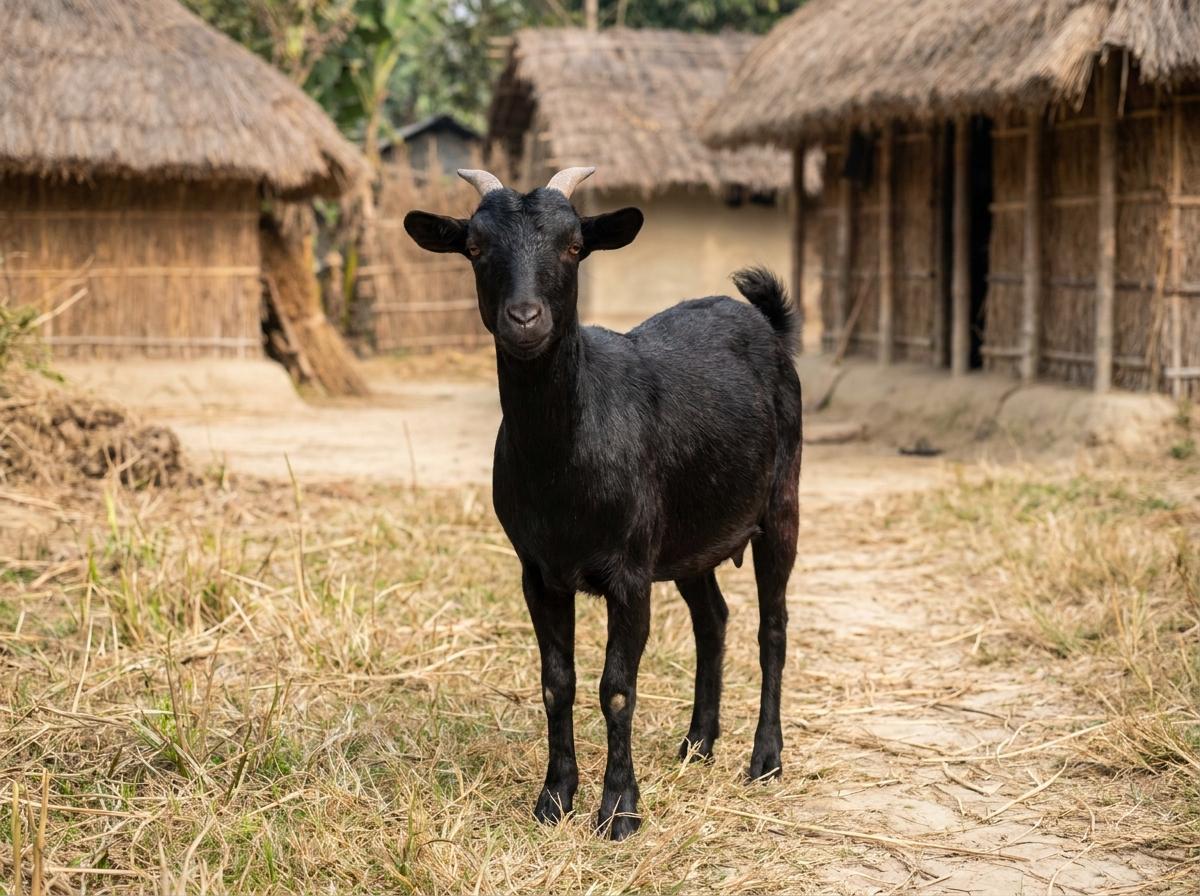
The Black Bengal is a very small, usually black, extremely prolific meat and skin goat from Bangladesh and the neighbouring eastern Indian states. A mature doe weighs about 20 kg and stands a little over half a metre at the shoulder. She carries short ears held out sideways, small horns, and a short glossy coat. She will also, under decent management, deliver three kiddings of twins in two years on feed that would not sustain a dairy goat, which is why a breed most Western keepers have never seen has decades of peer reviewed literature behind it.

That research base is why this page can be specific where breed pages usually hedge: measured weights with their sample sizes attached, litter size distributions rather than a rounded average, growth rates under named feeding systems. You can see how the breed sits against others on the Creatures goat species page, and the one thing this page will not do is pretend you can buy one in North America.
Browse listings, public profiles, breeders, or add your animal.
Why a 20 kg goat has this much research behind it
Bangladesh runs one of the largest national goat herds on earth, on the order of 26 to 31 million head depending on which official series you read, and a 2025 review puts the Black Bengal at 90 percent of it, with small scale farmers owning roughly three quarters of those animals. This is not a niche breed with a fan club. It is the working livestock of tens of millions of households, which is why agricultural universities in Mymensingh, Chattogram, Sylhet and Kalyani have been measuring it for fifty years.
The economics explain every other trait on this page. A household with a quarter of an acre cannot keep a cow. It can keep the two or three goats that FAO’s survey work found in a typical village flock, browsing hedgerows and crop residues at almost no feed cost, and producing a saleable animal every few months. The value here is not carcass size. It is how many saleable animals a very small amount of feed generates per year, plus a hide with its own export market.
Two consequences surprise people. Growth rate is genuinely mediocre: in the on-farm arm of a 2020 Bangladeshi feeding trial, goats on traditional semi-intensive village feeding gained about 18 grams a day, against about 52 grams a day on a complete pellet ration, a difference the authors report as significant at p below 0.01. A Boer would embarrass both figures. And the milk is close to irrelevant. The breed wins on reproduction and on skin, not on the scoreboard a commercial meat producer usually reads.
How to recognise one, and how it differs from the long eared breeds
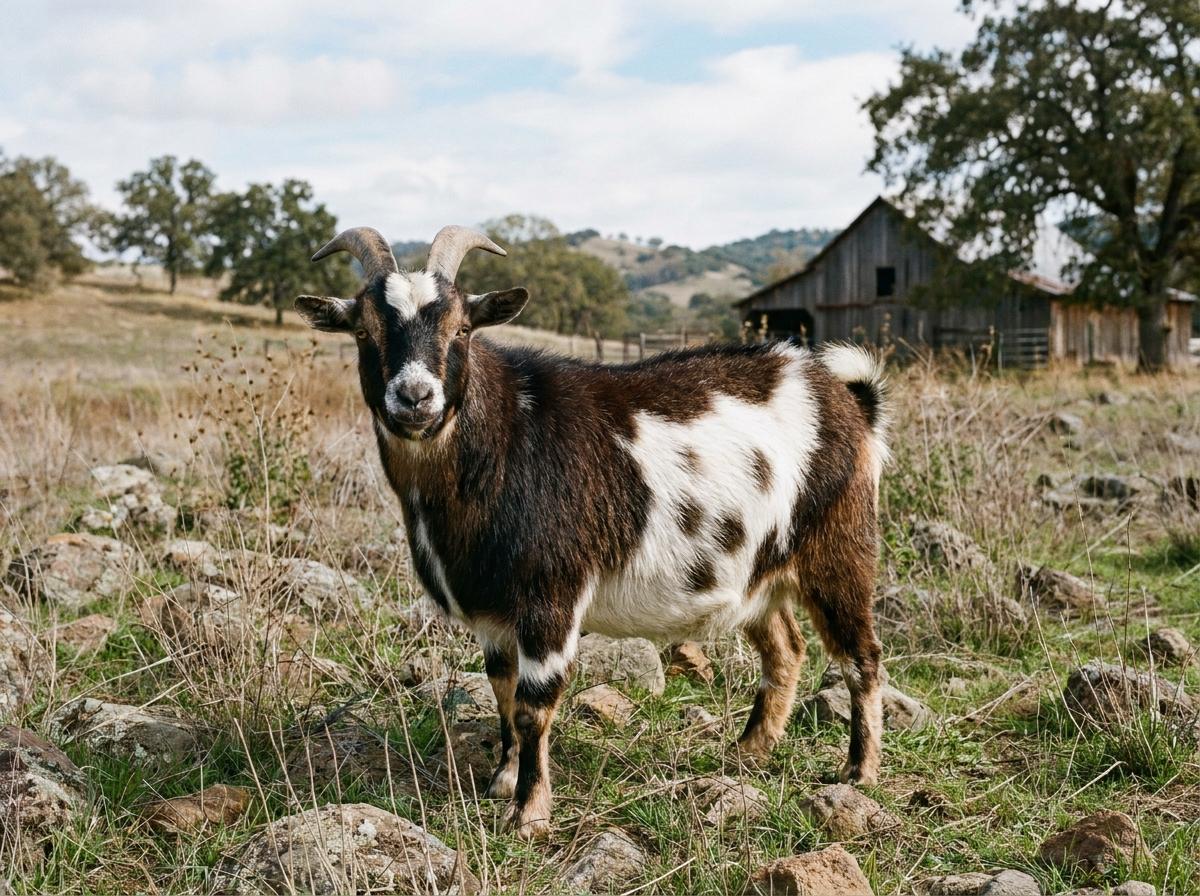
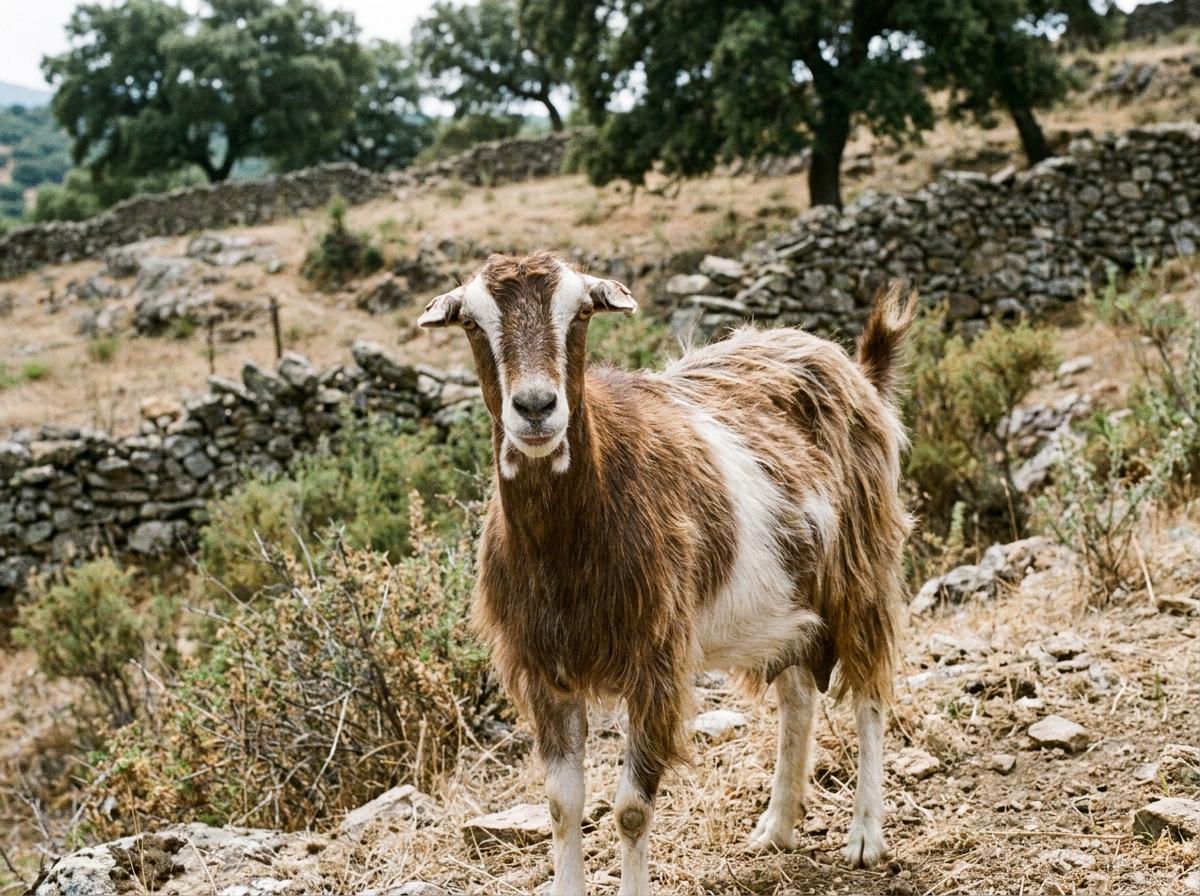
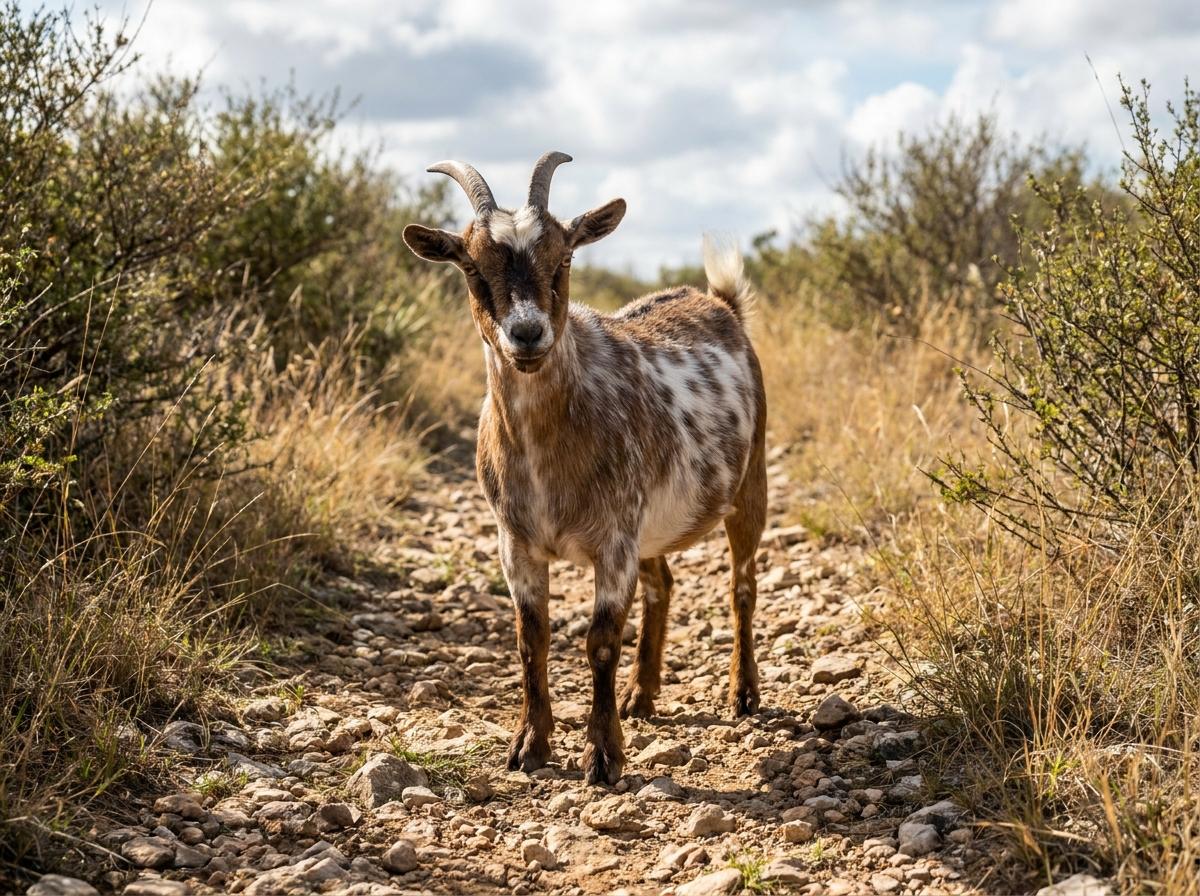
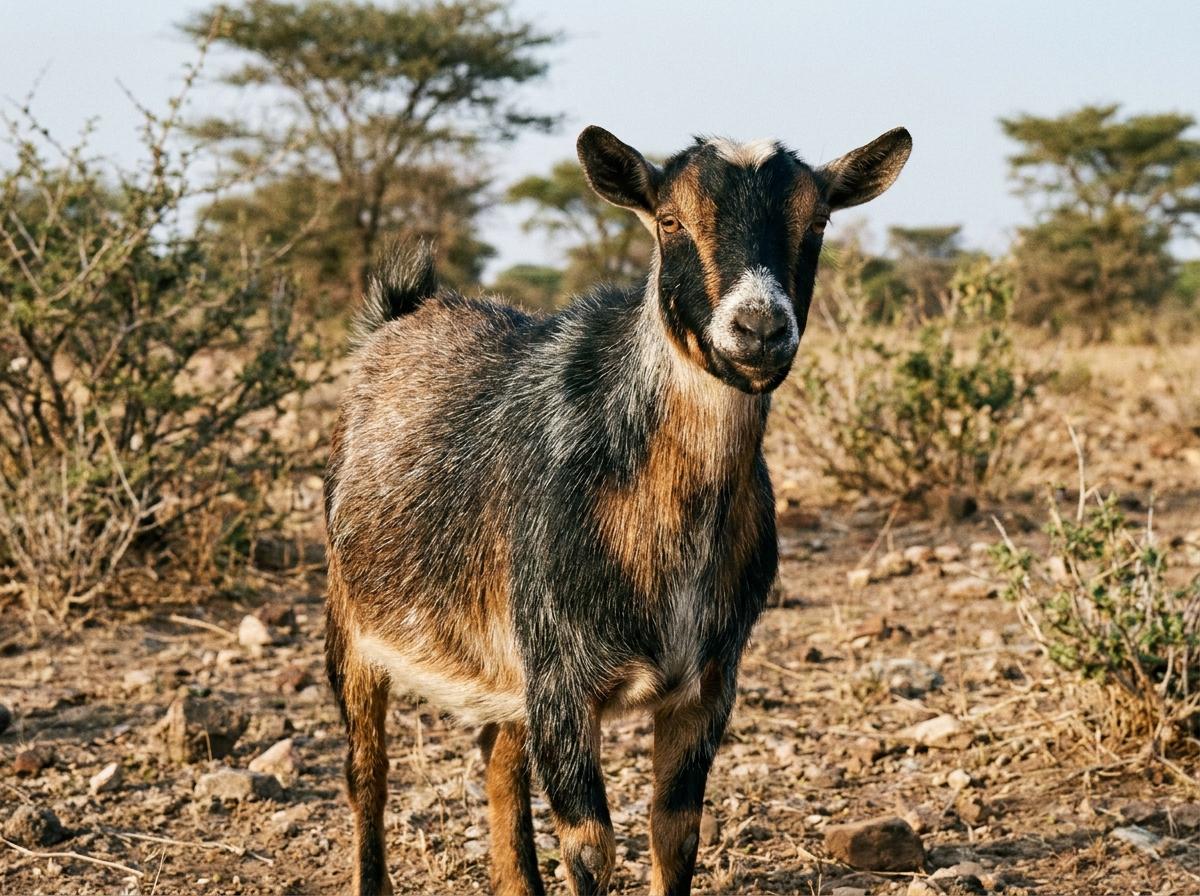
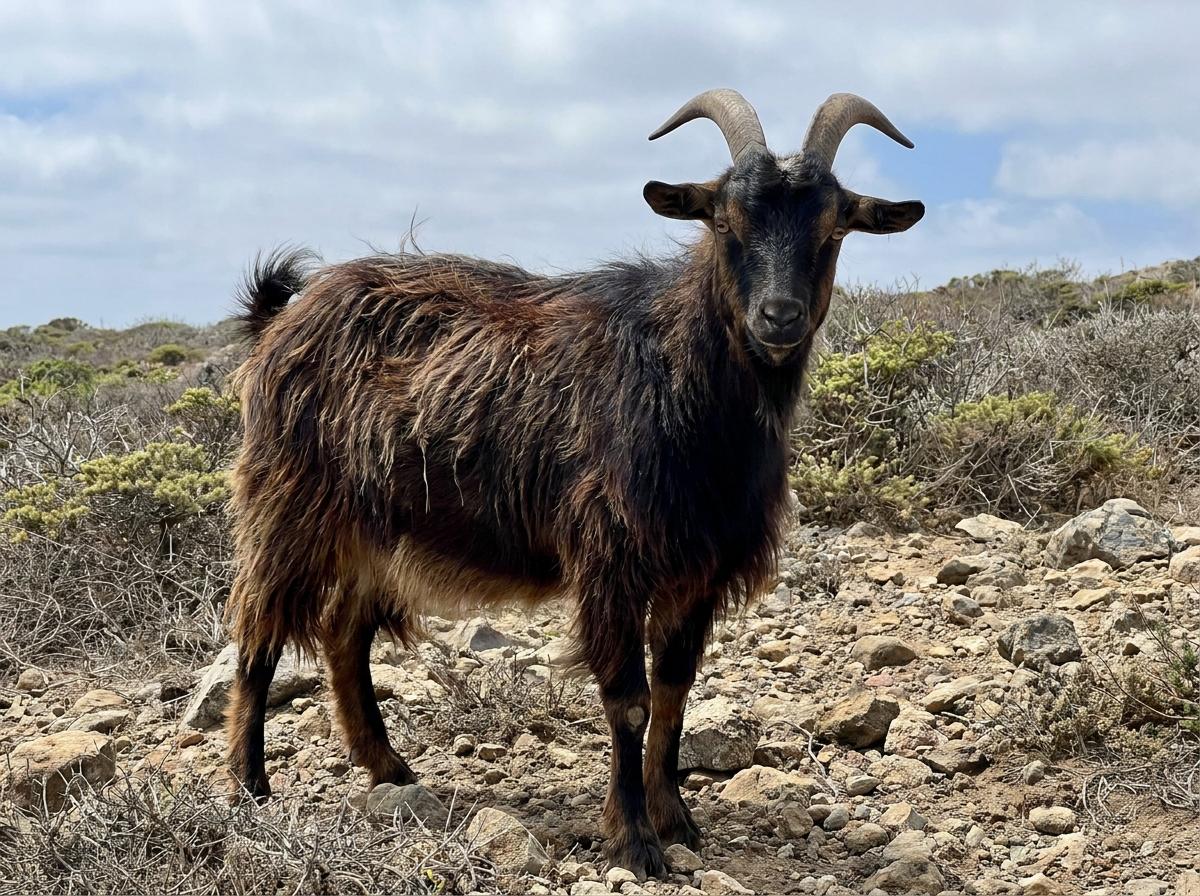
FAO’s breed survey is still the most precise description available, and it measured the features rather than describing them. The ears are short, averaging 13.8 cm across a range of 11.5 to 14.1 cm, flat, and carried horizontally out from the head. The horns are small in both sexes, averaging only 6.4 cm across a range of 5.8 to 11.5 cm, and sweeping upward and sometimes backward. The upper bound is nearly double the mean, so a longer horned animal is not off type. Both sexes carry a beard, which catches people out, because a bearded animal here is not necessarily a buck. The nose line is slightly depressed, meaning very gently concave rather than convex. The coat is short and lustrous.

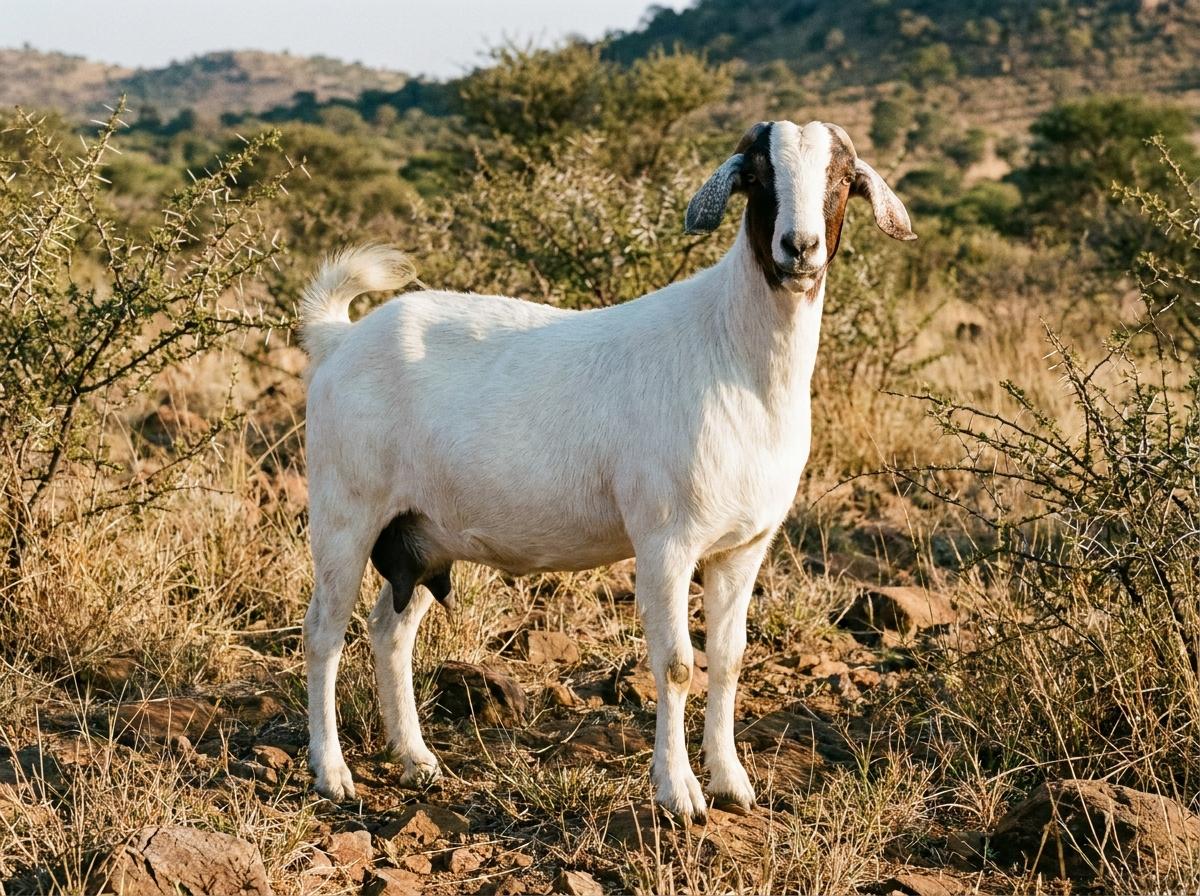
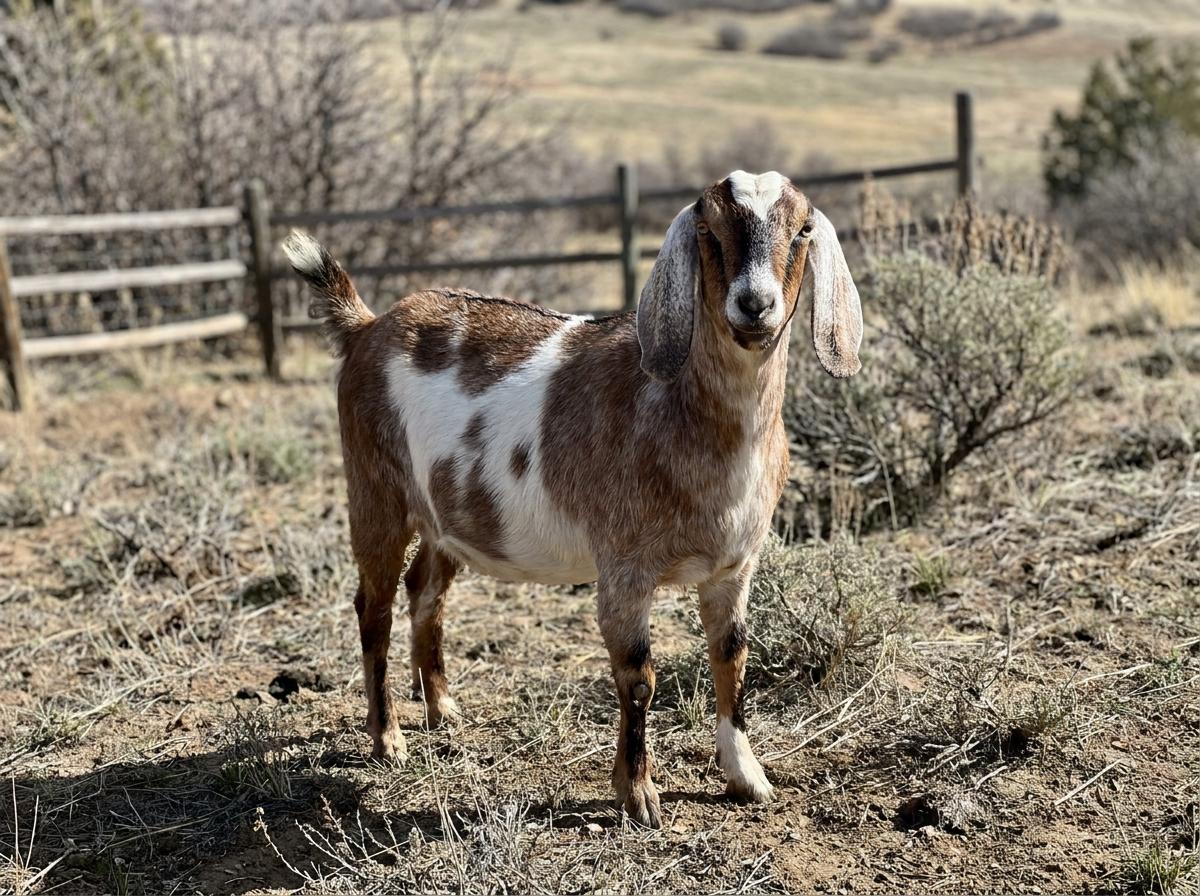
That short ear and gently dished face is the fastest way to separate this breed from its regional neighbours. The Damascus carries ears measured at 27 to 32 cm, hanging well below the jaw, on a long convex Roman profile, and it is a tall dairy animal: about three times the weight of a Black Bengal doe against the improved Cyprus population at 65 kg, and about twice it against FAO’s Syrian figures. The Kamori of Sindh is likewise a large, long eared, long necked animal. Put a Black Bengal next to either and the contrast is not subtle: short ears against ears that swing when the animal walks, a slightly dished face against a convex one, and a goat you can lift against one you cannot.
Colour is the trait people over trust. Black is the classic coat and gives the breed its name, but the breed is not exclusively black. In an FAO reported survey of goats in Assam, 96 were completely black, 51 completely white, 11 brown, 45 white with black markings and 17 brown with black markings. FAO gives that survey as 230 animals and those five categories sum to 220, so a row is unaccounted for in the original tabulation. The shape holds either way: fewer than half were completely black. A black goat is not automatically a Black Bengal, and a brown one is not automatically a cross. Judge the frame, the ears and the horns.
How big is a Black Bengal goat, really
This is where most sources quietly round. FAO’s breed survey of eastern India published measured means with sample sizes, and the sample sizes matter more than the means.
For the plains population of West Bengal, Bihar and Odisha, adult does averaged 20.38 kg and stood 55.4 cm at the withers, measured on 554 animals. That figure is solid. The adult buck row in the same table reads 32.37 kg and 58.3 cm, but it rests on four animals, so treat it as indicative rather than a breed standard. That caution is not reserved for FAO: several trials cited further down this page are single station studies on a dozen animals or fewer, and their sample sizes are given wherever the source states one.
One more caveat belongs here and not only in the prolificacy section. FAO’s table is headed Bengal, and the survey notes that the breed’s individuals are sometimes distinguished by colour as Black, Brown, Gray and White Bengal. These are Bengal-type means, with Black Bengal much the largest part of that type. FAO’s birth-weight row does cite a Black Bengal specific study; the adult weights and heights do not separate the colours.
The northeastern population of Assam and the surrounding states is materially smaller: 15.38 kg for males on 25 animals and 14.27 kg for females on 137, both standing about 49 cm. Both populations are correctly called Bengal goats. The gap between them is not an error in one of the sources, and it is the single most common reason two reputable pages disagree about this breed’s weight.
Growth to those adult weights is slow and well documented. FAO records 1.31 kg at birth across 1,321 kids, 6.09 kg at weaning, 8.80 kg at nine months and 12.60 kg at twelve months. A recent Bangladesh Agricultural University trial recorded kid birth weights of 1.23 to 1.50 kg for males and 0.94 to 1.13 kg for females, closely matching figures collected four decades earlier.
The prolificacy numbers, and what they actually say
Prolificacy is the headline trait and it deserves better treatment than the rounded average that circulates online. FAO published two litter size distributions rather than a single mean, and the two disagree in a way that is informative.
A farm dataset of 74 kiddings in the general Bengal-type population recorded 44.6 percent singles, 51.3 percent twins and 4.1 percent triplets, which works out to about 1.6 kids per kidding. A separate study, described by FAO only as “another study of Black Bengal does”, recorded 22.4 percent singles, 54.0 percent twins, 20.9 percent triplets and 2.7 percent quadruplets, giving about 2.0 kids per kidding. FAO does not reconcile the two, gives no sample size for the second where it gave 74 kiddings for the first, and does not say how those does were chosen. The likely reading is that the second describes a more closely managed Black Bengal group and the first ordinary farm animals of the wider Bengal type, but that is an inference and FAO does not state it. Twins are the modal outcome in both. Anyone who tells you the breed averages exactly 1.8 is handing you the midpoint of a real spread without mentioning the spread.

Early maturity is the other half of the story. A recent controlled trial at a single research station in West Bengal recorded, in the unsupplemented control arm of a three arm design, first oestrus at 215 days, first conception at 270 days and first kidding at 418 days, with a gestation of 148 days and a return to oestrus 39 days after kidding. That is one arm of one station trial, so it is a datapoint rather than a breed figure. Reviews quoted in the same paper give first oestrus anywhere from 131 to 338 days and first kidding from 273 to 500 days. That band is too wide to quote a single number from, so take the shape instead: a doe that reaches puberty at seven months, carries for five, and cycles again within six weeks of kidding can realistically produce three kiddings in two years.
There is a genomic angle too, though it needs reading carefully. A 2026 whole genome study found duplications spanning GDF9 and BMPR1B, two major regulators of ovulation rate, and separately across collagen and laminin genes tied to skin structure. The authors are explicit that these are associative signals rather than proven causes, and no genotype to phenotype link was tested. It is a promising explanation, not a finding you should breed on yet.
Meat, milk, and the skin that made the breed’s name
Meat. FAO recorded a dressing percentage of 45.7 percent. That is respectable for a small goat, but 45 percent of a 20 kg doe is not much meat. The reputation rests on eating quality rather than volume, and the review literature describes the carcass consistently as high quality. Treat that as strong regional consensus rather than a blind panel result.
Milk. This is the honest weak point. FAO recorded an average lactation yield of 58 kg over 118.9 days, on 76 lactations. The Damascus, for comparison, commonly sells 200 to 350 kg in a lactation. A Black Bengal doe produces enough to raise her own kids and very little beyond, and one Bangladeshi trial found lactation length itself ran from 62 to 99 days depending on how the doe was fed in late pregnancy. If you want a dairy goat, this is the wrong animal, and no amount of feeding will change that.
Skin. The hide is the part that genuinely has a global reputation, and it is not marketing. FAO’s 1982 survey noted flatly that the skins “are of excellent quality and are highly prized”, and the 2026 genome work describes the fine grained, high tensile skin as something the international leather trade values specifically. What we will not do is attach a price or an export tonnage to it, because the figures circulating for the Bangladeshi leather trade are not separable by breed and we could not verify one.
Keeping them: feed, housing, and the kid survival problem
The breed’s tolerance of low input systems is real and it is also the thing most often overstated. A 2024 review attributes it to concrete mechanisms: small body mass, a lower metabolic rate, and efficient use of high fibre forage, with measured physiological stability even in high salinity coastal conditions. Surviving on poor feed and producing on it are different things.

Feeding is where the productivity actually gets decided. The on-farm gain figures above, about 18 grams a day on traditional village feeding against about 52 on a complete pellet, are roughly a threefold difference in growth rate, and it compounds over every month to slaughter. One caveat belongs with them: the same paper’s research-station arm compared two conventional rations against pellet at 33.8, 34.8 and 50.3 grams a day and found no significant difference. The effect that survives the statistics is the on-farm one, where the baseline is genuine village feeding rather than an already decent station ration, which is also the comparison a smallholder is actually facing.
More important, a Bangladesh Agricultural University trial on 12 does showed that raising crude protein in the last 50 days of pregnancy lifted milk yield, extended lactation from 62 days to 99, and produced heavier carcasses. Kid survival improved, though not in a straight line: 71, 83 and 62 percent on the high, medium and low protein levels, so medium beat high. The direction is clear and the dose response is not. A doe carrying twins on browse and crop residue alone is being asked to do something the ration cannot fund.
Housing in this climate means dry and raised. Monsoon wet ground drives both footrot and parasite burden, and raised slatted floors are standard in the region precisely because they keep animals out of the wet. The pen in the photograph above shows the pattern worth copying: a slatted deck lifted well clear of the ground, generous space, clean water and a rack to feed from. Some cut fodder has spilled onto the slats, as it always does. That is a different proposition from feeding on soil, because droppings fall through slats instead of sitting in the feed, and the parasite section below is why the distinction earns its keep.
Kid mortality is the honest weak point of the whole system, and the literature is blunt about it. A high level of kid mortality, together with poor growth rate, is named as a significant barrier to Black Bengal productivity, driven by low birth weight, insufficient dam milk immediately after kidding, and poor husbandry. A doe that throws triplets and loses two of them has out produced nobody. The single most valuable record you can hold on this breed is kids born against kids weaned, per doe, per parity, which is exactly what a free animal profile with records attached is for.
Health: PPR, parasites, and what “disease resistant” means
Peste des petits ruminants dominates goat health in the breed’s home range and the current numbers are not reassuring. A 2026 survey of 368 unvaccinated goats across eight upazilas in northeastern Bangladesh found 16.6 percent actively infected by PCR and 35.1 percent seropositive, with 75.6 percent of sampled households showing exposure. Nationally, 524,805 PPR cases were reported between 2014 and 2017, peaking in the June monsoon, with annual losses estimated at about 25 million US dollars and reported goat mortality running as high as 50 to 80 percent in outbreaks. Bangladesh is working toward the global PPR eradication target of 2030. If you keep goats anywhere in that range, PPR vaccination is not optional and your veterinarian sets the schedule.
Parasites are the other constant. A 2025 immunology study is the most useful thing published on this recently: Black Bengal kids primed with repeated small doses of Haemonchus contortus larvae carried 58 percent fewer larvae in the abomasum by day seven of challenge than naive kids, alongside a clear Th2 cytokine response. Read that carefully, because it describes acquired immunity that develops with exposure, not an innate shield the breed is born with. Young kids and newly introduced animals are the vulnerable ones.
So the reputation for hardiness is real but relative. The breed survives conditions that would flatten a specialised dairy goat. It still needs a parasite plan matched to a hot wet climate, clean kidding, hoof care and a vaccination programme, and every medical decision belongs with a veterinarian who can see the animals.
Crossbreeding, and the conservation problem it creates
Because the breed is small, there has been sustained pressure to cross it with larger goats, the Jamunapari most often, to lift carcass weight. That pressure is the main threat the literature names to the purebred population, and the evidence says the trade is a bad one.
A carcass study compared Jamunapari cross wethers against Black Bengals selected for growth and against random bred Black Bengals at one year of age. The cross and the selected purebreds differed significantly on almost nothing, and where they did it was three traits: height at withers and dressing percentage, both higher in the cross, and muscle fibre diameter, which was significantly smaller in the cross. Both groups comfortably beat the random bred animals.
The part of that paper which cuts against this section deserves stating rather than leaving out. When hot carcass, non carcass, variety meat, prime cuts, fat deposition and total saleable portion were each expressed as a percentage of empty live weight, the study reports that the cross ranked first on every one of them. Judged on carcass yield per kilogram of animal, the cross won.
Two things survive that. The authors’ own conclusion is that selecting for growth within Black Bengal raised live weight and improved meat production, so the pure route worked too. And the yield comparison ran on wethers at one year, which measures nothing about the trait the breed is actually valued for: how many kids a doe raises per year on almost no feed. That is the trait the crossing literature reports losing, which is the next paragraph. You do not need another breed to get a bigger Black Bengal, you need to keep records and select.
The cost of the other route is documented too. The 2024 review states directly that crossbreeding to improve growth rate has been attempted and that prolificacy “has been decayed” as a result. Trading the trait the breed is uniquely good at for a modest gain in one it was never going to win is a bad exchange, and it is why conservation of pure lines at government and university farms in Bangladesh is treated as serious work rather than nostalgia. The breed’s genome was drafted in 2019 from a male in Chattogram, annotated to 26,458 gene models, which gives that work a reference to select against.
Can you buy a Black Bengal outside South Asia?
Realistically, no, and the reason is regulatory rather than commercial.
US federal regulation at 9 CFR 94.1 states that APHIS “considers foot-and-mouth disease to exist in all regions of the world except those declared free of the disease by APHIS”, and that importing any ruminant originating in, or even transiting, such a region “is prohibited”. Foot and mouth disease is endemic in Bangladesh, and the cost estimates are nowhere near each other: a single 2025 review carries about 60 million US dollars a year, a World Bank figure of 125 million, and a national estimate of 188.57 billion taka, roughly 2.22 billion dollars. Take the spread, not one of them. What is not in dispute is that the disease is present, and that closes the door. This is a prohibition, not a permit process with a long queue.
There is no US registry for the breed, no domestic herdbook, and no established population to buy from. Anyone advertising purebred Black Bengal goats in North America is making a claim the import rules make very hard to support, and the burden of proof sits entirely with the seller. If what draws you is the profile, small stature and high fertility on modest feed, the realistic route is one of the small breeds already established here, which are different animals with different strengths rather than substitutes.
Inside the home region the breed is ordinary commercial livestock, traded constantly in local markets and priced on age, sex, condition, body weight and breeding record. There is no meaningful published market rate, and we are not going to invent one.
Frequently asked questions
What is a Black Bengal goat used for?
Meat and skin. Milk yield averages about 58 kg over a 119 day lactation in FAO’s records, which raises the kids and little more, so it is not a dairy breed.
How big does a Black Bengal goat get?
Small. FAO measured adult does at 20.4 kg and 55 cm at the withers on 554 animals in the eastern Indian plains, and at 14.3 kg and about 49 cm in the northeastern population. The buck row in the same survey rests on four animals, so treat any confident buck weight with caution.
How many kids does a Black Bengal have?
Twins, usually. Two FAO datasets imply averages of about 1.6 and about 2.0 kids per kidding, with triplets at 4 percent in one and 21 percent in the other, and quadruplets recorded. They differ because they sampled differently.
Are Black Bengal goats always black?
No. Black is the most common coat and gives the breed its name, but an FAO reported colour survey in Assam found fewer than half the animals completely black, alongside white, brown and two marked categories. Colour alone does not confirm the breed.
Do Black Bengal goats have horns?
Yes, usually in both sexes, and they stay small: FAO recorded a mean of 6.4 cm over a 5.8 to 11.5 cm range. Both sexes also carry a beard, so a bearded animal is not necessarily a buck.
How is it different from a Damascus or Kamori goat?
Size and ears. Both of those are large, long eared breeds, and the Damascus also has a pronounced convex Roman profile. The Black Bengal is a fraction of the size, with short ears carried horizontally and a slightly dished nose line.
Can I buy a Black Bengal goat in the United States?
No. Under 9 CFR 94.1 the importation of ruminants originating in or transiting a foot and mouth disease region is prohibited, and that covers the breed’s entire home range. There is no US registry and no established population here.
How long do Black Bengal goats live?
There is no breed specific published figure, so the general domestic goat expectation of roughly ten to fifteen years is the best available guide. Productive life in a working flock is much shorter and is a management decision.
Do this next on Creatures
Whether you keep goats in the breed’s home region, run a smallholder flock anywhere, or landed here comparing small meat breeds, Creatures is the records, marketplace and directory layer that keeps it in one place. Start with the Creatures goat species page if you are still comparing breeds against the Damascus and the Kamori.
Record the thing that matters. In a breed judged on fertility, kids born against kids weaned is the number that decides which does you keep. Create a free animal profile in a few minutes, no account needed to start, and the walkthrough is in adding an animal to Creatures.
Log kiddings, weights and treatments. Open a record on Creatures to capture litter size, birth weights, weaning weights and health events. The sheet opens for any visitor to look through, and a free account is what saves what you enter. See adding a record.
Browse what is actually available. Check goats on the marketplace and search trusted breeders and farms in the Creatures breeder directory. Expect the Black Bengal filter itself to be empty for the reasons set out above.
There is no listing alert for this breed, on purpose. We are not going to offer to email you when a Black Bengal is posted in North America, because 9 CFR 94.1 means one cannot legally get here. If you are shopping for goats of other breeds, saving searches and using your watchlist is worth setting up for those.
List your farm. Running a goat operation or a breeding programme? Create a free organisation profile so buyers can find you, then read getting listed in the breeder directory and creating an organization and adding your team.
Sell with confidence. Planning to sell kids or breeding stock? Read how seller payout works before you list.