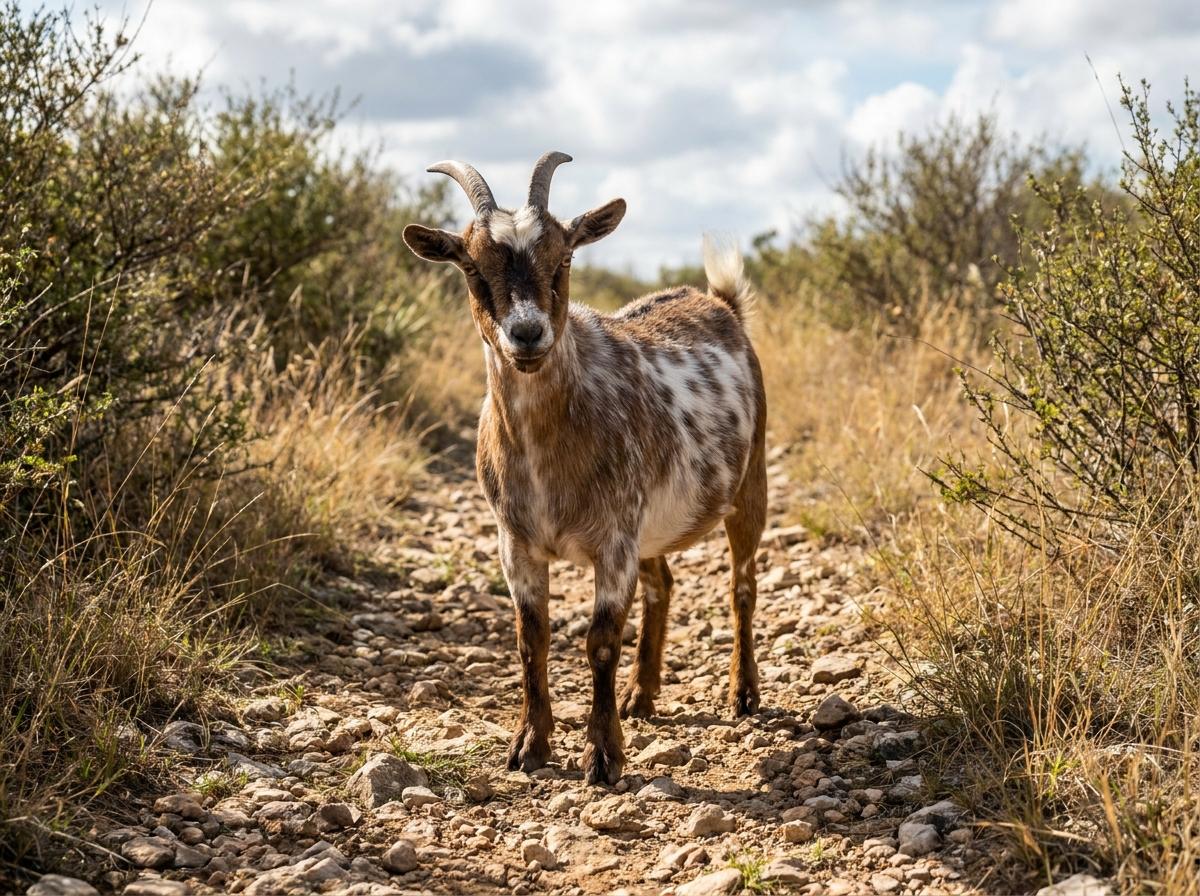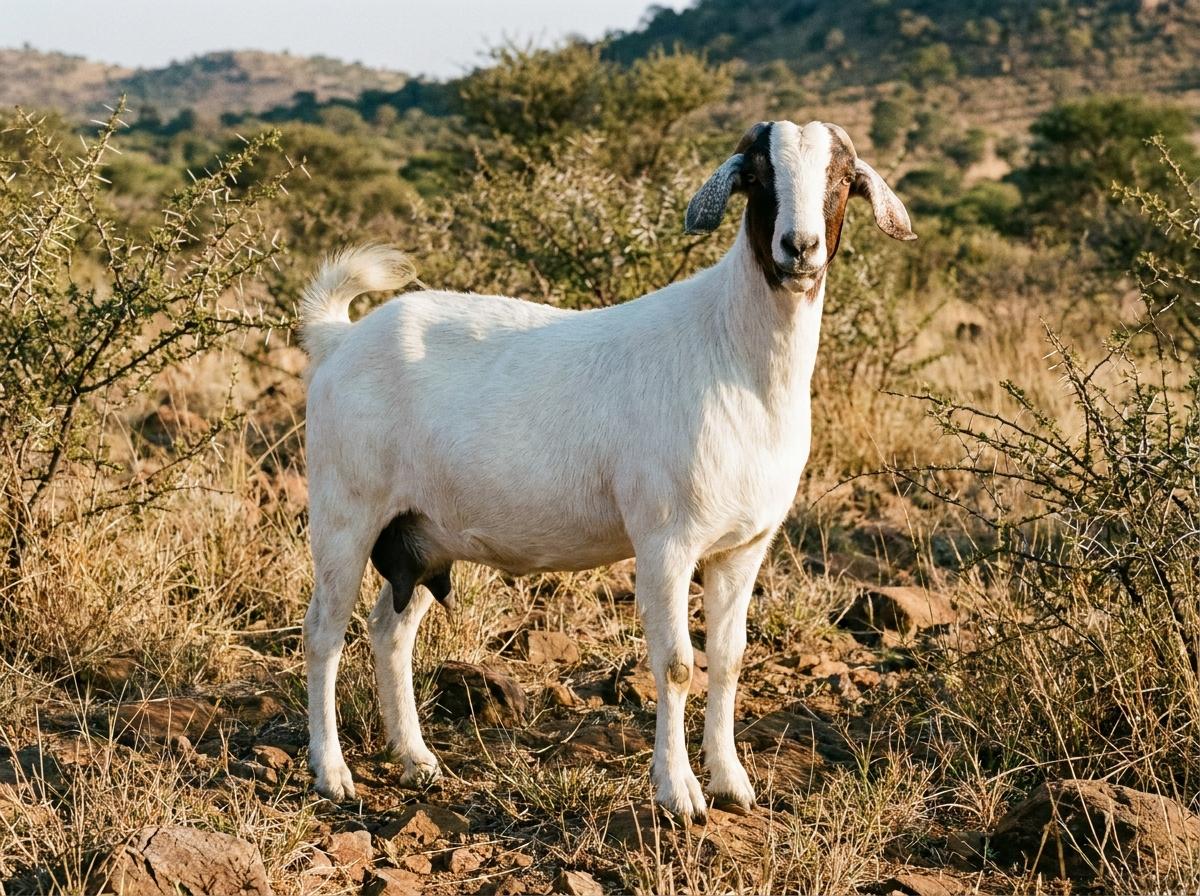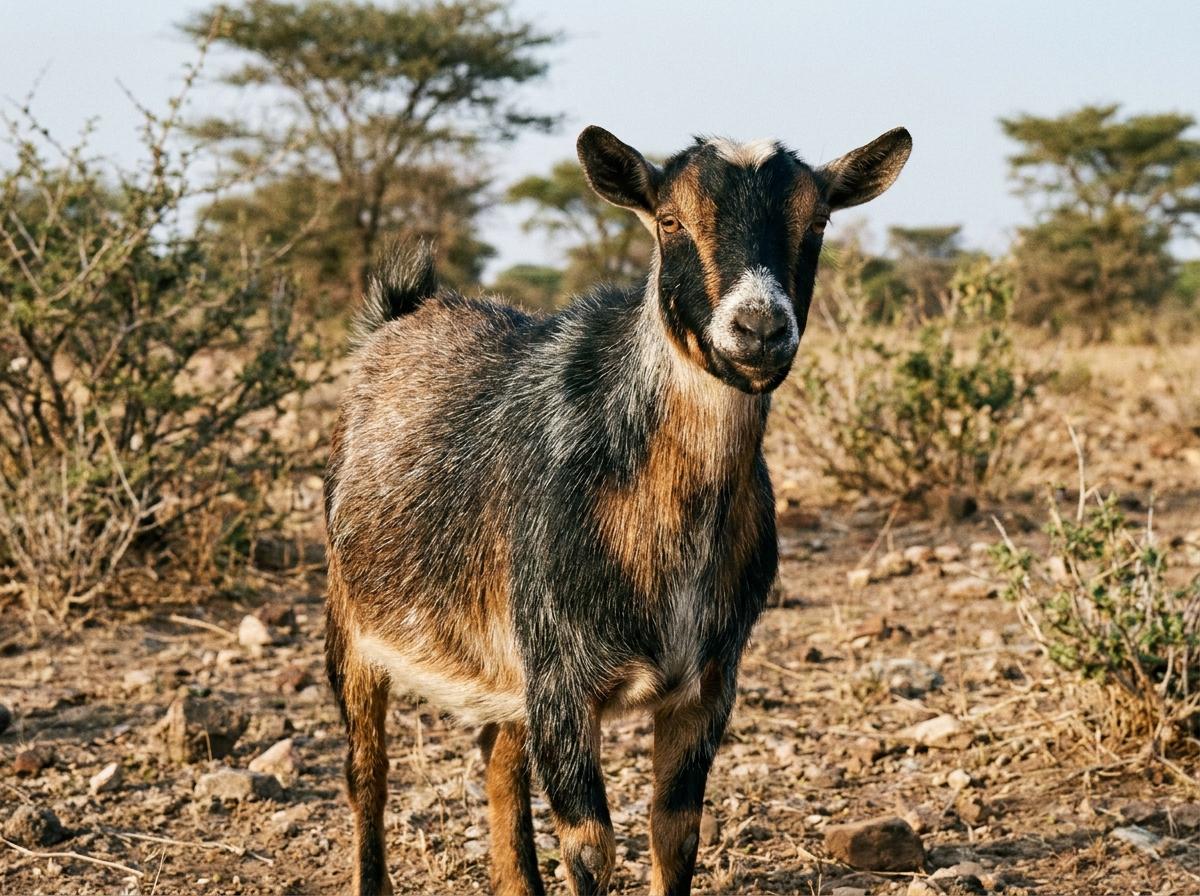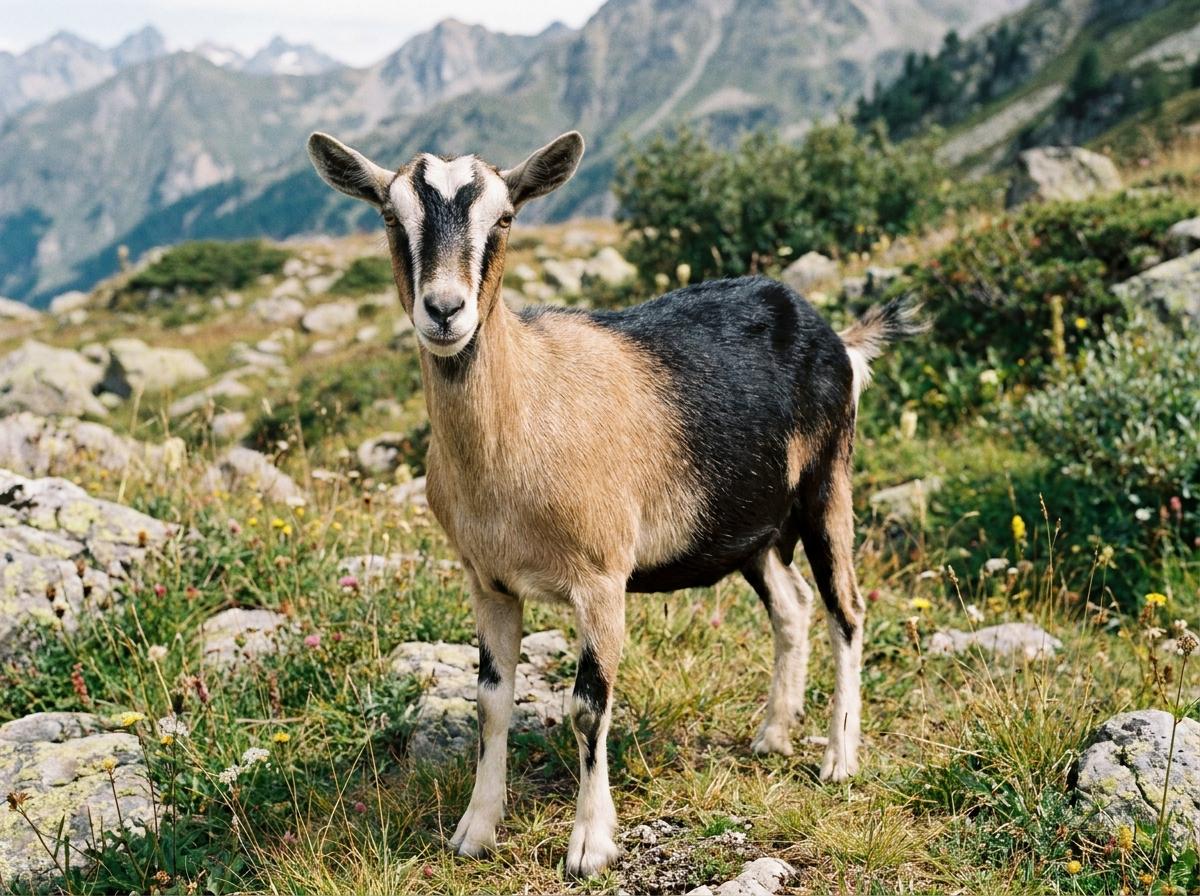
Valais Blackneck
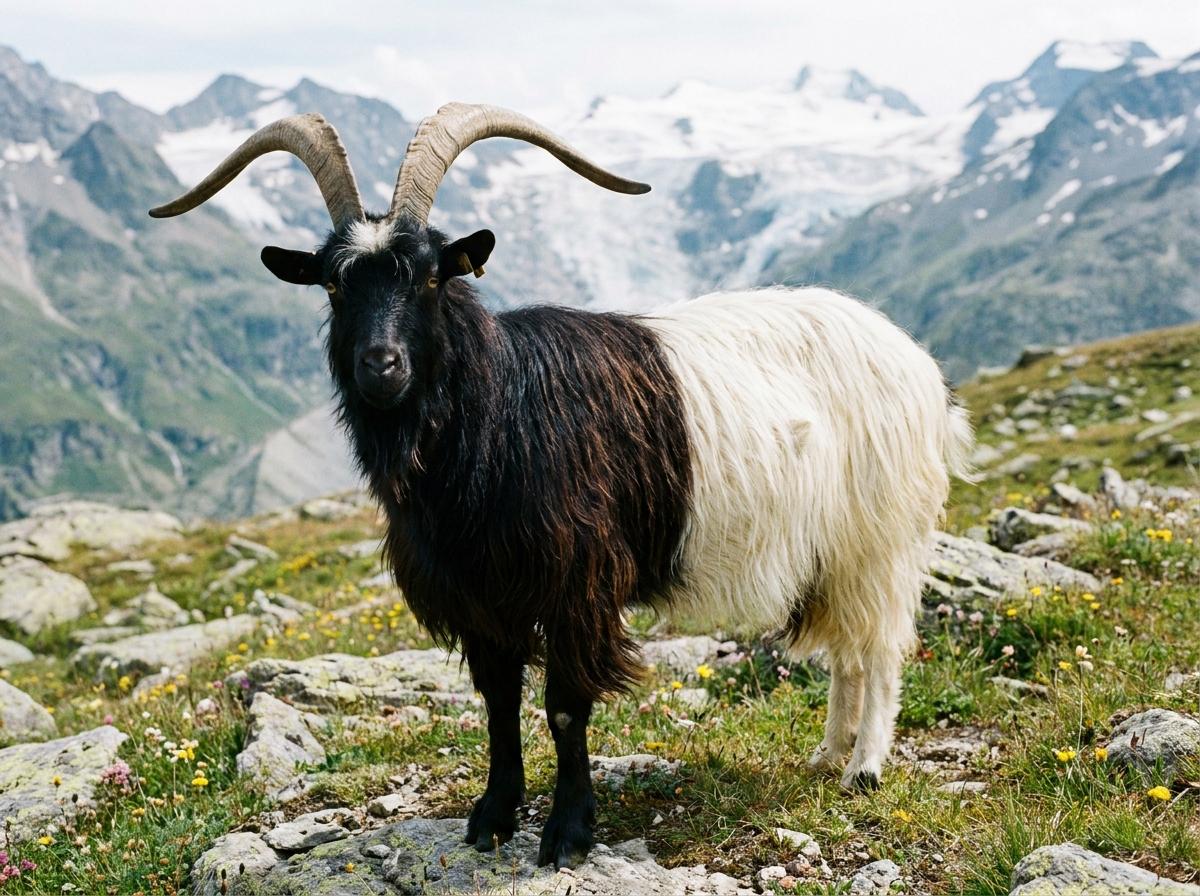
A goat that is solid black from the nose to the middle of its body and solid white from there back to the tail is almost certainly a Valais Blackneck, the long haired mountain breed from the canton of Valais in southern Switzerland. Both bucks and does carry long curved horns, the coat hangs in shaggy strands down the legs, and the Swiss breed standard is exact about where the two colours meet: at the last rib, measured at the spine, with a tolerance of about three centimetres either way. In German it is the Walliser Schwarzhalsziege or Gletschergeiss, in French the chevre col noir du Valais or chevre des glaciers, and in Italian the Vallesana.
It is not a high output dairy goat. This is a hardy conservation breed kept mainly for meat, for raising kids and for grazing steep alpine ground, and it is genuinely scarce. The Swiss herd book held 1,461 of them on 1 June 2025, and roughly seven in ten of those animals were in canton Valais itself.
This page covers what the standard requires, how to tell the breed from the animals it gets confused with, where it came from, what it produces, what keeping one involves, and what to ask before you buy. Genuine goats almost never reach the open market outside the Alps, so if you are hoping to find one, a free Valais Blackneck listing alert is the practical way to hear about it.

Browse listings, public profiles, breeders, or add your animal.
What a Valais Blackneck goat looks like
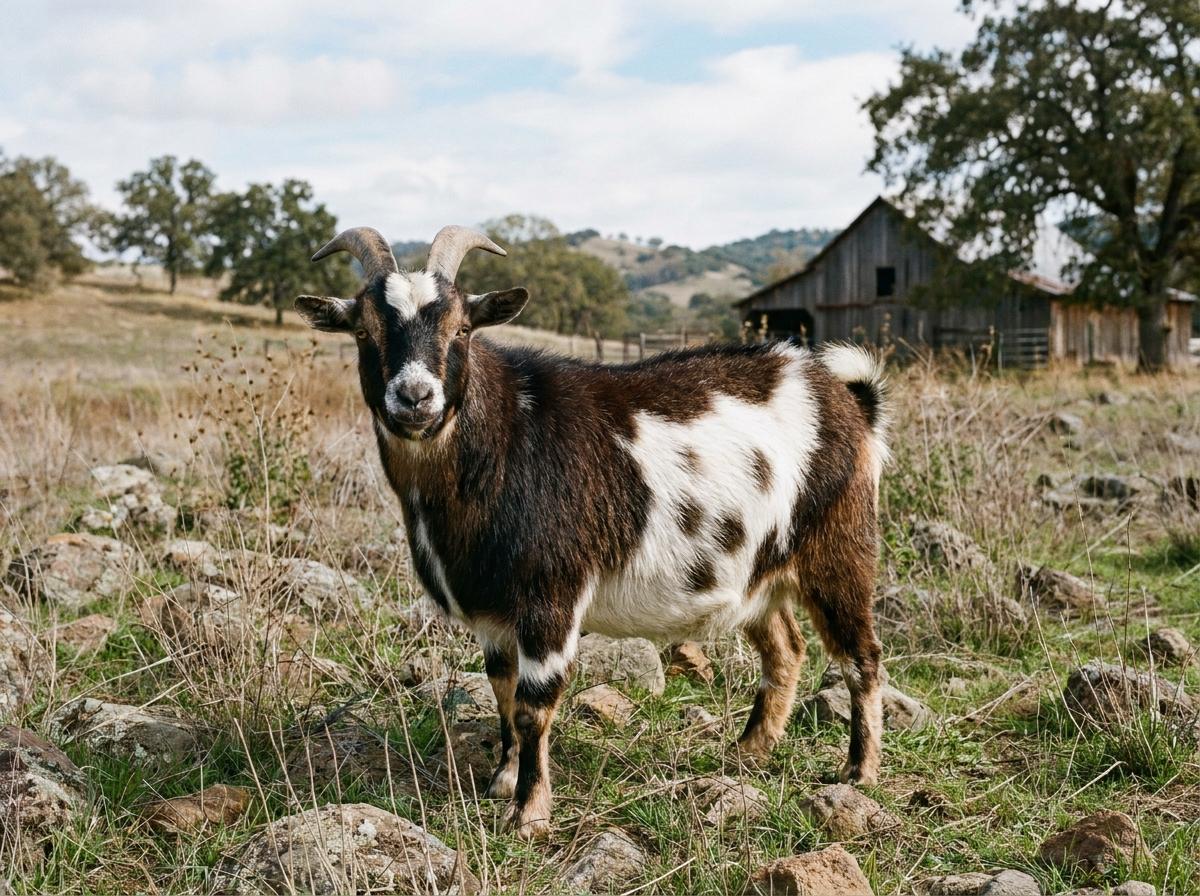
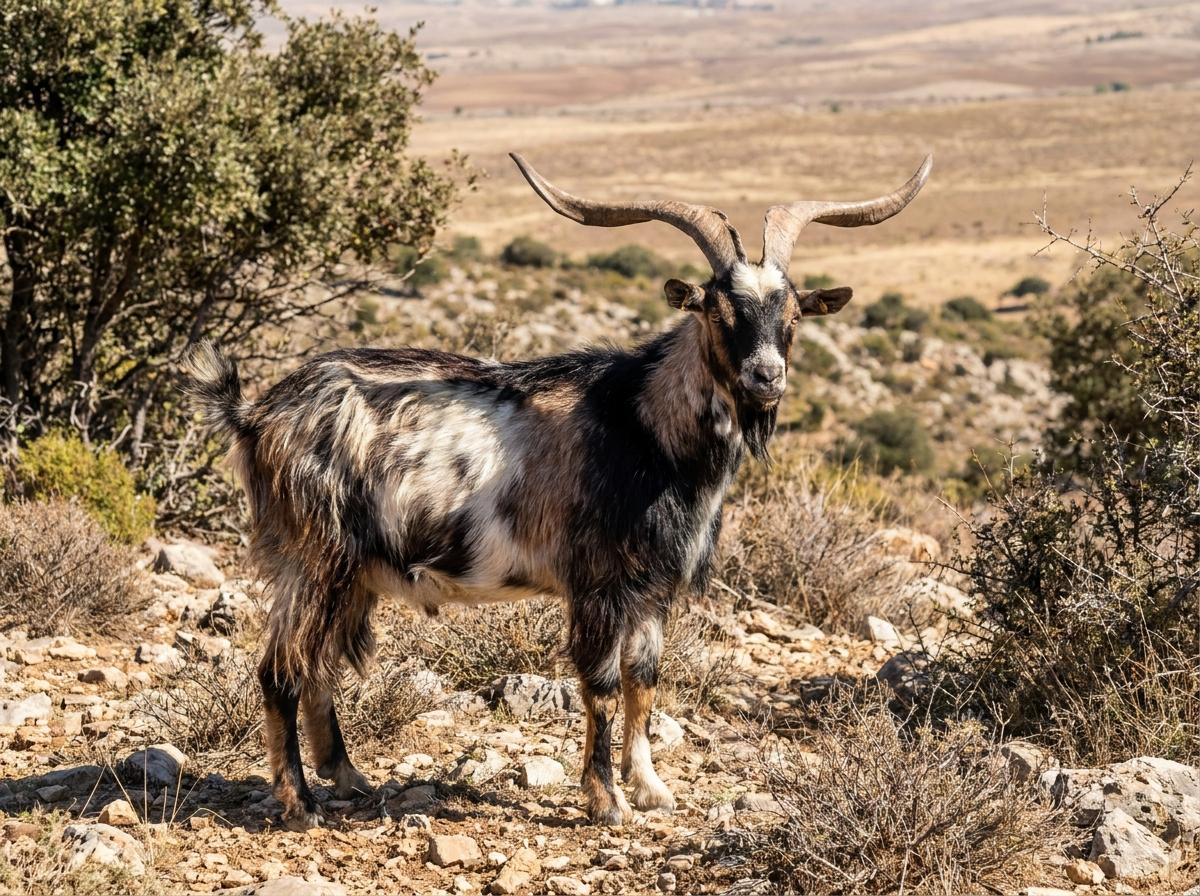
The pattern is the whole point of the breed, and the Swiss standard leaves little room for interpretation. The SZZV breed standard sheet in force from 1 January 2025 asks for the head and forequarters to be coal black as far as the middle of the body, the hindquarters snow white, and the two to meet in a sharp separation at the last rib, measured where the rib meets the spine, tolerating a deviation of plus or minus 3 cm. Front hooves are black, hind hooves white, and pigment spots on the white hindquarters are penalised.
The judging guidance is just as specific, and it tells you what breeders are actually selecting for. Grey ticking through the black costs one or two points depending on age, a blurred boundary between the colours costs one or two, and pigment spots on the hindquarters can cost up to five. On the last two faults bucks are marked more strictly than does. A dehorned or naturally hornless animal is capped at the lowest grade outright, so horns are not optional here, and does are horned as a matter of course rather than disbudded as they would be in most dairy breeds.

The same sheet gives the reference figures for a top scoring animal: 85 cm at the withers and a minimum of 75 kg for bucks, 75 cm and a minimum of 55 kg for does. Field figures published elsewhere wander around those numbers by a few centimetres and a few kilograms, so read them as the standard’s benchmark rather than as a measurement of every goat you will meet. The build is medium sized and solid, made for mountain work rather than for a dairy frame, and both sexes carry black beards.
The standard asks only for a long coat, and in practice the length has drifted over the last century. The Swiss heritage foundation ProSpecieRara points out that photographs from the early twentieth century show goats with 20 to 30 cm of clearance between the coat and the ground, which made sense for animals working wild alpine pasture and for anyone trying to milk them. Many goats today carry hair that reaches the ground, and the grooming bill has gone up accordingly.
One detail is worth knowing because it comes back later on this page. The white half is not pale pigment. When Swiss researchers sampled skin from a Valais Blackneck as a comparison case in a 2019 study of goat coat colour genetics, the unpigmented rear half turned out to lack pigment cells entirely, making this a white spotting pattern rather than a diluted or reddish white (Henkel and colleagues, PLOS Genetics). The dividing line is a boundary between skin that has pigment cells and skin that does not.
It is not the Valais Blacknose sheep, and it is not a Bagot
Two animals swallow most of the search traffic that should belong to this goat, and it is worth being blunt about both.
The first is the Valais Blacknose sheep, the curly coated, black faced Swiss sheep that became a social media favourite and now has organised breeding up programmes in the United States, the United Kingdom and New Zealand. It is a sheep, it is mostly white with black markings on the face, ears, knees and hocks rather than split into two solid halves, and it is far easier to buy. It comes from the same canton, which is why the names collide. If you have been searching for a Valais animal and keep finding sheep breeders, that is the reason.
The second lookalike is a goat, and the confusion runs deeper. The Bagot is a British breed whose head and forequarters are predominantly black and whose hindquarters are predominantly white, with curved horns in both sexes and a long coat. Its first recorded herd was at Blithfield in Staffordshire in the fourteenth century, and the Rare Breeds Survival Trust lists it as at risk. Two things separate it from the Valais Blackneck. Bagots are smaller, and some carry black patches on the hindquarters and a white blaze on the face, exactly what the Swiss standard marks down. They have also been genetically isolated in England for centuries rather than bred in the Alps. The mix up is not hypothetical. An Italian goat breed atlas states that the Vallesana is called the Bagot goat in England, which is simply wrong, and it shows how easily two half black, half white goats get folded into one entry.
The other Valais goats: copper, grey and white
If you have searched for an albino Valais goat, this is the section you actually wanted.
The all white Valais goat is not an albino. It is the Capra Sempione, one of three colour varieties that used to run in Valais herds alongside the black necked animals and were written out when the breed standard was revised in 1938. ProSpecieRara found a copper coloured one in 2006 on a tip from a breeder in the Bernese Oberland, tracked down 28 living animals by spring 2007, and later added the grey and white types to the rescue project. At the end of 2020 the Swiss Federal Office for Agriculture recognised all three as Swiss breeds in their own right, and from July 2021 the SZZV has kept separate herd books for them.
Genetics settled what each of them is. A 2021 study in the Journal of Heredity genotyped 393 Valais goats and got a perfect match between colour and genotype:
- Kupferhalsziege, the copper neck. Brown instead of black at the front, caused by a mutant TYRP1 allele that came in from Toggenburg goats.
- Capra Sempione, the white Valais goat. White throughout, caused by a white agouti allele introgressed from Appenzell or Saanen goats. That means pigment cells present and producing white hair, not pigment cells missing, which is what makes it neither an albino nor the same kind of white as the Blackneck’s rear half.
- Grueenochte Geiss, the grey neck. Greyish at the front, from an agouti allele that came in from Peacock goats.
None of these is albinism, which is a failure of pigment production in cells that are present, and none is the same mechanism as the white spotting on a Blackneck’s hindquarters. Three different genetic routes to white in one small family of Swiss goats.
All three are far rarer than the Blackneck: on 1 June 2025 the Swiss herd book held 206 copper necks, 69 grey necks and 61 Capra Sempione. Their breeders’ association, which works with ProSpecieRara and the SZZV, has also set their standards deliberately apart from the modern Blackneck, with a shorter and easier to manage coat and a colour change set further forward towards the neck.
Where the breed comes from
The Valais Blackneck belongs to the Rhone valley and the side valleys above it, with its stronghold around Visp in the Upper Valais, which is why French sources sometimes call it the race de Viege. From there it spread into neighbouring alpine areas of northern Italy, where it is registered as the Vallesana in the provinces of Vercelli and Verbania, and smaller numbers reached Austria and Germany. Switzerland has kept a herd book for the breed for more than a hundred years, and the standard that produced the modern two tone animal dates from the 1938 revision.

The origin story you will read everywhere is that the goats descend from animals brought into the Valais by immigrating African, probably Saracen, peoples around the year 930. ProSpecieRara repeats it as what historical reports indicate rather than as settled fact, and adds that Italian copper goats are also thought to have played a part. Treat it as tradition: published goat genetics has not tested it for this breed in any depth, and the honest position is that the deep origin is unresolved.
The environment that shaped the breed is not in doubt. Steep, rocky, high altitude pasture and long alpine winters selected for a sure footed, cold hardy goat with a heavy coat that could turn rough mountain browse into meat and move up and down the slopes with the seasons. That is still the job, and it is why the breed’s most valued output today is arguably not meat but grazing pressure on ground that would otherwise scrub over.
What the breed is actually for
Meat and kid rearing come first. Does are kept largely to raise their own kids rather than to fill a milking parlour, and ProSpecieRara is direct about why: most Valais Blacknecks are kept as a traditional hobby by people who earn their living elsewhere, so they are rarely milked and are usually run in a mother rearing system, with selection emphasising looks and robustness.
That shapes what the Swiss system measures. Rather than milk recording, the breed sits in a rearing performance test, and the SZZV breed sheet states the breeding goal as kid growth: 215 g of lifetime daily gain for the oldest age class of does. Published lactation figures do exist and range from roughly 445 kg to roughly 600 kg depending on the source, but they are not drawn from a Swiss milking string, they disagree with each other, and quoting any one of them would be false precision.
Twins are common and does raise kids well on rough ground. In its home region the breed earns its keep twice over, because a herd of these on an alpine slope is a genuine draw for visitors.
Temperament and handling
Valais Blacknecks are lively, and ProSpecieRara ranks them among the more spirited Swiss goat breeds. The practical consequence matters more than the adjective: the foundation’s own advice is that a well structured barn and enough space let the herd work out its ranking order and let lower ranking animals get out of the way. Crowd them and you will see it in the herd rather than in an individual goat.
Treat any temperament description as practitioner observation rather than a measured trait. Behaviour depends heavily on handling, space, and whether you are dealing with does and wethers or a buck in rut.
Keeping one: ground, fencing, coat and records
A hardy heritage breed is not a low effort one. The notes below are the shape of good management rather than a care plan, and any medical decision belongs with a veterinarian who can examine the animal and build a parasite, vaccination and mineral programme for your region.

Ground and shelter. This is a breed built for space and slope, and it does best with varied, well drained pasture and browse plus dry, draft free shelter for hard weather. Cold hardiness is real, but dry footing and dry bedding are not negotiable, and wet ground is as bad for the coat as it is for the feet.
Fencing. Horns in both sexes make fence choice a welfare question, not a preference. Square mesh, stock netting and anything else a horned head can push through and then fail to withdraw from is the classic hazard. Smooth rail, board and properly tensioned wire systems avoid the problem, and feeders and gates should be checked with the same question in mind.
Feeding. The breed forages efficiently on rough pasture and browse, which is one of its genuine strengths, but pregnant and lactating does and growing kids still need enough energy and protein to hold condition, plus clean water and minerals suited to your area. Goats have copper requirements that differ from sheep, which is one more reason not to manage the two as if they were interchangeable.
The coat. Brushing is a real job on this breed, not a finishing touch. ProSpecieRara warns that if you leave the brush alone too long the undercoat felts so badly that only shears will fix it. Check regularly for matting, burrs and external parasites hiding in the hair, and watch body condition, which a heavy coat hides well. In hot, humid climates a long alpine coat becomes a heat and parasite liability, so climate fit deserves an honest answer before you take the breed on.
Records. In a small, closely bred conservation population, pedigree is not paperwork, it is the tool that keeps the population viable. ProSpecieRara lists keeping an eye on the breed’s partly elevated inbreeding values among its own breeding goals, and a 2016 genome wide study of ten Swiss goat breeds concluded that the Valais goats are one of four Swiss breeds that should be prioritised in future conservation work on the strength of their genetic diversity measures. Keep pedigree, kidding and health records you can actually query when you plan a mating. You can track health, kidding and pedigree records on Creatures attached to the animal rather than scattered across notebooks.
How rare is it really?
Most breed profiles quote a Swiss population of roughly 3,000 to 3,400 head. That figure is more than a decade old, and the Swiss registry publishes something better: an annual herd book count, breed by breed, every 1 June. Here is what it shows for the Walliser Schwarzhalsziege.
- 2016: 1,947 animals
- 2017: 1,948
- 2018: 1,894
- 2019: 1,760
- 2020: 1,629
- 2021: 1,665
- 2022: 1,613
- 2023: 1,535
- 2024: 1,530
- 2025: 1,461 (134 bucks, 1,327 does)
Two caveats before drawing conclusions. A herd book count is registered breeding stock, not a census, so the number of Valais Blacknecks alive in Switzerland is higher. And the Swiss goat herd book as a whole shrank over the same period, from 28,543 animals in 2019 to 26,393 in 2025.
Even allowing for both, the trend is not comfortable. The fall is not a straight line, and 2021 was a genuinely better year than 2020, but registrations for the breed fell about 17 percent between 2019 and 2025 while the whole Swiss goat herd book fell about 8 percent, so it lost ground faster than goats in general. ProSpecieRara’s breed portrait still describes the population trend as slightly increasing, which the registry’s own annual counts do not support over this window. Read the two together rather than either alone.
Of the 1,461 animals recorded in 2025, 1,058 were in canton Valais. This is still very much a local breed living where it was made, and one Switzerland actively supports: the SZZV lists it among the country’s endangered native breeds, and since 2024 Swiss conservation contributions have been paid for native goat breeds carrying endangered or critical status.
Cost, availability and what to ask a seller
Inside its home range the Valais Blackneck is a working conservation breed traded among alpine farmers and heritage keepers, and price tracks the usual things: age, sex, conformity to the standard (a clean colour split and correct horns above all), pedigree and breeding value. Very few animals change hands and there is no reliable public price to quote, so we are not going to invent one.
Outside the Alps, scarcity is the whole story. A small number of keepers in the United Kingdom, Germany and Austria have imported stock and advertise kids, but nothing resembles the pipeline the Blacknose sheep enjoys, and in North America the regulatory picture is the binding constraint. The USDA’s APHIS import page for live sheep, goats and germplasm sets out requirements for live sheep and goats from Australia and New Zealand; European material appears there under semen and embryos, subject to permits, health certificates, scrapie premises registration and a changing list of disease prohibitions. Anyone quoting you a price on an imported European goat should be able to say which pathway their animals came through, and check the current APHIS position yourself rather than take a seller’s word for it.
If you do pursue the breed, buy on evidence.
- Confirm the species first, then the breed. Make sure you are being offered a Valais Blackneck goat, not a Valais Blacknose sheep, not a Bagot, and not a black and white crossbred wearing the name.
- Check the pattern against the standard. Clean black front, clean white rear, division near the last rib, black front hooves and white hind hooves, horns on both sexes. Grey ticking, blotchy edges and pigment spots on the white are what Swiss judges mark down.
- Ask about the sire’s assessment. The SZZV herd book rules require a buck to be shown and assessed up to and including the age of four, with at least one of those assessments in his first breeding year, and that assessment is part of what earns him herd book breeding eligibility. Ask whether the sire was assessed, and ask to see the pedigree and performance certificate.
- Ask for pedigree depth, not just papers. In a population this small with documented inbreeding pressure, how related the animals are matters more than it would in a common breed.
- Assess climate fit honestly. A heavy alpine coat in a hot, humid region is a management problem you will own every summer.
You can check the Valais Blackneck page on the Creatures marketplace and save that search so you hear about anything that does get posted, and look for farms and breeders in the Creatures directory. If you are comparing hardy Swiss breeds more broadly, the Toggenburg and the Chamois Colored goat are both worth reading, and the Creatures goat species page shows where each of them sits.
Frequently asked questions
Is the Valais Blackneck a goat or a sheep?
It is a goat. The confusion comes from the Valais Blacknose sheep, a different and far more widely kept animal from the same canton: a curly coated, mostly white sheep with black markings on the face and legs, not a two tone goat.
Why is it black at the front and white at the back?
Because the breed standard has required it since 1938 and breeders have selected for it ever since. The current Swiss standard puts the division at the last rib, measured at the spine, with about 3 cm of tolerance, and penalises blurred boundaries and pigment spots on the white.
Is there an albino Valais goat?
No. The all white Valais goat is the Capra Sempione, a separate Swiss breed recognised in 2020, whose white comes from a white agouti allele introgressed from Appenzell or Saanen goats. Albinism is a different mechanism entirely. There were 61 Capra Sempione in the Swiss herd book in 2025.
Do both males and females have horns?
Yes, and it is not optional in this breed. Both sexes carry long curved horns, and the Swiss standard caps a dehorned or hornless animal at the lowest grade.
How big do Valais Blackneck goats get?
The standard’s reference figures are 85 cm at the withers with a 75 kg minimum for bucks, and 75 cm with a 55 kg minimum for does. They are medium sized and stocky rather than tall and angular.
Is it a good dairy goat?
Not really. It gives useful milk, but it is kept for meat and for raising its own kids, it is rarely milked, and the Swiss breeding goal is stated in kid growth rather than milk yield. If milk is the point, a specialist dairy breed will out produce it and be far easier to buy.
Can I buy one in the United States?
It is very rare in North America and has no import pipeline like the Blacknose sheep’s. Live small ruminant imports are tightly controlled by APHIS and the eligible pathways are limited and change, so verify any animal’s actual origin and paperwork. Because genuine goats surface so rarely, a saved listing alert is usually the most practical way to catch one.
Do this next on Creatures
Whether you are identifying a goat you saw, hunting for genuine stock, or already keeping alpine and heritage goats, Creatures is the records, marketplace and directory layer to do it in one place.
Get alerted. Genuine Valais Blackneck goats are rare, so set a free Valais Blackneck listing alert and we will tell you if one is posted. No account needed to start. New to this? See saving searches and using your watchlist.
Find stock. Check the Valais Blackneck marketplace page, where you can save the search, and look through trusted breeders and farms in the Creatures directory.
Add your goat. Already keeping Valais Blacknecks? Create a free animal profile in a few minutes. No account needed to start, and the walkthrough is in adding an animal to Creatures.
Track health and pedigree. For a small conservation breed with documented inbreeding pressure, records are the tool that keeps matings sound. Track health, kidding and pedigree records on Creatures. The record sheet opens for any visitor to look around, and a free account saves what you enter. See adding a record and health and medical records for the how to.
List your farm. Breeding heritage goats? Create a free organization or breeder profile so buyers searching for this hard to find breed can reach you, and read getting listed in the breeder directory.
Compare Swiss breeds. Still deciding? Read up on the Toggenburg and the rest of the breeds on the Creatures goat species page.