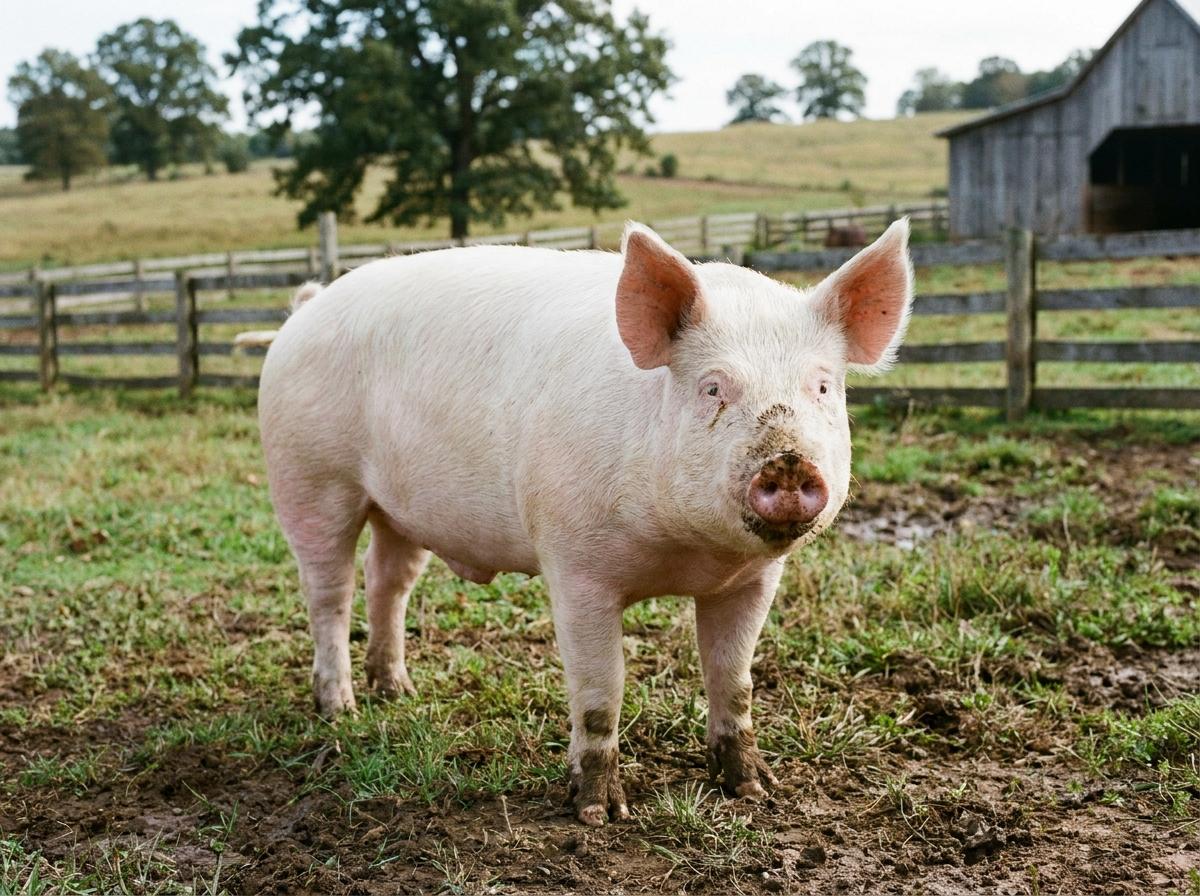
American Yorkshire
The American Yorkshire is the United States line of the English Large White pig, and it is bred to be a mother. Solid white, erect eared, long bodied and lean, it is recorded by the National Swine Registry as a maternal breed and selected for litter size, birth and weaning weight, rebreeding interval, durability and longevity. If you are trying to tell one from a Landrace at a show, work out what its papers actually promise, or decide whether the breed suits a small farm, those are three different questions with three different answers.
They are also three different readers. A commercial producer wants sow productivity indexes and a maternal line that holds up. A youth exhibitor wants breed character and a market hog that makes weight. A smallholder wants to know whether a big white pig will sunburn in July. All three are legitimate, and the breed shows up in all three places, so this page keeps them separate rather than blending them. If you are still comparing breeds, the Creatures pig species page is the place to line the American Yorkshire up against Landrace, Duroc, Hampshire and Berkshire.
One distinction is worth setting up front, because almost every confusing number about this breed comes from it. A registered American Yorkshire in a purebred herd and the white maternal line running in a large commercial barn are related but not the same thing, and their records are not interchangeable. Below: what the breed is, how to identify it, what its own recorded performance shows, where it sits in commercial pork, how housing rules and the sow housing debate touch it, what it takes to keep one, and what to check before you buy.

Browse listings, public profiles, breeders, or add your animal.
What an American Yorkshire actually is
The Yorkshire was developed in England in the county of York. The name was later changed to English Large White, and in most of the world outside the United States the breed is still called Large White. The National Swine Registry traces the modern breed’s improvement to Robert Bakewell, who in 1761 took an interest in a local group of hogs known as the Leicestershire breed and reshaped them into a larger, more useful animal.
Creatures carries both names as separate breed pages, because in practice they are used as separate populations: the Large White page covers the English and international breed, and this page covers the American line that has been recorded and selected in North America since the nineteenth century. They share ancestry. They do not share a herdbook.
The registry side matters more here than for most breeds, because the Yorkshire’s whole selling point is documented performance. The American Yorkshire Club was organized on April 1, 1893, in Minneapolis, Minnesota. In 1994 it merged with the Hampshire Swine Registry and the United Duroc Swine Registry to form the National Swine Registry, which the Landrace association joined in 1998. The NSR is based in West Lafayette, Indiana, and states that it represents 87 percent of the total purebred hog population in the United States. So when someone says an animal is a registered American Yorkshire, there is a specific organization, a specific herdbook and a specific set of rules behind that claim.
How to identify one
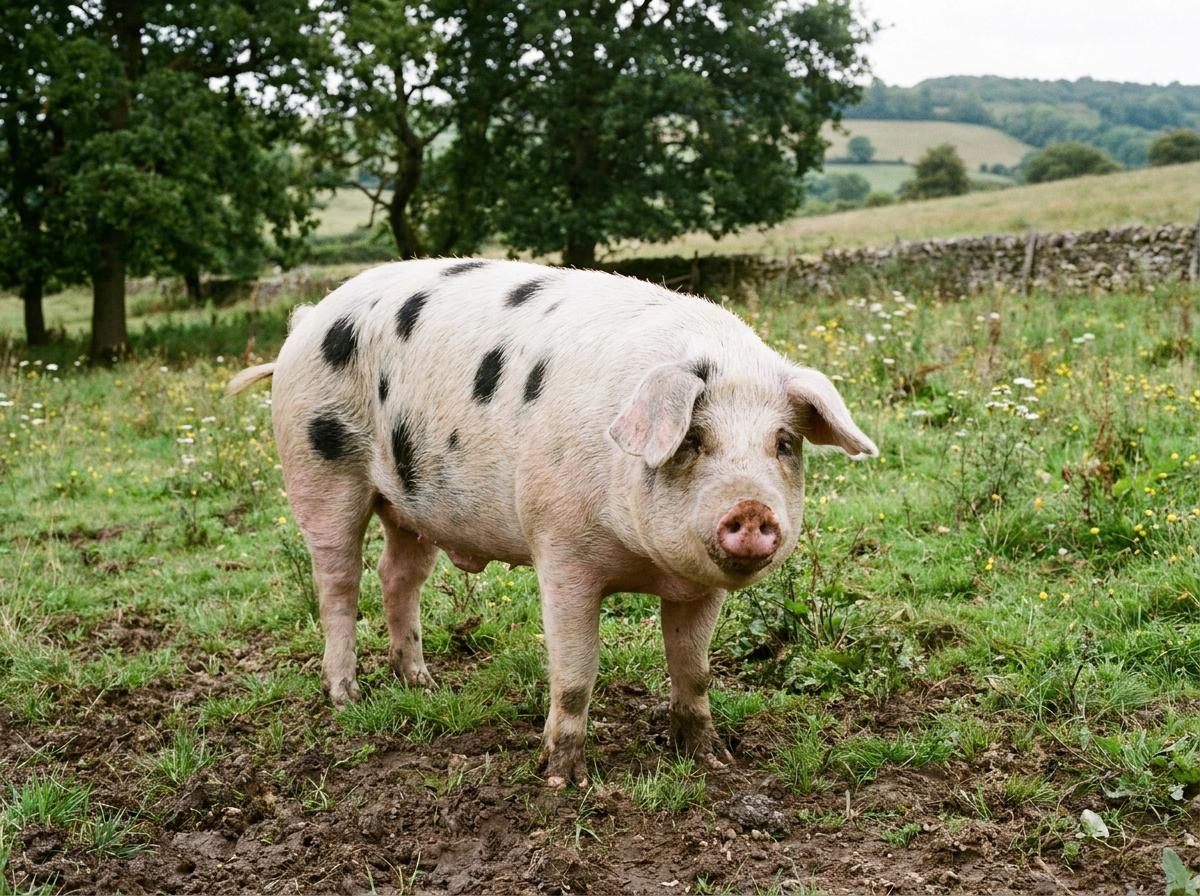
The single most reliable field mark is the ears. American Yorkshires carry erect, pointed ears held up and slightly forward. The other great white maternal breed in North America, the Landrace, carries heavy lop ears that hang forward over the face. Both are long, white and bred for mothering, and at a distance in a pen they can look alike, but the ear carriage settles it in a second.

Beyond the ears, look for:
- A solid white coat over pale, unpigmented skin. Fine white hair, pink skin underneath. The National Swine Registry’s breed eligibility rules require Yorkshires to be white with erect ears, and set a limit on skin pigment: no coloured hair, and no more than two pigment spots larger than a dime or one larger than a quarter.
- A long, deep body with a long level top line. Length is part of the breed’s economic point, and it is what a judge and a packer are both looking at.
- A slightly dished face with a long straight snout. The registry describes what it wants as Yorkshire breed character rather than giving a millimetre spec, so read it as a moderate, functional head, not an extreme one.
- Straight legs and sound upright feet. In a large-framed sow this is not cosmetic, and the buying section below explains why.
Three registration rules are worth knowing even if you never register an animal, because they tell you what the breed community has decided matters. Pigs must be ear notched within seven days of birth, which is what makes an individual identity and therefore a record possible at all. Animals must show no evidence of an extra dewclaw. And animals must be stress negative, meaning free of the inherited stress-susceptibility genotype behind porcine stress syndrome, the condition the Merck Veterinary Manual describes as malignant hyperthermia in pigs. That last requirement is a good example of a registry using a DNA test to remove a welfare problem from a whole population rather than managing around it.
For breeding stock there is one more, and it is the most maternal rule in the book: a boar or gilt must have six or more functional teats on each side of the underline to be recorded and exhibited. Count them. A sow cannot raise more piglets than she has working teats.
The mother breed, and what its records actually show
The National Swine Registry calls the Yorkshire “The Mother Breed,” and the traits it names are the maternal set: litter size, birth and weaning weight, rebreeding interval, durability and longevity. That is a claim about selection emphasis, and the breed backs it with an unusual amount of paperwork.

Yorkshire breeders record through STAGES, the registry’s Swine Testing and Genetic Evaluation System, which runs a BLUP genetic evaluation over a database the NSR describes as nearly two million performance records, with EPDs updated each evening. Between 1990 and 2006, Yorkshire breeders submitted more than 440,000 growth and backfat records and more than 320,000 sow productivity records. Those figures are the registry’s own, and they are the reason breed comparisons involving Yorkshire tend to be better documented than most.
The three numbers on a Yorkshire pedigree that actually drive decisions are the STAGES indexes:
- SPI, the Sow Productivity Index, weights the EPDs for number born alive, number weaned and 21 day litter weight by their economic values in a crossbreeding program. It is the pure maternal number.
- MLI, the Maternal Line Index, is for seedstock used to produce replacement gilts. It combines maternal and postweaning traits, placing twice as much emphasis on reproduction as on postweaning performance.
- TSI, the Terminal Sire Index, weights backfat, days to 250 pounds, pounds of lean and feed per pound of gain. A Yorkshire being bought as a terminal sire is being bought against the wrong index for its breed’s strength, which is worth noticing.
Has the selection worked? A North Carolina State University analysis of American Yorkshire Club records, published through the Pork Information Gateway, measured the trend from 1988. Average breeding values improved by 0.36 pigs for number born alive, 0.10 pigs for number weaned and 3.6 kg for 21 day litter weight, while the Sow Productivity Index rose 5 points and the Maternal Line Index rose 17. Over the same period the average annual change in breeding value was minus 0.06 cm for backfat depth and plus 0.43 square cm for loin muscle area, with days to market weight falling about 0.45 days a year. The authors’ conclusion is the interesting part: the breed improved reproduction and lean growth at the same time, which selection theory does not guarantee. That analysis dates from 2001, so read it as evidence that the selection program worked, not as a current-year figure.
A caution about litter size. You will find confident numbers online for “the average Yorkshire litter.” Treat them carefully, because they usually come from unsourced breed listicles rather than from a herdbook. What can be sourced is national context and herd context. USDA’s Quarterly Hogs and Pigs report for June 25, 2026 puts the United States average at 11.87 pigs weaned per litter for March through May 2026, across all breeds, systems and herd sizes. A 2026 University of Missouri Extension planning budget for a confinement feeder pig operation assumes 24.2 pigs weaned per sow per year. Neither is a Yorkshire figure. Both are the yardstick a Yorkshire sow gets measured against, and both are far more useful than a made-up breed average.
Where the breed sits in commercial pork
Almost all commercial pork in North America comes from crossbred pigs, and the standard structure is a terminal crossbreeding system. As Purdue University’s extension material on terminal crossbreeding lays it out, Yorkshire and Landrace supply the maternal side, their F1 crossbred daughter becomes the commercial female, and Hampshire or Duroc sires go over her to make market pigs. The National Swine Registry makes the same point from the Yorkshire end: mated to a Landrace, a Yorkshire produces F1 females that express full maternal heterosis.
That structure exists because hybrid vigour lands hardest on exactly the traits Yorkshires are selected for. Heterosis is largest in traits with low heritability, which is why litter size, survival and weaning weight respond to crossbreeding while carcass traits mostly do not. The long-standing extension figures, from the Pork Industry Handbook crossbreeding fact sheet PIH-39, put the advantage of using a crossbred female rather than a purebred one at roughly 8 percent for pigs born alive and 23 percent for litter size at 21 days. Those are older numbers and modern lines have moved, so take them as the shape of the effect rather than a current measurement. A purebred Yorkshire herd is not usually trying to beat them itself. It is trying to produce the parent that makes them possible.
The other half of the picture is less flattering to purebred registrations and worth stating plainly. A study of pedigree records for five US swine breeds by researchers at the USDA Agricultural Research Service, Purdue University and the National Swine Registry itself, published in the Journal of Animal Science in 2010, analysed 727,268 Yorkshire pedigree records. Registrations peaked in 1990 for four of the five breeds, Yorkshire among them, and have declined for all of them since 2001. The authors attribute that decline to the industry’s shift away from purebred populations toward large breeding companies marketing composite lines. Yorkshire’s fall from its peak year to 2007, at 58.6 percent, was the smallest of the five, but the direction was the same.
So the honest description of the breed today is layered. There is a purebred, registered, STAGES-recorded American Yorkshire population, smaller than it was and concentrated in seedstock herds, youth programs and small farms. And there is Large White and Yorkshire ancestry inside proprietary commercial maternal lines, which is where most of the pork actually comes from and which no herdbook publishes. A pig sold to you as “Yorkshire genetics” could mean either. Ask which.
That same study carries a buying lesson. Yorkshire had the lowest share of heavily inbred animals of the five breeds, at 1.16 percent above 25 percent inbreeding, and an effective population size of about 113, comfortably above the floor of 50 the FAO suggests a breed be kept above. But in four of the five breeds, the most-used boars were on average as closely related to each other as first cousins, and the top ten percent of sires accounted for more than 75 percent of all great-grandprogeny. Popular sires concentrate fast. If you are building a herd, look at the pedigree behind the animal, not only the index on the front of it.
Housing, welfare, and the law
This is the part of the American Yorkshire story that has changed most in the last decade, and it needs handling carefully, because the breed does not determine the housing system. Yorkshire genetics run in deep bedded group barns, in stall systems, in hoop buildings, on pasture and in back paddocks. Nothing about being a Yorkshire commits an animal to any of them.

What the systems are. During gestation, a sow is housed either individually or in a group. The University of California, Davis Center for Animal Welfare’s 2018 briefing on Proposition 12 and pigs describes a typical gestation crate as about 7 feet by 2 feet, roughly 14 square feet, in which a sow can stand, sit and lie down but not turn around, and notes that group pens give at least 20 square feet per sow and freedom to move about. Extension guidance from the U.S. Pork Center of Excellence on sow housing options for gestation sets out the alternatives, including group pens, free access stalls, electronic sow feeding and deep bedded systems, with space allowances that scale with body weight: about 18 square feet per sow on bedding at 220 to 330 pounds, rising to about 28 square feet above 550 pounds. Separately, a farrowing crate holds the sow around birth and through lactation, and exists mainly to reduce the crushing of piglets.
What the law now requires. California’s Proposition 12 amended the state’s Health and Safety Code. Under sections 25990 to 25992, a breeding pig may not be confined in a way that prevents it “lying down, standing up, fully extending the animal’s limbs, or turning around freely,” and after December 31, 2021 confinement in less than 24 square feet of usable floorspace per pig also counts as cruel. The prohibition reaches sales, not just farms: whole pork sold in California must come from compliant production wherever the pig was raised. Section 25992 carves out exemptions, including transport, veterinary examination, slaughter, and a breeding pig during the five day period before her expected farrowing date and any day she is nursing piglets. That last exemption is the one most often missed in summaries: Proposition 12 changed gestation housing, and it did not ban farrowing crates.
The pork industry challenged the law and lost. In National Pork Producers Council v. Ross, decided May 11, 2023, the Supreme Court affirmed the Ninth Circuit and rejected the dormant Commerce Clause challenge, observing that Congress had not adopted any statute displacing Proposition 12. Massachusetts has a comparable sales ban from its 2016 Question 3; the University of Arkansas National Agricultural Law Center records the pork provisions taking effect on August 24, 2023 after litigation. Bills to preempt state confinement laws have been introduced in Congress repeatedly and reintroduced in the current farm bill debate, and none had been enacted as of this writing, so treat any claim that the question is federally settled as premature in either direction.
How much of the industry this covers. USDA’s Economic Research Service reported in April 2023 that ten states had passed laws restricting gestation crates: Arizona, California, Colorado, Florida, Maine, Massachusetts, Michigan, Ohio, Oregon and Rhode Island. By 2026, ERS projected, those bans would cover less than 8 percent of the US breeding hog inventory and about 6 percent of the total hog inventory, while applying to more than 17 percent of US pork producer operations. Read those two figures together: the rules bite on a small share of the pigs and a much larger share of the farms, which is why the burden falls unevenly on smaller producers.
What the veterinary profession says. The American Association of Swine Veterinarians revised its sow housing position on April 25, 2024. Rather than endorsing a system, it lists outcomes any housing must deliver: access to food and water, protection from temperature extremes, reduced exposure to disease, pain and injury, the ability to express appropriate behaviour, minimised aggression, good air quality, the ability to evaluate and treat individual animals safely, and alternative housing based on an individual sow’s needs. It then says there are advantages and disadvantages to any sow housing, that stockmanship is as important as housing type, and that selection methods should be considered for identifying animals that can thrive in various housing environments. That last clause is where a breed actually enters the argument, and it points at temperament, structure and soundness rather than at a system.
The evidence supports that caution in both directions. Group housing lets a sow turn around, walk, root and lie with other pigs, which matches what pigs do when nobody is stopping them: the UC Davis briefing notes that free-living sows live in small groups called sounders, isolate themselves a day or two before farrowing, and build a nest by rooting a shallow hole and lining it. But group housing is not automatically kinder, because it has to be managed. A peer reviewed study of lameness in pen gestation published in the Journal of Swine Health and Production in 2022, covering 214,254 sow removals from 23 farms between 2014 and 2020, found lameness was the third most reported reason for removal at 13.7 percent, and that the odds of a sow being removed for lameness rose with the use of dynamic groups and with decreasing square footage per sow. Space and grouping strategy, not the label on the system, did the work.
If you are a smallholder reading this and wondering whether any of it applies to you: mostly not, directly. These rules govern commercial sale of pork, not a family’s two pigs. What does carry over is the standard the whole argument is conducted against, which is a pig that can stand, turn, lie down stretched out, root in something, get to clean water and get out of the weather. That standard is cheap to meet on a small farm and there is no good reason not to.
Keeping American Yorkshires
A white pig with unpigmented skin has one care requirement that a coloured breed does not, and it is the thing new keepers get wrong.

Shade is not optional. An American Yorkshire is fine white hair over unpigmented pink skin, end to end, and unpigmented skin is precisely where sun damage lands. The Merck Veterinary Manual puts it plainly for photosensitivity: lesions appear first in white-haired, nonpigmented or hairless areas, and are most common on unpigmented skin with frequent UV exposure. Penn State Extension’s advice for outdoor pigs is equally short, which is that they need shade from direct sun. So give them real shade they can reach at any hour of the day, and a wallow. A wallow is not a sign of a dirty pig, it is thermoregulation. Pigs have no functional sweat glands, so wet mud is how they shed heat, and it screens their skin while it does it.
Watch what is in the pasture, too. Sunburn is one problem and photosensitization is a related, worse one, where something the animal has eaten or been given makes its skin react to light. Merck names clovers, alfalfa, buckwheat, mustards, St John’s wort and Bermuda grass among the plants involved, and phenothiazine anthelmintics, tetracyclines and sulfonamides among the drugs. Its management line for an affected animal is to shade or house it and let it graze only in darkness. A white pig on a clover-heavy paddock in July is worth watching, and worth mentioning to your veterinarian if the skin starts to react.
Heat is the other half of that. Penn State Extension’s guidance on keeping pigs cool puts mature pigs comfortable between 50 and 75 degrees Fahrenheit, with heat stress risk climbing quickly above 80 degrees for pigs over 100 pounds, which includes grow-finish pigs, developing gilts and mature sows and boars. The practical advice is to offer at least twice the normal water on hot days, use drip lines or sprinklers while leaving dry space for pigs to dry off, open at least two sides of a shelter for airflow, feed in the cooler part of the day, and move pigs early or late rather than at noon.
Space and footing. Use the extension space allowances above as a floor rather than a target, and remember what the lameness research found: less square footage per sow raised the odds of losing her to lameness. Dry, sound, non-slip footing matters as much as area for a heavy animal.
Rooting is a need, not a vice. Pigs root. Given ground they will turn it over, which is useful in a garden rotation and destructive in a lawn, so plan the fencing and the rotation before the pig arrives rather than after.
Feet, legs and the underline are what to be fussy about in a breeding animal, for the reasons the registry and the lameness study both point at. Check them on the animal in front of you, not in the photograph.
Veterinary care. Have a relationship with a veterinarian who sees pigs before you need one, and defer every medical decision to them. Swine health is also a herd and biosecurity question, not only an individual one, and that is worth discussing with a vet who knows your area.
Show pigs and youth projects
The American Yorkshire has an unusually strong youth pathway, which is one reason the breed stays visible even as commercial production moves to composite lines. The National Junior Swine Association, the NSR’s youth arm, describes itself as the largest youth livestock organization in the world with more than 12,000 members, and runs national and regional shows, leadership conferences, contests and scholarships across the four NSR breeds.
For a market hog project, the endpoint is a finished pig. USDA’s Livestock Slaughter 2025 Summary puts commercial hog slaughter at 128 million head for 2025 at an average live weight of 289 pounds, which is the commercial benchmark a show ring weight class sits near.
Two honest notes for exhibitors. First, the registry rules differ between market animals and breeding animals: barrows and gilts shown as market animals have no underline requirement, while boars and gilts recorded and exhibited as breeding stock need those six functional teats per side. Second, show selection and commercial selection are not the same objective. A ring rewards what a judge can see standing still. An index rewards what a sow does over four litters. A good Yorkshire can satisfy both, but if you are buying for a herd rather than a banner, buy the index and the records.
What they cost, and what to check before you buy
There is no single reliable public price for an American Yorkshire, and anyone quoting one without saying what kind of animal they mean is guessing. Price tracks what you are buying: a weaned feeder pig, a commercial gilt, a registered breeding animal with a STAGES record behind it, or a show prospect are four different markets with four different numbers.
For an anchor rather than a quote, the 2026 University of Missouri Extension feeder pig planning budget, built on price forecasts as of October 2025, values a 50 pound feeder pig at roughly 65 dollars a head in a Missouri confinement operation. Registered breeding stock and competitive show prospects run well above that, sometimes by an order of magnitude, and those prices are set at sales rather than published in a table. You can see what is currently listed on the Creatures marketplace, and find farms and breeders in the Creatures directory.
What to ask for, in rough order of how much it tells you:
- The papers, and what is on them. A registration certificate documents registry identity and pedigree. Match the animal’s ear notch or tag to the certificate, and ask what parentage or DNA verification exists. A performance pedigree with STAGES EPDs and an SPI or MLI figure tells you what the animal is likely to do. Ask which one you are being shown.
- The right index for the job. SPI or MLI for a female or a maternal boar. Do not buy a Yorkshire on a terminal index and then be surprised by what you got.
- Stress negative status. Required for NSR recording, and worth confirming in writing for any breeding animal.
- The underline. Six or more functional teats a side, counted by you. Pin teats and inverted nipples do not count.
- Litter and health history. Number born alive, number weaned, farrowing ease, treatments. A breed with this much recording culture should be able to hand it over.
- Feet, legs and movement. Watch the animal walk. In the pen gestation study above, lameness was the third most reported reason sows left the herd, and those sows produced fewer litters before they went.
- Pedigree breadth. Given how concentrated popular sire lines are, check that you are not stacking the same boar behind every female you buy.
- What the seller means by “Yorkshire.” Registered purebred, or a white maternal line with Large White ancestry? Both can be the right answer. Only one comes with a herdbook.
Whatever you buy, start the record on day one. Ear notch or tag, birth date, litter, pedigree, weights, treatments and farrowing history are exactly the data this breed’s own registry has spent 130 years proving is worth keeping, and they are far easier to capture as they happen than to reconstruct later.
Frequently asked questions
Is an American Yorkshire the same as a Large White?
They are the same breed by origin. The Yorkshire was renamed English Large White in England, and Large White is the usual name outside the United States. The American Yorkshire is the line recorded and selected in North America under its own herdbook, so the animals share ancestry but not registration. Creatures keeps Large White as its own breed page for that reason.
How do I tell a Yorkshire from a Landrace?
The ears. Yorkshires carry erect, pointed ears held up. Landrace carry heavy lop ears that hang forward over the face. Both are long, white maternal breeds, so the ear carriage is the quick answer.
How many piglets does a Yorkshire sow have?
There is no trustworthy single breed average, and the confident figures circulating online are mostly unsourced. For scale, the US national average was 11.87 pigs weaned per litter for March through May 2026 across all breeds and systems, and a 2026 extension planning budget for a confinement herd assumes 24.2 pigs weaned per sow per year. A specific animal’s own SPI and litter records will tell you far more than any breed average.
Are American Yorkshires raised in gestation crates?
Some breeding females in commercial systems are housed individually during gestation and some are group housed, and that is a decision made by the farm and by the law where its pork is sold, not by the breed. California and Massachusetts ban the in-state sale of pork from non-compliant systems, and USDA’s Economic Research Service counted ten states with laws restricting gestation crates as of 2023. Purebred herds, youth projects and small farms sit largely outside all of it.
Do Yorkshire pigs sunburn?
Yes, easily. Unpigmented pink skin gives them no protection, so shade and a wallow are basic requirements in any outdoor system rather than luxuries.
Are they a good breed for a beginner or a small farm?
They can be. They grow well, and their mothering is the whole point of the breed. Keepers generally describe them as manageable to work with, though treat that as practitioner observation rather than a studied breed trait, and expect individual temperament to vary with handling. An intact boar is a different proposition from a gilt at any age. They are also big animals with real feed, space, shade and fencing requirements, and rooting behaviour that will rearrange ground you have not planned for. Sort the housing, the shade, the water and the veterinary relationship before the pig arrives.
How long do they live?
Domestic pigs can live well past a decade in good conditions. Working sows rarely do, because they are replaced after a handful of litters. In a study of 23 United States herds using pen gestation, lameness was the third most reported reason a sow was removed. Longevity is one of the traits the breed is selected for, which tells you it is not a given.
Do this next on Creatures
Whether you are comparing breeds, hunting for breeding stock, or already running Yorkshires, Creatures is the records, marketplace and directory layer to do it in one place.
Compare the breed. Line the American Yorkshire up against its crossbreeding partners on the Creatures pig species page, or read the individual pages for Landrace, Duroc and Hampshire.
Find stock. Browse American Yorkshire pigs on the marketplace and search trusted breeders and farms in the Creatures directory. New to the marketplace? See saving searches and using your watchlist.
Get alerted. Good registered stock moves at sales rather than sitting on a listing, so set a free American Yorkshire listing alert and we will tell you when one is posted. No account needed to start.
Add your pig. Already keeping Yorkshires? Create a free animal profile in a few minutes, with ear notch, litter and pedigree in one place. The walkthrough is in adding an animal to Creatures.
Keep the farrowing and health record. Add a record on Creatures for litters, weights, treatments and weaning. The record sheet opens for any visitor to look around, and you will need a free account to save what you enter. See adding a record for the full how-to.
List your herd. Running a seedstock herd or a small farm? Create a free breeder profile, no account needed to start, then read getting listed in the breeder directory and creating an organization and adding your team if you run the operation with family or staff.
Sell with confidence. Planning to sell pigs or a litter? Learn how seller payout works before you list.