

Argentine Pila
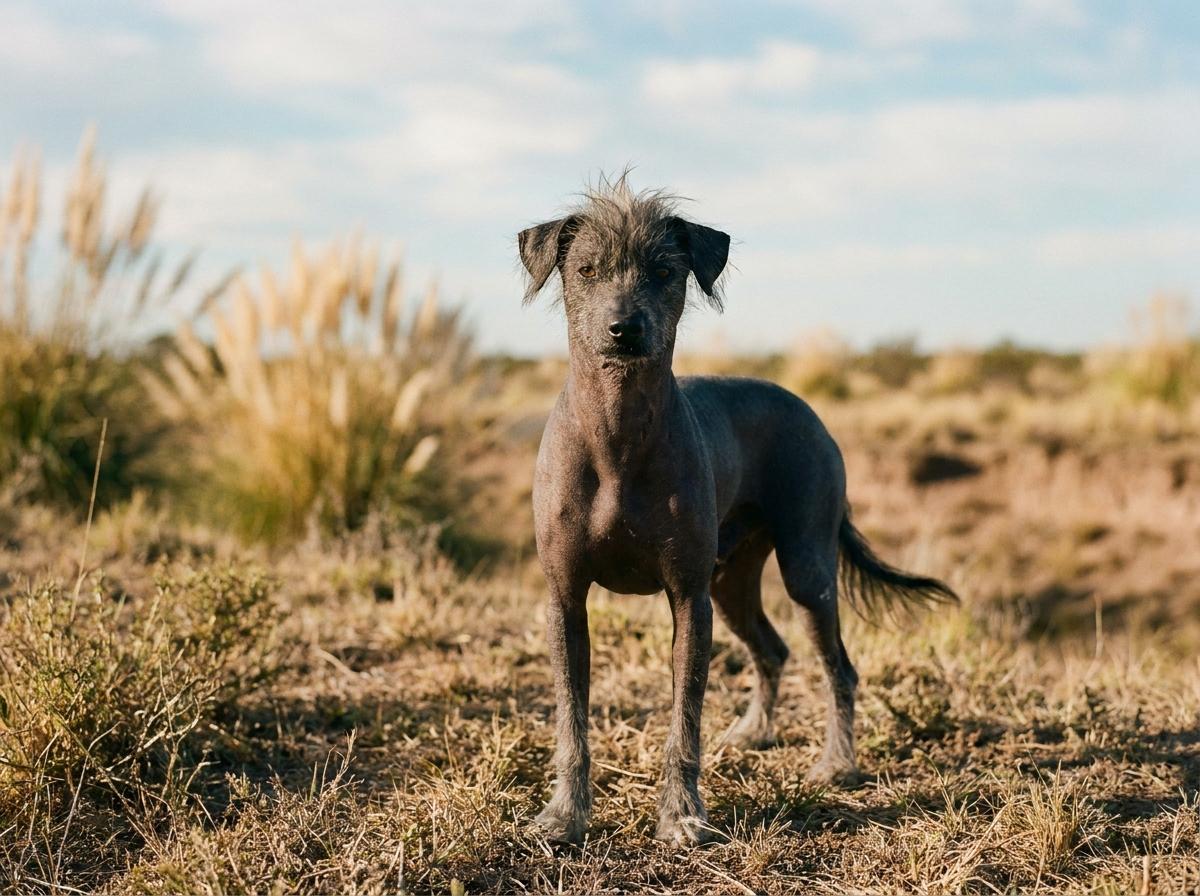
The Argentine Pila, or Perro Pila Argentino, is a rare hairless dog from the northwest of Argentina, kept mostly around Salta and the neighboring Andean provinces. It belongs to the same old South American hairless group as the Peruvian hairless dog and the Mexican Xoloitzcuintli, it is recognized at home by the Asociación Canina Argentina, and it is recognized by essentially nobody else. Adults stand under 45 cm at the shoulder in the two sizes the Argentine standard recognizes, carry bare skin instead of a coat, routinely lack premolars, and need sun protection in summer and a warm bed in winter.
The single most important thing to understand before breeding one is that hairlessness in this family of dogs is not a simple recessive trait you can fix by pairing two hairless dogs. In the Peruvian, Mexican and Chinese Crested breeds it is a dominant variant that appears to be lethal when a puppy inherits two copies, which changes what a hairless-to-hairless mating actually produces. That mechanism has never been published for the Pila specifically, and this page is careful about the difference. If you keep one, you can start a free profile for your dog on Creatures in a few minutes and record the litter results, teeth and skin history that this breed badly lacks.

Browse listings, public profiles, breeders, or add your animal.
What is an Argentine Pila?
The Pila is a companion dog of the Argentine northwest. The name comes from a local word for naked, and the breed has been kept for generations by rural and small-town families in Salta, Jujuy, Tucumán and La Rioja, mainly as a house dog, a bed warmer and an alert little watchdog rather than as a working or sporting animal.
Structurally it is a light, fine-boned dog of moderate size, closer in outline to a small primitive-type dog than to a terrier or a sighthound. The Asociación Canina Argentina recognizes two sizes: a small Pila under 35 cm at the withers, and a medium Pila from 35 to 45 cm. Body length runs roughly equal to height at the withers, the chest is moderately deep, the waist is slender, and the tail is long, fine and carried in an arc over the back when the dog moves.
What makes it a Pila rather than one of its better-known relatives is a set of small distinctions the Argentine standard was written to protect. Compared with the Xoloitzcuintli its ears are noticeably narrower, compared with the Peruvian hairless dog its ears are shorter and its tail is set and carried higher, and unlike the Chinese Crested it never carries a long flowing crest, feathered feet or a plumed tail. Those are fine distinctions between closely related populations, and the Argentine standard is explicit that all four breeds evidently came from one original type.
If you are working through the rare and regional end of the dog world, the same records problem shows up on the Gull Terrier and the Nureongi: breeds with real local populations, thin documentation, and very little written down about individual animals. The broader Creatures dog species page is the place to compare them.
Where the breed comes from
Hairless dogs are genuinely old in the Andes. The clearest recent evidence comes from Castillo de Huarmey in Peru, where a 2026 zooarchaeological study identified three individuals as Peruvian hairless dogs from the Wari period, roughly 600 to 1050 CE, on the strength of congenitally missing premolars and sometimes molars, the dental signature that travels with the hairlessness gene (Tomczyk et al., Journal of Anthropological Archaeology, 2026). One of those dogs was naturally mummified with skin and ears still attached and produced the oldest radiocarbon date recovered from the site.
Argentine breed sources trace the Pila to that same pre-Columbian stock, and describe the dogs arriving in the northwest through Inca expansion in the fifteenth century, when the empire reached into what is now Argentina. That specific route is breed-community history rather than something an archaeologist has demonstrated for Argentine material, so treat it as tradition with a plausible basis rather than as established fact. What is not in doubt is that hairless dogs were present, valued and deliberately kept across the Andean world long before Europeans arrived.
The recent history is easier to document and more uncomfortable. The Pila was never formalized, never had a studbook, and was kept as an ordinary household dog for most of the twentieth century. When the Asociación Canina Argentina approved the first official standard in October 2007, its own introduction described the Pila as a domestic breed in danger of extinction, noted that crossbreeding with other breeds had increased markedly, and called for a controlled breeding program to be started as soon as possible. That is the position the breed is still in: a small, scattered, informally kept population with no international registry behind it.
What an Argentine Pila looks like
The defining feature is bare skin. A correct Pila is completely hairless on the body, with skin the Argentine standard describes as fine and smooth, similar in texture to a young piglet, and warm to the touch. Thick, coarse, rough or wrinkled skin is a fault, and heavily folded “elephant skin” is a disqualification.
Hair is limited to a few places. Some dogs carry only a few stiff bristles on the head, the lower part of the tail and the legs below the carpus and hock. Others carry finer, softer hair up to about 5 cm in the same places plus the ears, often standing upright on the head. Both patterns are currently accepted. Hair on the neck, body, muzzle or the first third of the tail is a fault, and a hairless dog carrying hair anywhere the standard does not allow is disqualified.
Skin and hair can be any color or combination of colors. In practice you see slate greys, warm browns, near-blacks and pink or cream mottling, often freckled, and pigment usually deepens with sun exposure through the season. Eyes are medium, almond-shaped and well separated, and can be any color except pink or blue. Ears are medium-large, longer than wide, set fairly low, carried erect when the dog is alert and often folded back at rest, with fine translucent skin that lights up from behind.

Movement is worth a mention because it is characteristic. The Argentine standard describes a fast, extended trot with a lot of suspension and lift in the front legs, likened to a Miniature Pinscher but more elastic, and notes the breed’s unusual jumping ability. Smaller Pilas show it more than larger ones.
The genetics of hairlessness, and what it means at the whelping box
This is the part that changes decisions, so it is worth getting exactly right.
What the published science shows
In 2008 a team led by Cord Drögemüller mapped canine ectodermal dysplasia, the missing-hair-and-teeth phenotype, to a single locus and identified a frameshift variant in a previously uncharacterized gene, FOXI3, which is expressed specifically in developing hair and teeth. The paper studied three breeds: Mexican hairless dogs, Peruvian hairless dogs and Chinese Crested dogs. It described the trait as a monogenic autosomal semidominant one (Drögemüller et al., Science, 2008). The specific variant is a 7 base pair duplication in the first exon, which shifts the reading frame and produces a premature stop codon (Kupczik et al., Scientific Reports, 2017).
Two consequences follow, and both are load-bearing.
Every hairless dog of this type carries one working copy. In the 2017 dental study, every individual with the hairless phenotype that was genotyped was heterozygous, and every coated dog carried two functional copies. No homozygous hairless animal has been found in any of these breeds. A 2017 review of hairlessness across dog breeds states the interpretation plainly: “The lack of homozygotes in either breed suggests that the mutation is embryonic lethal” (Parker et al., Philosophical Transactions of the Royal Society B, 2017). Be precise about what that sentence is: an inference drawn from the consistent absence of homozygotes, not a study that watched embryos die. It is the best-supported explanation available and it is what breeders should plan around, but it is an inference.
Coated puppies are not a breeding failure. Because a hairless dog must be heterozygous, the same review notes that “there are always coated dogs born as littermates to the hairless pups”, the variety Chinese Crested breeders call the powderpuff. A coated pup from a hairless pairing is genetically ordinary at this locus and is the only reason the hairless line can continue at all.
A second point that matters when you read anything about hairless dogs: this is not the only way a dog can be born bare. Hairlessness in the American Hairless Terrier comes from a completely separate recessive variant in a different gene, SGK3, with no dominant lethality attached. “Hairless dog” is not one genetic thing, so genetics written about one breed cannot be assumed to apply to another.
Is any of this documented for the Pila specifically?
Not yet, and it matters that we say so.
The Argentine Pila was not among the breeds analyzed in the 2008 study, was not in the 2017 dental study, and does not appear in the 2017 review of hairlessness across dog breeds. We could find no published work that has genotyped a Pila at FOXI3. Encyclopedic pages that state flatly that the Pila’s hairlessness is caused by a dominant FOXI3 mutation cite those papers, none of which sampled the breed. The attribution is an inference from shared ancestry and an identical phenotype, not a measurement.
The inference is a strong one, and two independent observations support it. First, the Argentine standard records that all Pilas lack premolars and frequently other rear teeth, which is the same dental signature FOXI3 produces in the Peruvian, Mexican and Chinese Crested breeds. Second, the standard describes the inheritance pattern in phenotype terms and gets it right without naming a gene: it states that the factors producing hairlessness also affect the teeth and raise the probability of death in the uterus or immediately after birth in completely hairless fetuses, that all hairless dogs that survive birth apparently do so because of the coated factor in their genotype, and that the statistical composition of a litter is one pure hairless dog that dies, two hairless dogs carrying the coated factor, and one pure coated dog. That is the FOXI3 model, described from the whelping box rather than from a sequencer.
So the honest statement is this. Plan your matings as though the Pila carries a dominant hairless variant that is lethal in the homozygous state, because every observation available lines up with that. Do not claim a DNA result you do not have. Commercial FOXI3 tests exist and are offered by veterinary genetics laboratories, but they are validated against the variant found in the Peruvian, Mexican and Chinese Crested breeds, and no published work establishes what such a test does or does not detect in a Pila. Discuss any result with a veterinarian or a veterinary geneticist before you act on it.
What it means in practice
If the mechanism is what the evidence indicates, the arithmetic is simple and it is worth having in front of you before you plan a litter.
- Hairless to hairless. Roughly a quarter of conceptions inherit two copies and are lost before or around birth, so these litters should be expected to run smaller. Of the puppies born alive, about two thirds are hairless and about a third are fully coated.
- Hairless to coated. No puppy can inherit two copies, so there is no expected loss on this account. About half the litter is hairless and about half is coated.
- Coated to coated. Every puppy is coated. The hairless trait is gone from that pairing.
Treat those as expectations across many litters, not as a promise about the next one. Small litters make ratios noisy, and a single whelping tells you very little.
The practical recommendation follows directly. Hairless to coated is the mating that avoids the loss, and the Argentine standard says the same thing from the other direction: coated puppies should be selected and kept for periodic inclusion in the breeding program, because their mouths tend to be more correct and more complete than those of their hairless siblings. The standard also goes out of its way to criticize the culture around this, observing that owners and breeders of Pilas, Xolos and Peruvians alike tend to keep quiet about coated puppies in the belief that they represent a breeding fault, and that nobody mentions the occasional loss before or after birth. Recording both, honestly, is how a small breed gets a real evidence base. It is exactly the kind of thing a free litter and health record is for.

Teeth
The same gene builds hair and teeth, so the dental picture is part of the breed rather than an unlucky extra. In the FOXI3 breeds the 2017 dental study found hairless dogs losing the permanent canines, premolars and to some extent the incisors in both jaws, and found the deciduous fourth premolars and the permanent first and second molars consistently missing their distal and lingual cusps, leaving a single enlarged cusp in a basin-like heel. The Merck Veterinary Manual likewise notes that affected dogs, including most hairless breeds, commonly have associated dental anomalies (Merck Veterinary Manual, hereditary alopecia and hypotrichosis).
The Argentine standard treats this as normal for the breed while still setting a floor: all Pilas lack premolars and frequently other rear teeth, but the dog should have good upper and lower incisors and canines with a scissor or pincer bite, straight conical canines are a fault, and a dog under five years old with no rear molars at all is disqualified. The standard also warns that as a Pila ages, a weak and incomplete set of teeth can make chewing difficult, and that food should be adapted accordingly.
For an owner this means two things. Get a veterinary dental examination as part of routine care and keep the findings written down, because in this breed the baseline is unusual and the only way to spot a change is to know what was there last year. And when a dog starts leaving food or eating slowly, have the mouth checked rather than assuming it is fussiness. All treatment decisions belong with a veterinarian who can examine the dog.
Skin and sun
Bare skin is the whole care load of this breed, and it splits into two jobs.
Sun. The Merck Veterinary Manual is direct about the risk: prolonged exposure to sunlight on sparsely haired, minimally pigmented areas of the body is a major predisposing factor for squamous cell carcinoma, and it recommends limiting ultraviolet exposure through shade, sunscreen and keeping animals indoors during peak sunlight between 10 in the morning and 2 in the afternoon (Merck Veterinary Manual, epidermal and hair follicle tumors). For hereditary hairlessness in particular, Merck states that management focuses on prevention of secondary infections, solar protection and physical protection of the skin. The Argentine standard reaches the same conclusion from practice: the Pila is an indoor breed, needs protection from the sun all year, and needs a sunscreen strength scaled to its pigment, from a minimum for black and slate dogs up to a total block for predominantly pink ones.
Use a product intended for dogs and chosen with your veterinarian. The American Kennel Club’s guidance is that dog sunscreens should not contain zinc oxide or para-aminobenzoic acid, both of which are a problem if a dog licks the skin, that you should test a small area first, apply about twenty minutes before going out, and reapply every four to six hours and after swimming (AKC, do dogs need sunscreen). Shade, timing and a light shirt do more of the work than any cream. A Pila that lives an indoor life and goes out early and late is not a difficult dog to protect.
Skin condition. Merck notes that all animals with abnormal follicular development are prone to secondary bacterial and yeast overgrowth, comedone formation, hair follicle infections and hair foreign body granulomas. In practice that means a regular gentle bath and moisturizing routine, checking the skin over with your hands weekly, and getting anything persistent looked at rather than treating it at home. The Argentine standard also notes that very dark-skinned dogs tend to develop small hard pearl-like moles and rougher skin along the back. Any new lump, a patch that will not settle, or skin that becomes greasy, scaly or smelly is a veterinary conversation, not a shampoo choice.
Cold, warmth and where a Pila lives
A hairless dog has no insulating coat, and a small, fine-boned, lean one has very little else to work with either. University of Wisconsin School of Veterinary Medicine guidance is that short-haired, short-legged, slender and elderly dogs are less cold-tolerant than dogs with thicker coats, that no pet should be outside for long periods in below-freezing weather, and that coats and boots genuinely help this type of dog (UW School of Veterinary Medicine, winter hazards).
The Argentine standard puts it in one line: Pilas need heating in winter. This is a dog that sleeps under the blankets, wears a sweater on a cold walk, and lives inside. Argentine breed accounts describe Pilas being taken into beds for warmth, including by people with aching joints, and that arrangement was never one-sided. It was also how the dog stayed warm.
One myth is worth clearing up while we are here. A Pila feels hot to the touch, and people conclude that the breed runs a higher temperature. It does not. The Argentine standard states directly that its body temperature is the same as that of other dogs, between 38 and 39 degrees Celsius, and that the absence of insulating hair simply produces the impression of extra heat. There is no extra warmth to spare, which is the whole reason the dog needs a blanket.

Temperament and daily life
The Argentine standard describes the Pila as a companion animal that is sweet, affectionate and playful with the people it lives with and distrustful of strangers, not aggressive towards other household animals or children, and quick to learn house rules. Keepers value the same combination: a soft, close, indoor dog that is also alert enough to announce anything unusual.
Two practical notes come from the same source and both ring true for a small indoor dog. House-training can take a while, and many puppies benefit from an indoor litter tray with absorbent granules up to around five months old. And this is an agile, springy animal with a real jump on it, so a small yard is not automatically a contained yard.
Treat the temperament description as breed-community observation rather than as a studied trait. There is no published behavioral work on the Pila, and in any dog, temperament is shaped as much by socialization, handling and individual variation as by breed.
Health, lifespan and honest gaps
The Argentine standard describes the Pila as not very prone to health problems, and Argentine breed sources commonly quote long lives, with figures of fifteen years and more in circulation. There is no published veterinary study of lifespan or disease prevalence in this breed, so those numbers are breeder observation rather than data, and this page will not repeat a specific figure as though it were established. What can be said fairly is that its known problems are the ones the hairlessness gene brings with it, and that the breed carries none of the exaggerated conformation that causes trouble in some popular breeds.
Those known issues are the skin and the mouth, both covered above. The standard adds one breeding note worth recording: completely hairless males appear to show some tendency towards monorchidism or cryptorchidism, and the standard advises against including totally hairless dogs of either sex in a breeding program unless they are crossed with coated dogs. Retained testicles are a genuine veterinary matter in any breed, so that is a conversation for your veterinarian rather than something to manage at home.
The honest summary is that the evidence base for this breed is thin. Nobody has published a genetic study of it, a health survey of it, or a lifespan figure for it. That is a reason to write things down, not a reason to assume everything is fine.
Registration, recognition and buying one
The Asociación Canina Argentina approved the first official standard for the Perro Pila Argentino in October 2007, explicitly recognizing it as Argentina’s native breed and asking for international recognition from that point. The Kennel Club Argentino adopted the standard the following year.
Outside Argentina, recognition has not followed. The Pila does not appear in the FCI nomenclature, whose hairless breeds are the Xoloitzcuintle and the Peruvian Hairless Dog in Group 5 and the Chinese Crested Dog in Group 9. It is not in the American Kennel Club’s breed directory, which the AKC describes as the official list of all its breeds and which does include the Xoloitzcuintli and the Peruvian Inca Orchid. It is not among the United Kennel Club’s breed standards, which cover the Xoloitzcuintli, the Peruvian Inca Orchid, the Chinese Crested and the American Hairless Terrier. If you are buying outside Argentina and a seller offers registration papers for an Argentine Pila, ask precisely which body issued them and check that body exists.
For availability, set expectations low. This is a small, informally kept population that its own registry described as endangered and heavily crossed in 2007, and there is no meaningful export trade. Realistically, a genuine Pila outside Argentina is an unusual find, and a dog advertised as one may be a hairless dog of another breed or of no particular breed at all. That is not necessarily a bad dog. It is just not the same purchase.
What to check if you do find one:
- Ask what the parents were and what the litter did. Hairless to hairless, hairless to coated, how many were born, how many were coated, and whether any were lost. A breeder who tracks this is a breeder who understands the trait.
- Look in the mouth. Missing premolars are normal here. Incisors and canines should be present with a scissor or pincer bite, and the standard disqualifies a dog under five with no rear molars at all.
- Feel the skin. It should be fine, smooth and supple. Thick, coarse or wrinkled skin is a fault and heavy folding is a disqualification.
- Ask about sun and skin history. Any history of sunburn, recurring infections or lumps should be documented and discussed with a veterinarian.
- Check the paperwork against reality. Argentine registration means the Asociación Canina Argentina or the Kennel Club Argentino. Nothing else currently registers this breed.
You can watch for hairless and rare dog listings on the Creatures marketplace and look for breeders and rescues in the Creatures directory. Because genuine stock is scarce, a saved listing alert is usually the more practical route than checking by hand.
Frequently asked questions
Is the Argentine Pila the same as a Peruvian hairless dog or a Xoloitzcuintli?
No, though they are close relatives from the same original hairless type. The Argentine standard was written specifically to separate the Pila from the other three: its ears are narrower than the Mexican dog’s and shorter than the Peruvian’s, its tail is set and carried higher than either, and its outer ear edges stay parallel. Only the Xolo, the Peruvian and the Chinese Crested are internationally recognized.
Why do two hairless Pilas produce coated puppies?
The Pila standard reports coated pups and a litter pattern consistent with related FOXI3 hairless breeds. If Pila hairlessness uses the same mechanism, as available evidence strongly suggests, hairless dogs would carry one hairless copy and one normal copy, and embryos with two hairless copies would not survive, which makes coated puppies the normal, expected outcome of a hairless pairing rather than a mistake. No published study has yet genotyped the Pila itself. The Argentine standard advises keeping the coated puppies for the breeding program because their teeth tend to be better.
Are Argentine Pilas hypoallergenic?
No. The Argentine breed standard itself calls the Pila an ideal dog for people with allergies, and that claim does not hold up. Dog allergy is driven by proteins such as Can f 1 that come from skin, saliva and dander rather than from hair, and a study measuring Can f 1 in the hair and homes of breeds marketed as hypoallergenic found no evidence supporting the classification (Vredegoor et al., Journal of Allergy and Clinical Immunology, 2012). A hairless dog sheds less hair around the house. That is a cleaning benefit, not an allergy one.
Do Pilas run hotter than other dogs?
No. Their body temperature is the same 38 to 39 degrees Celsius as any dog. Bare skin simply transfers heat to your hand directly, so they feel hotter than they are.
Do they really need sunscreen?
Yes, alongside shade and timing. Merck’s veterinary guidance identifies sparsely haired, lightly pigmented skin under prolonged sun as a major predisposing factor for squamous cell carcinoma. Use a dog-specific product chosen with your veterinarian, avoid formulations containing zinc oxide or PABA, and treat shade and avoiding the middle of the day as the primary protection.
Can I get a DNA test to confirm the hairless gene in my Pila?
FOXI3 tests exist through veterinary genetics laboratories, but they are validated against the variant identified in the Peruvian, Mexican and Chinese Crested breeds, and no published study has genotyped a Pila. Talk to your veterinarian about what a result would and would not tell you before ordering one.
How many Argentine Pilas are there?
Nobody knows precisely. The Asociación Canina Argentina described the breed as endangered when it approved the standard in 2007 and warned that crossbreeding had increased sharply. The population is small, concentrated in the northwest, and not systematically counted.
Do this next on Creatures
The Pila’s real problem is not that it is unusual. It is that almost nothing about individual dogs is written down. Creatures is the records, marketplace and directory layer where that can change.
Add your dog. Create a free animal profile for your Pila and record its skin history, dentition and litter details. No account needed to start. The walkthrough is in adding an animal to Creatures, and the profile page tabs explains what each section holds.
Track skin, teeth and litters. Add a health or breeding record. The record sheet opens for any visitor to look around, and you will need a free account to save what you enter. See adding a record and health and medical records for the detail.
Never miss the sunscreen and skin checks. A hairless dog runs on routine. Reminders and upcoming care shows how to schedule recurring skin checks, dental exams and veterinary appointments.
Get alerted when one appears. Genuine Pilas are scarce, so set a free Argentine Pila listing alert and we will tell you when one is posted. No account needed to start, and saving searches and using your watchlist covers the rest.
Search now. Browse dogs on the marketplace and search trusted breeders and rescues in the Creatures directory.
List your program. Breeding or rescuing Pilas or other rare hairless dogs? Create a free organization profile so people looking for this breed can find you. No account needed to start. Then read getting listed in the breeder directory and creating an organization and adding your team.
Working on other rare breeds too? The Assyrian Mastiff, the Gull Terrier and the Nureongi have the same documentation gap, and the same fix.