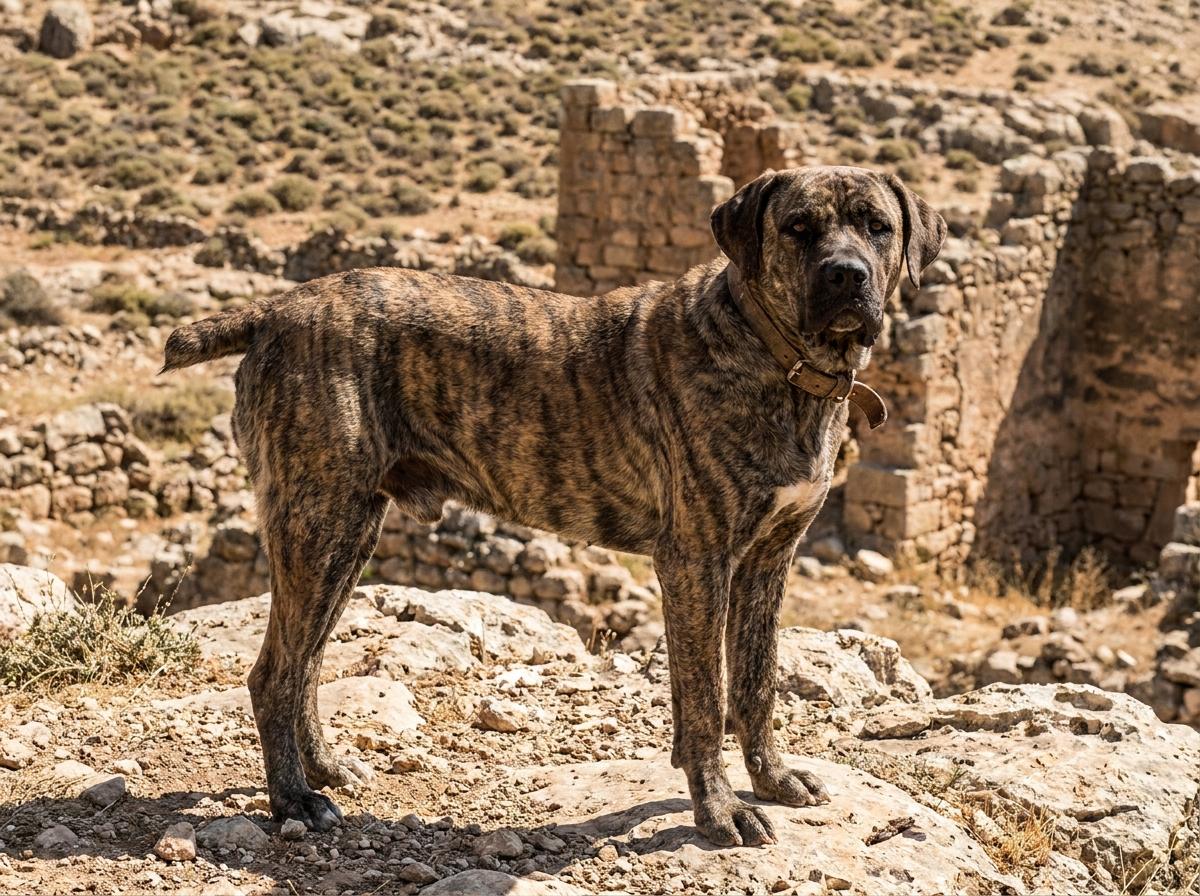
Assyrian Mastiff
Assyrian mastiff is a name, not a breed. No breed standard is published under it by the registries an English-speaking buyer would check, and no living dog can show a documented line of descent from the heavy dogs carved into Assyrian palace walls in the seventh century BC. The name usually points at one of two real things: the powerful dogs that ancient Mesopotamian art and ritual texts genuinely record, or a living Middle Eastern livestock guardian population, most often the Pshdar dog of Iraqi Kurdistan, which some writers call the Assyrian shepherd. Those are worth separating before money changes hands. This page sets out what is documented, what is inferred, and what is sales copy, then covers build, temperament, care, health, and the checks that matter if a dog is offered to you under this name. If you are comparing regional guardian and working types, the Creatures dog hub and the breeder directory are the places to start.

Browse listings, public profiles, breeders, or add your animal.
What people mean when they say Assyrian mastiff
The phrase gets used three different ways, and the three do not describe the same animal.
As an archaeological label. Writers use it for the large, heavy dogs that appear in Assyrian and Babylonian art and in Mesopotamian texts. That usage describes objects in museums, not dogs you can buy.
As a regional name for a living guardian dog. In and around Iraqi Kurdistan, the big flock guardian of the Pishdar district is known locally as the Pshdar or Pisder dog and in English as the Kurdish mastiff. Some regional writing also calls it the Assyrian shepherd, and English listings shorten that to Assyrian mastiff. These are real, living, working dogs.
As a sales label. Because nobody owns the name, it can be attached to any big dark-masked dog with no paperwork to contradict it. A puppy advertised as an Assyrian mastiff might be a Pshdar dog, a Kangal, a Central Asian Shepherd, a Sarabi from Iran, a cross of several, or something else entirely.
The Creatures breed page you are reading sits at the third usage, because that is where buyers arrive. The rest of this guide is about telling the three apart.
What the ancient evidence actually shows
The Assyrian material is genuinely remarkable, and it is more specific than most of what gets written about it.

Illustration in the style of a Neo-Assyrian palace relief. It is a modern drawing made for this article, not a photograph of an excavated panel, and it is not a portrait of any identified ancient dog.
Five named dogs under a doorway at Nineveh
In the mid nineteenth century, excavators at the North Palace at Nineveh found five clay model dogs buried under a doorway. They date to around 645 BC, each retains traces of colored pigment, and each carries a cuneiform name. The Nimrud project on ORACC, the Open Richly Annotated Cuneiform Corpus, records them as “Expeller of evil”, “Catcher of the enemy”, “Don’t think, bite!”, “Biter of his foe!” and “Loud is his bark!”, now British Museum numbers 30001 to 30005.
Those figurines were ritual objects, not breed records. A cuneiform tablet from Assur, written during the reign of Ashurbanipal, gives instructions for keeping evil out of a building by burying two sets of five model dogs beneath a doorway, and the Nineveh set matches the prescription closely. Six similar bronze dogs came out of a well in the Northwest Palace at Nimrud during the 1951 to 1952 season.
One correction while we are here. The claim that these inscribed dogs date to “around 2000 BC” circulates widely online. The Nineveh set is seventh century BC, roughly thirteen centuries later than that.
Dogs in the palace reliefs
The other famous evidence is sculptural. The gypsum panels from Ashurbanipal’s North Palace at Nineveh, carved about 645 to 635 BC and now in the British Museum’s Assyria lion hunts gallery, show handlers holding heavy, broad-headed dogs on leads in the hunting arena. They are unmistakably large, powerfully built animals, and they are shown under close human control.
What that proves, and what it does not
Taken together, the reliefs, the figurines and the ritual texts prove a lot. Assyrians kept large powerful dogs. They used them for hunting and guarding. They thought highly enough of them to name them, carve them, and bury models of them for protection. That is a serious documented record of a working relationship between people and big dogs in Mesopotamia.
What it does not prove is a breed. The dogs in the reliefs were not registered, measured, or bred to a written standard, and nothing in the archaeological record connects them to a named living population today.
Documented, inferred, or marketing
It helps to sort claims into three buckets before you evaluate a dog.
Documented. Assyrian art and texts record large mastiff-type dogs used for hunting, guarding and ritual protection in the seventh century BC. Living livestock guardian dogs of the same broad build work across Iraq, Iran, Turkey and Central Asia today. Some of those populations have written standards and registries under their own names.
Reasonably inferred. Big guardian dogs have almost certainly worked continuously in this region for thousands of years, because the job never went away. Predators, flocks and shepherds are all still there. Continuity of a working role is a fair inference.
Not established. An unbroken, documented pedigree from any dog in the Nineveh reliefs to any living dog. This is where most of the marketing lives, and the genetics are against it. In their 2012 review in the Proceedings of the National Academy of Sciences, Larson and colleagues concluded that “there is a major disconnect between truly ancient dogs and modern breeds”, noting that closed studbooks and strict aesthetic standards only appeared in the nineteenth century and that “the vast majority of modern breeds were only created in the past 150 y”. Even breeds that look genetically distinctive today usually got that way through recent geographic isolation rather than by preserving an ancient line.
That is not a slight on the dogs. It is a warning about a sentence. “Descended from the war dogs of Nineveh” is a story, and it does not tell you anything about the animal in front of you.
The idea of the Assyrian mastiff as a distinct breed traces largely to Victorian and Edwardian dog writing, which habitually read figures in ancient art as portraits of an ancestral type. That was a period convention rather than a finding, and it has been repeated ever since.
Which living dogs get called this

The population most directly tied to the name is the Pshdar dog, from the Pishdar district in Sulaymaniyah Governorate in the Kurdistan Region of Iraq. It is a working flock guardian, and reporting from the region describes large males reaching roughly 90 cm at the shoulder and around 80 kg. Treat those as field descriptions rather than standard figures, because there is no registry standard to measure them against.
Beyond that, the label attaches loosely to several guardian populations across the same arc of country, including the Sarabi or Iranian mastiff, the Central Asian Shepherd Dog, and Turkish flock guardians.
Registry recognition, checked rather than assumed
Checked in August 2026, “Assyrian mastiff” does not appear in the American Kennel Club’s breed index, in the United Kennel Club’s breed list, or on the FCI’s list of breeds recognized on a provisional basis, which is where a newly standardized breed would enter. No registry we could check publishes a standard under the name, which means there is no written description of the dog, no herdbook, and no health screening scheme attached to it.
The neighboring guardians that do have standards carry other names, and their standards are worth reading because they describe the same broad kind of dog with real numbers attached:
- Kangal Shepherd Dog, Turkey. FCI standard number 331 puts males at 72 to 78 cm at the withers with a 2 cm tolerance and 48 to 60 kg, females at 65 to 73 cm and 40 to 50 kg. Coat 3 to 7 cm, fawn to wolf sable, with a black mask.
- Central Asian Shepherd Dog. FCI standard number 335 sets minimums rather than ranges: males at least 70 cm and 50 kg, females at least 65 cm and 40 kg.
- Anatolian Shepherd Dog, a fully recognized American Kennel Club breed in the Working Group.
Read the two FCI standards side by side and one line stands out in both. Each lists “aggressive or overly shy dogs” as a disqualifying fault. Wherever this kind of dog has actually been written down by the people who judge it, fighting drive is a defect, not a selling point.
Dog fighting, stated plainly
Guardian and mastiff-type dogs from this region are entangled with organized dog fighting in some places, and the honest thing is to say so rather than write around it. The sister guide to the Gull Terrier covers a closely comparable problem in a different population.
Reporting from Iraqi Kurdistan describes Pshdar dogs being used in fights. Rudaw writes that the breed, long used by shepherds to guard flocks, is also “cruelly misused for dog fighting”. The Kurdistan Chronicle reports that fights in Pishdar take place monthly through autumn and winter, draw crowds of around two thousand, and involve gambling, and it says this happens despite being prohibited in the Kurdistan Region of Iraq.
Where you live, the law is likely to be blunt about it:
- In the United States, animal fighting ventures are prohibited under section 26 of the Animal Welfare Act, and 18 U.S.C. section 49 sets the penalty at a fine, imprisonment for “not more than 5 years”, or both, for each violation. Attending a fight is separately punishable by up to a year, and causing a child under sixteen to attend by up to three years.
- In the United Kingdom, section 8 of the Animal Welfare Act 2006 makes it an offence to cause an animal fight, to attend one, to take bets on one, to keep or train an animal for fighting, to supply premises for one, or to distribute a recording of one.
Creatures does not support dog fighting in any form, and we will not help anyone source a dog for it. That is a deliberate limit on this guide. You will not find advice here on identifying fighting lines, evaluating a dog’s record in the pit, or finding sellers who breed for it, because that guidance would serve the practice rather than the dog.
For a buyer, the practical version is short. A seller who advertises fighting lines, shows scars as credentials, or talks about a dog’s record is a seller to walk away from. It is a welfare problem, a legal problem in most of the English-speaking world, and it selects for exactly the temperament that makes a large dog dangerous to live with.
Temperament, honestly
A livestock guardian dog is bred to work alone, at night, at a distance from people, and to decide by itself whether something approaching the flock is a threat. That independence is the whole point of the job, and it is the single most misunderstood thing about these dogs.
What that means in a home:
- They make their own calls. A guardian that checks in with you before acting is a guardian that arrives too late. Expect a dog that assesses situations independently and is not especially interested in taking your word for it.
- Territory is the organizing instinct. Fence lines, gates, driveways and visitors matter more to this dog than a ball does. Barking at night is normal working behavior, not a fault, which makes close neighbors a genuine planning problem.
- Reserve with strangers is typical. Both FCI standards above describe wariness of strangers as normal and aggression as a disqualifying fault. Those two are not the same thing, and the difference is worth learning to see.
- Size is not a detail. A dog in the 50 to 80 kg range that decides something is a threat cannot be managed by strength. It has to be managed by structure, containment and training laid down long before the moment arrives.
These dogs are not a good first dog, and they are a poor fit for apartments, shared yards, or households that cannot commit to consistent management for a decade. Plenty of experienced owners keep them very happily. The failures tend to come from people who bought the silhouette.
Behaviour work with a large guardian breed is a job for a qualified professional who can see the dog. If you have concerns about aggression, guarding, or reactivity, take them to a veterinary behaviorist or a credentialed trainer rather than to a forum.
Care and daily management

Containment first. Secure, tall, well maintained fencing is the foundation, not an upgrade. A roaming guardian dog is a liability to livestock, to neighbors, and to itself. Plan the fence before you plan the puppy.
Housing. These dogs are built for weather and generally prefer to be outside, which is not a license to leave one chained in a bare yard. What they need is shelter that is dry, shaded, roomy and clean, with constant access to fresh water and the freedom to move, patrol and lie where they choose. Tethering a guardian dog is both a welfare failure and a training failure, because a dog on a chain cannot do the job it was bred for and frequently becomes frustrated and reactive instead.
If the dog is going to work with stock, the early weeks decide the outcome. South Dakota State University Extension describes bonding puppies to sheep between 8 and 20 weeks of age as crucial to their success, and warns that dogs that become too attached to people may leave the flock. That is the reverse of how you would raise a companion puppy, and it is why a working prospect and a house dog are different projects from the start.
Exercise and growth. Guardian breeds do their work at a walk, and they need space and patrol time far more than they need hard repetitive exercise. Large-breed puppies should not be conditioned like adults. Ask your veterinarian when an individual dog’s growth plates and joints are ready for harder work.
Coat and heat. A dense double coat sheds heavily, especially seasonally, and needs regular brushing. It insulates against heat as well as cold, so shade, ventilation and water matter more than clipping.
Ears and tails. Cropping is still practiced on guardian dogs in parts of the region, and the FCI Kangal standard even says cropped ears, where cropping is allowed, are judged the same as uncropped ones. The American Veterinary Medical Association opposes ear cropping and tail docking of dogs done solely for cosmetic purposes and encourages removing them from breed standards. If you are choosing a puppy, a breeder who leaves ears and tails alone is telling you something useful about their priorities.
Health
Because this is not a registered breed, there is no breed health survey, no registry health scheme, and no published incidence data for it. That is a real limitation, and the way around it is to stop asking about the breed and start asking about the parents.
Two conditions dominate planning for any very large, deep-chested dog.
Gastric dilatation and volvulus. The Merck Veterinary Manual describes GDV as an acute, life-threatening emergency, with reported mortality of 20 to 45 percent even with treatment, and worse outcomes when signs have been present for more than about six hours. Warning signs are restlessness, unproductive retching, drooling and a distended, drum-like abdomen. Merck notes that a gastropexy, done preventively or after an episode, should prevent the life-threatening twist, and lists smaller more frequent meals, avoiding exercise around mealtimes and using flat rather than raised bowls among management measures. Know the signs and know your nearest out-of-hours surgical clinic before you need it.
Hip dysplasia. Merck describes it as most common in large-breed dogs, with rapid growth, exercise, nutrition and heredity all contributing, and points to Orthopedic Foundation for Animals grading and PennHIP stress radiography as the screening routes. Ask for the parents’ actual screening results, with the dogs identified by microchip, rather than an assurance that the line has never had a problem.
Beyond those, the routine matters: a parasite and vaccination plan suited to your area, weight control on a heavy frame, dental care, and regular checks of ears, feet and skin. All medical decisions belong with a veterinarian who can examine the dog.
Keep the records where you can find them again. A guardian dog’s screening results, growth weights, vaccination dates and any treatment history are the evidence you will want when a lameness appears at four or a buyer asks about the litter at six.
Cost, availability and importing
There is no reliable published price for a dog sold under this name, and inventing one would be worse than saying so. In the region, prices for a good working flock guardian vary widely with the dog’s reputation, working record and lineage as understood locally. Viral figures for very expensive dogs circulate constantly and rarely survive checking.
Outside the region, the practical position is that you are almost never buying an Assyrian mastiff. You are buying a Middle Eastern or Central Asian guardian type, or a cross, being sold under an evocative name. That is not automatically a bad dog. It is a reason to buy on evidence about the specific animal instead of on the label.
Importing is its own project. The CDC’s final rule on the importation of dogs and cats, effective 1 August 2024, requires every dog entering the United States to carry an ISO-compatible microchip, to be at least six months old, and to arrive with a submitted CDC Dog Import Form. Dogs that have been in a country CDC classifies as high risk for dog-maintained rabies face additional requirements including proof of rabies vaccination and serologic test results from a CDC-approved laboratory. Check the current country list and requirements before anyone books a flight, because they have changed repeatedly.
What to check before you buy
Because the name carries no paperwork, everything useful has to come from the individual dog and the person selling it.
- Ask what the dog actually is. Which population, from where, and how does the seller know? A straight answer such as “Pshdar lines out of Sulaymaniyah” or “Kangal, here are the parents’ registrations” is worth far more than “ancient Assyrian bloodline”.
- See the parents, in person if you possibly can. With a guardian breed, the parents’ temperament around strangers is the most informative thing you will see all day. Calm and watchful is what you want. Frantic, cowering or explosive is a reason to leave.
- Ask for health screening on the parents, identified by microchip: hip grading at minimum, plus whatever your veterinarian recommends for the type.
- Ask what the puppy has been raised with. A prospect intended to guard stock should have been with stock. A prospect intended to live with a family should have been handled and socialized. The two paths pull in opposite directions from the first weeks, so be clear which one you are buying.
- Walk away from fighting talk. Any reference to fighting lines, game-bred stock, or a dog’s record is disqualifying. So are cropped ears presented as a mark of quality.
- Get everything in writing, including what the dog was sold as, and keep the paperwork somewhere durable. If you create a free profile for the dog on Creatures, that paperwork, the screening results and the vaccination history live in one place instead of in a folder you will not find in three years.
- Check your local rules on large or guarding breeds, insurance and containment before you commit, not after.
Frequently asked questions
Is the Assyrian mastiff a real breed?
Not in the sense a registry would recognize. It is a name applied to a historical type seen in Assyrian art and to living Middle Eastern guardian dog populations. As of August 2026 it does not appear in the AKC breed index, the UKC breed list, or the FCI’s provisional recognition list.
Is the Assyrian mastiff extinct?
That framing assumes there was a defined breed to go extinct. The specific dogs shown in seventh century BC Assyrian reliefs are long gone, and no living population has a documented line of descent from them. Guardian dogs of a broadly similar build still work across the same region.
Is it the same as the Kurdish mastiff or Pshdar dog?
Often, yes. The Pshdar dog of Iraqi Kurdistan is also called the Kurdish mastiff and, in some regional writing, the Assyrian shepherd, which is where the English name usually comes from. But the label also gets applied to Turkish, Iranian and Central Asian guardians, so confirm which population a specific dog belongs to.
How big do they get?
There is no standard to quote for this name. Regional reporting on Pshdar dogs describes large males near 90 cm at the shoulder and about 80 kg. For a written reference point, the FCI Kangal standard specifies males at 72 to 78 cm and 48 to 60 kg.
Are they good family dogs?
For an experienced household with secure land, a well-bred and well-socialized guardian dog can be a devoted family member. They are a poor choice for first-time owners, small properties, or homes with a lot of unfamiliar foot traffic. Reserve with strangers is normal for the type; aggression is a fault, and both FCI standards for related breeds disqualify it.
Are these dogs used for fighting?
Some are, and pretending otherwise would not help anyone. Reporting from Iraqi Kurdistan describes organized fights involving Pshdar dogs despite the practice being prohibited there. Dog fighting is a federal felony in the United States and an offence under section 8 of the Animal Welfare Act 2006 in the United Kingdom. Creatures does not support it, and a seller who markets fighting lines should be avoided.
Can I import one to the United States?
Possibly, but treat it as a serious logistical project rather than a purchase. Since 1 August 2024 CDC requires every imported dog to be microchipped, at least six months old, and covered by a submitted CDC Dog Import Form, with extra requirements for dogs from countries at high risk for dog-maintained rabies. Verify the current rules before committing to anything.
Do this next on Creatures
Whether you are trying to identify what a dog actually is, keeping a guardian breed already, or breeding and selling working dogs, Creatures is the records, marketplace and directory layer for it.
Compare the types. Start at the Creatures dog hub, then read the sister guides to the Gull Terrier and the Nureongi, two more regional names that describe a population rather than a closed pedigree.
Record what the dog actually is. Create a free animal profile and put the parentage, the seller’s claims and the paperwork in one durable place. No account needed to start, and the walkthrough is in adding an animal to Creatures. The profile page tabs guide shows where each kind of information lives.
Keep the health evidence. Add hip screening, vaccinations and growth weights as records. The record sheet opens for any visitor to look around, and a free account saves what you enter. See adding a record and health and medical records for the detail, and reminders and upcoming care to stop a booster date getting away from you.
Watch for dogs coming up. Browse guardian type listings on the marketplace, and because they appear rarely and under several names, set a free listing alert so you hear about one when it is posted. New to this? Read saving searches and using your watchlist.
Find people, not adverts. Search trusted breeders, farms and rescues in the Creatures directory, where you can see who someone is before you talk to them.
Breeding or working these dogs? Add your kennel or farm profile so buyers looking for honest provenance can find you, and read getting listed in the breeder directory and creating an organization and adding your team.