

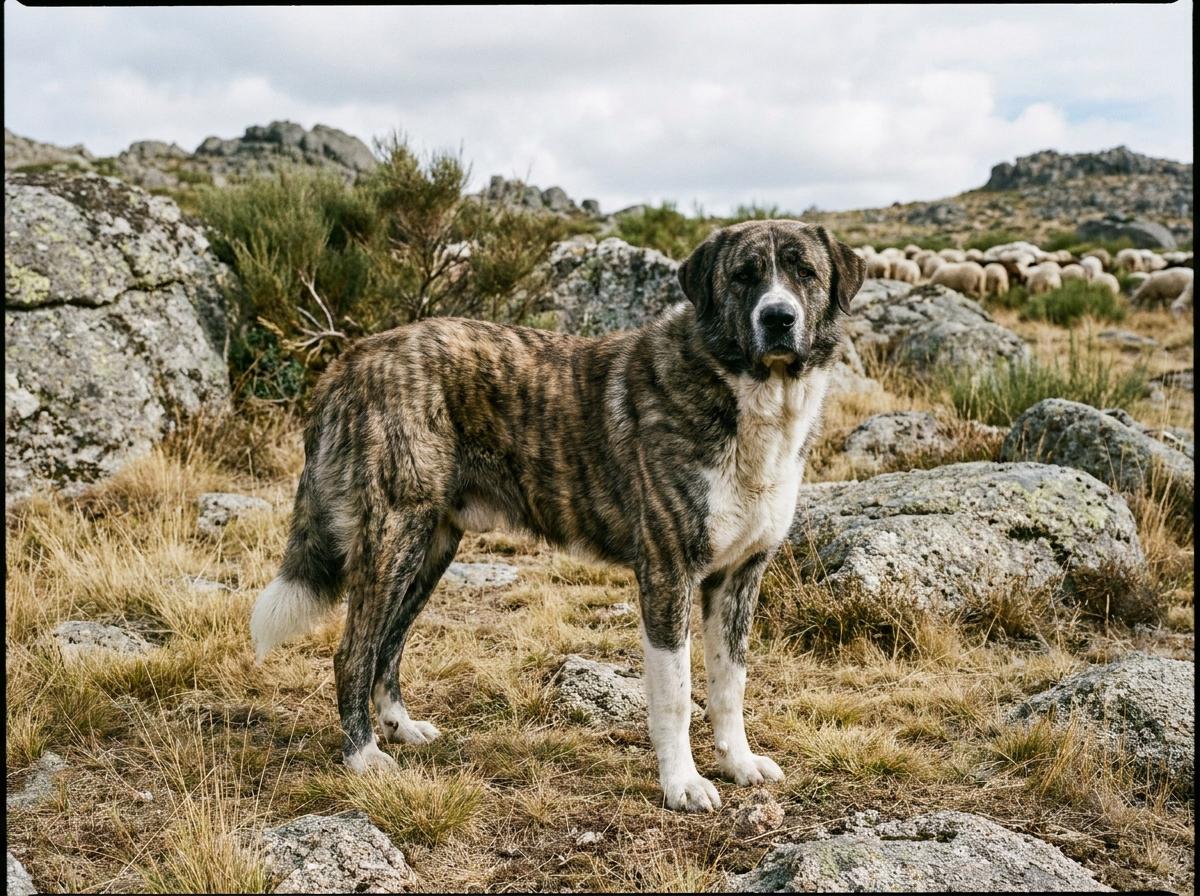
Cão De Gado Transmontano
The Cao de Gado Transmontano, written Cão de Gado Transmontano in Portuguese and known in English as the Transmontano Mastiff, is Portugal’s largest native dog breed. It is a livestock guardian from Tras-os-Montes in the far northeast of the country, shaped over centuries to live with sheep and goat flocks and to face down the Iberian wolf. Under the official FCI standard, males stand 75 to 85 cm at the shoulder (about 30 to 33 inches) and weigh 60 to 75 kg (132 to 165 lb), numbers that make a grown male taller at the shoulder than almost any other dog you will meet on a farm.
Scale is only half the story. This is a serious working guardian, independent, territorial, and calmest when it has animals to protect. It is not a heavy, wrinkled companion mastiff, and it is not a beginner’s pet. Portugal still uses the breed for exactly what it was made for: these dogs guard flocks inside the country’s wolf coexistence programs, and a small number have been field-tested by the USDA against wolves and grizzly bears in the American West.
It is also a rare breed with no real pet market, so if you are hoping to find one, the practical route is to watch Cao de Gado Transmontano listings on the Creatures marketplace and set an alert for new posts; more on that at the end.

Browse listings, public profiles, breeders, or add your animal.
What is a Cao de Gado Transmontano?
The name says exactly what the dog is. “Cao de gado” means livestock dog, and “transmontano” means from Tras-os-Montes, the historical province “beyond the mountains” in Portugal’s far northeast. The FCI standard sums up the breed’s purpose in one line: a livestock guarding dog for sheep and goat flocks.
A guardian is not a herder. A Border Collie gathers and drives sheep on command; a guardian like the Transmontano lives among the animals day and night, bonds with them from puppyhood, and treats the flock as its own to defend. It does not need instructions to do this. In Tras-os-Montes the threat it evolved to answer has always been the Iberian wolf, and that pressure explains almost everything about the breed, from its size to its watchful, deliberate temperament.
The Transmontano belongs to the family of big Iberian mastiffs and is most closely tied to the Rafeiro do Alentejo, its cousin from Portugal’s southern plains. The two populations diverged over centuries as the long seasonal flock migrations that once connected north and south fell away. To see where guardians sit among working dogs more broadly, start from the Creatures dog species page.
Bred by transhumance and wolves
The FCI standard is unusually direct about the breed’s origin: it ties the Transmontano to the shared history of all Iberian mastiffs and links its evolution to the peninsula’s transhumance routes, the long seasonal movements of flocks between summer pastures in the mountains and winter grazing on the plains. Big guardian dogs walked those routes for centuries, spreading and mixing along the way, and the populations that settled in each region slowly took on their own character. In the steep, remote uplands of Tras-os-Montes, with hot dry summers, cold winters, and wolves that never disappeared, that character became the tallest of Portugal’s guardians.
For most of the twentieth century these dogs were simply part of the farm, bred by shepherds for function rather than to a written standard. As pastoral life contracted, the breed became rare and regional. The revival has been deliberate. A breeders’ association, the Associacao de Criadores de Cao de Gado Transmontano, organized around the breed’s heartland in Vinhais and worked with the Montesinho Natural Park and the national kennel club to get formal registration going in the mid-2000s; by the end of 2005 it counted 169 adult dogs and 418 puppies in the books. The Transmontano is the most recently standardized of Portugal’s four native livestock guardian breeds, and its recovery is tied as much to wolf conservation as to dog fancy.
Recognition: CPC, FCI, and what about the AKC?
Portugal’s national kennel club, the Clube Portugues de Canicultura (CPC), maintains the breed’s standard, and the national timeline runs in two steps rather than one. Grupo Lobo dates the first registrations to 2004 and definitive recognition of the standard to 2012; registration in those early years ran through the Montesinho Natural Park under a protocol with the CPC. International recognition came later still: on 26 February 2020 the Federation Cynologique Internationale accepted the breed on a provisional basis as standard No. 368 in Group 2 (molossoid and mountain-type breeds), Section 2.2. As of August 2026 that recognition remains provisional, which is the FCI’s normal first stage for a national breed going international rather than a mark against it.
The American Kennel Club does not recognize the breed, and it is not enrolled in the AKC’s Foundation Stock Service as of August 2026; the dogs in the United States are working imports and their descendants. The practical consequence for buyers: a legitimate pedigree traces to the CPC studbook in Portugal, so ask for CPC registration and be wary of paperwork that does not lead back there.
What a Cao de Gado Transmontano looks like
Start with the scale. Males stand 75 to 85 cm at the withers and weigh 60 to 75 kg; females stand 68 to 78 cm and weigh 50 to 60 kg. The standard calls for clear sexual dimorphism, so a male should read as obviously taller and bulkier than a female. What keeps the breed from looking like a giant English Mastiff is the frame those numbers hang on: the profile is square, the legs are long and strongly boned, and the height at the elbow is noticeably more than half the height at the withers. This is a tall, rangy, athletic guardian, not a low, thickset one.

The details to look for, straight from the standard:
- A big but clean-lined head. Massive without being bulky for the body, with a moderate stop, a muzzle slightly shorter than the skull, and no exaggerated wrinkling or loose flews. The expression should be calm and sober.
- Thick, triangular drop ears. Medium sized, slightly longer than wide, set above the eye line, with a rounded tip, and very thick. They hang, and they are very mobile: they can pull back and fold vertically, and when the dog is paying attention they fold forward.
- Dark almond eyes. Honey brown or darker, slightly slanted, with a serene look.
- A visible but simple dewlap on a strong neck with loose skin.
- A thick sabre tail that hangs at rest and rises into a high sickle curve in motion, sometimes curling at the tip. Rear legs may carry single or double dewclaws.
- A light, ground-covering gait. The standard makes a point of it: despite the dog’s size and bulk, movement should be light, energetic, and rhythmic with great extension. A ponderous, rolling mover is wrong for this breed.
The coat is thick, medium length, smooth, and very dense, with an obvious undercoat and shorter hair on the head, ears, and limbs. It is built for a climate that swings from hot, dry summers to freezing winters, and it needs regular brushing rather than any elaborate grooming.
Color is where the standard gets specific in a useful way. The most common pattern is white with large black, yellow, fawn, or wolf grey patches, so most Transmontanos read as big white-and-patched dogs. Solid fawn, yellow, or wolf grey dogs, plain or brindled, also occur, usually with white feet or a white blaze, and ticking or tan tricolor accents are allowed. Two colors are severe faults: solid white and solid black. That matters in the field: an all-white giant flock guardian is, by definition, not a good Transmontano.
Transmontano, Estrela, or Rafeiro? Telling Portugal’s guardians apart
Portugal has four native livestock guardian breeds, and search results routinely blur them together. Here is how to keep them straight, using each breed’s own FCI standard as the reference.
Estrela Mountain Dog (Cao da Serra da Estrela). The famous one, from the Serra da Estrela range further south. It is markedly smaller: males stand 65 to 73 cm and weigh 45 to 60 kg. The color rules are nearly the reverse of the Transmontano’s: an Estrela wears solid yellow, fawn, or grey, wolf grey, or brindle, almost always with a dark mask on the face, and white is tolerated only in small marks at the feet and chest. Many Estrelas carry the long coat variety with a bushy, feathered tail, and the tail ends in a distinct hook. If you are looking at a masked, self-colored, often long-coated guardian, you are looking at an Estrela Mountain Dog, not a Transmontano.
Rafeiro do Alentejo. The Transmontano’s closest relative, from the southern plains. Size is closer but still smaller: males 66 to 74 cm and 45 to 60 kg. The giveaway is the outline and the movement. The Rafeiro is longer than it is tall, with a rectangular profile, and its standard describes a heavy, slow, rolling gait; the Transmontano is square, higher on the leg, and moves light. Coat pattern will not separate them, because the Rafeiro do Alentejo also comes in white with colored patches. Look at the height, the proportions, and the way the dog covers ground.
Castro Laboreiro Dog. The smallest of the four, from the mountains of the far northwest, and the easiest to rule out on color. Its standard names the wolf color as the most common and the dark brindle “mountain color” as the most preferred, and neither one reads as a white-patched giant. At 30 to 40 kg for males it is also the lightest by a wide margin, and its standard is the only one of the four that calls the breed very agile and active.
One more lookalike trap for readers outside Portugal: the Great Pyrenees, a large white guardian of similar silhouette at a distance. A Transmontano should never be solid white, so an all-white dog with a finer head and profuse coat is a Pyrenees type, not this breed. And if rare upland guardians are what drew you here in the first place, the Kurdish Mastiff is another regional flock guardian with a similar working story and an even thinner paper trail.
Guardian of the flock, ally of the wolf
The most interesting thing about this breed is not a show ring statistic. It is the central role the Transmontano plays in one of Europe’s better-known predator coexistence efforts.
The Iberian wolf is a protected species in Portugal, and the traditional conflict is simple: wolves take sheep and goats, shepherds lose income, and retaliation against wolves follows. Well-placed guardian dogs break that cycle. A flock with competent guardians loses far fewer animals, which lowers the pressure to kill wolves and lets predator and shepherd share the landscape. The dog protects the livestock, and by doing so it protects the wolf.

Portugal has run this play at scale. The wolf conservation organization Grupo Lobo has operated its Cao de Gado program since 1996 and has delivered more than 700 dogs into northern and central Portugal, drawn from the four national guardian breeds with the Transmontano among them. Puppies go out to their flocks as soon as they are weaned and have had their first vaccinations, deep inside the socialization window, so they bond with the animals they will spend their lives protecting. Grupo Lobo also publishes what that achieved: it has supported more than 380 livestock producers, and in the program’s own evaluation 90 participating producers reported that the dogs cut wolf damage in 74 percent of cases, with the reduction ranging from 13 to 100 percent (Ribeiro and Petrucci-Fonseca, 2005). More recently, the LIFE WolFlux project run by Rewilding Portugal delivered its 101st guardian dog in early 2024, using Serra da Estrela and Cao de Gado Transmontano pups to shield herds south of the Douro River, where the wolf population is most fragile.
Note how the breed actually works: in teams. The FCI standard states plainly that flock guarding “is never done by a single animal,” and that males live and work together without conflict, often outnumbering females on the job. A lone Transmontano guarding a big flock against wolves is not the traditional picture; a group of them, spread through the flock, is.
The idea has traveled. In a study run by the USDA’s National Wildlife Research Center with Utah State University, researchers field-tested larger European guardian breeds, among them Kangals, Karakachans, and Cao de Gado Transmontanos, working with 19 producers, 21 range sheep bands, and 65 guardian dogs across Idaho, Montana, Oregon, Washington, and Wyoming. The question was whether bigger, bolder breeds could handle wolves and grizzly bears better than the dogs American ranches usually run. The 2016 preliminary results are not a verdict on any one breed: all the breeds in the study, imported and American alike, stayed close to their sheep, and the dogs told wolf decoys from deer decoys and responded aggressively to the wolves. Whether particular breeds deter grizzlies better than wolves, or work better in forest than in open country, was still open. Trade-press coverage of the study has separately credited the Transmontano with sizing a threat up before committing to it, which is the calm evaluation shepherds in Tras-os-Montes selected for over centuries, though that is a characterization rather than a published finding.
Temperament: bred to decide for itself
The standard describes the breed as docile but reserved, cautious without being aggressive, calm, and serene, an exceptional guard when flocks come under wolf attack. With strangers it keeps an initial reserve and then tolerates handling, and it is described as very sensitive to gentle treatment. Breeders describe the same dog in plainer words: quiet, sure of itself, slow to alarm, watching and weighing before it acts.
None of that makes it easy to live with. Like every livestock guardian breed, the Transmontano was bred to work all night without a handler and to make its own decisions, so it is independent to the core and will never be obedient the way a biddable sheepdog is. It patrols. It barks at night, because barking at night is the job. It is territorial, it can be protective of food and space, and an under-socialized adolescent of this size is a genuine management problem. Thorough early socialization, patient and consistent handling, and secure boundaries are not optional extras; they are the price of admission.
Put plainly: this is not a beginner dog, an apartment dog, or a dog for someone who wants an easygoing family companion. In the right rural home, with space, structure, and an owner who understands guardians, it is a devoted and surprisingly gentle presence. Without those things, it is a breed to admire rather than acquire.
Living with a Transmontano
If you can meet its needs, the day-to-day picture follows from everything above. Always defer specific medical and feeding decisions to a veterinarian who can see the dog.

Space and containment
A giant guardian needs room and a secure perimeter. This is a dog for a farm, a smallholding, or a genuinely rural property with strong fencing, not a suburban yard. Transmontanos patrol, and some will test boundaries or dig if their territory feels too small for the job they believe they have. Plan containment before the dog arrives, not after the first escape.
The right job
Guardian dogs are calmest when they have something to guard. On a working farm, that is the flock, and ideally more than one dog, since the breed’s traditional working unit is a team. Without livestock, an honest owner has to ask whether they can supply an equivalent structure: real acreage, a clear routine, and enough engagement that a dog bred for round-the-clock responsibility is not left inventing its own. These dogs were not made to lie quietly indoors all day.
Coat, health, and everyday care
The dense double coat handles heat and cold well and needs regular brushing, more during seasonal shedding, and little else. As with any giant, deep-chested breed, keep a sensible eye on growth rate, joints, and body condition through puppyhood, and follow your veterinarian’s guidance on feeding, parasite control, and vaccinations; your vet may also want to discuss bloat awareness, as they would for any breed of this build. Life expectancy is commonly cited at around 10 to 12 years, typical for a dog this size, but there is no large registry dataset behind that figure, so treat it as a general expectation rather than a promise.
Raising a puppy right
The guardian instinct is shaped early. Portugal’s placement programs move pups in with their flocks as soon as they are weaned and have had their first vaccinations, during the socialization window when they bond most readily, and then expect roughly a year and a half to two years of maturing before the young dog is a steady, reliable guardian. A working or companion owner should budget the same: early, broad socialization, patient training, and a long adolescence. Choose a puppy from parents that actually work and have stable, sound temperaments, and keep its early records, weights, vaccinations, and worming in one place from day one so nothing gets lost between breeder and buyer.
Price and availability
There is no meaningful public price to quote for this breed, and we will not invent one. The Cao de Gado Transmontano is rare even in Portugal, where most puppies move between working farms or through conservation placements rather than a pet market. Abroad it is scarcer still: the breed association has long noted interest from elsewhere in Europe, and the United States has a small working population tied to ranch and research placements, but there is no established breeder network in most countries. Expect a small pool of sources, waiting lists, real transport costs if you are importing, and the need to verify that a dog genuinely comes from working, CPC-registered lines. Treat any cheap, paperless “Transmontano” with caution; with a breed this rare, the paperwork is most of the proof.
Because supply is this thin, the practical strategy is patience plus alerts: browse current listings on the Creatures marketplace, search trusted breeders and working farms in the Creatures directory, and set a saved-search alert so a new litter finds you instead of the other way around.
Frequently asked questions
Is the Cao de Gado Transmontano a good family pet?
For most families, no. It is a very large, independent, territorial livestock guardian bred to live out with a flock and, traditionally, to work in a team against wolves. It needs an experienced owner, secure space, and ideally a real guarding job. In the right rural home it can be a calm, devoted companion, but it is not a beginner or apartment dog.
How big does a Cao de Gado Transmontano get?
It is Portugal’s largest native breed. Males stand 75 to 85 cm at the shoulder (about 30 to 33 inches) and weigh 60 to 75 kg (132 to 165 lb); females stand 68 to 78 cm and weigh 50 to 60 kg. The build is tall, square, and rangy rather than heavy and wrinkled.
How is it different from the Estrela Mountain Dog?
Size and color, mainly. The Transmontano is taller (males up to 85 cm versus 73 cm), is most often white with large patches, and never wears a required mask. The Estrela is solid-colored or brindle with a typical dark facial mask, allows white only in small marks, and often carries a long coat with a hooked tail.
Are they really used to protect sheep from wolves?
Yes, that is the breed’s living purpose, not a historical footnote. Grupo Lobo’s Cao de Gado program has placed guardian dogs with hundreds of Portuguese producers since 1996, and the LIFE WolFlux project has delivered over a hundred more, to cut wolf predation and protect the endangered Iberian wolf. Traditionally the dogs guard in teams rather than alone.
Is the breed recognized by kennel clubs?
In Portugal, yes. Its national kennel club, the Clube Portugues de Canicultura, maintains the standard; the first registrations were made in 2004 and the standard was definitively recognized in 2012. Internationally the FCI accepted the breed provisionally in 2020 as standard No. 368, and that status is still provisional as of August 2026. The AKC does not recognize the breed and does not list it in its Foundation Stock Service.
How much does one cost?
There is no standard price. Working pups in Portugal often change hands through farm and program channels, and export adds transport and health-certificate costs. Be suspicious of bargain puppies with no CPC paper trail; scarcity attracts mislabeled dogs.
Do this next on Creatures
Whether you keep working guardians, run a flock that needs one, or are researching this rare Portuguese breed, Creatures is the records, marketplace, and directory layer to do it in one place.
Find one. Browse Cao de Gado Transmontano listings on the marketplace and search trusted breeders and working farms in the Creatures directory.
Get alerted. Genuine working stock is rare, so set a free listing alert and we will tell you when a dog or litter is posted. No account needed to start. New to this? See saving searches and using your watchlist.
Add your dog. Already have a Transmontano? Create a free animal profile in a few minutes. No account needed to start, and the walkthrough is in adding an animal to Creatures.
Keep its records. Track vaccinations, weight, and health records for a giant breed as it grows. The record sheet opens for any visitor to look around, and a free account saves what you enter. See adding a record and health and medical records for the how-to.
List your farm. Breed or place working guardians? Create a breeder or farm profile so shepherds and owners searching for this hard-to-find breed can reach you, and read getting listed in the breeder directory.
Sell with confidence. Planning to place pups or sell stock? Learn how seller payout works before you list.