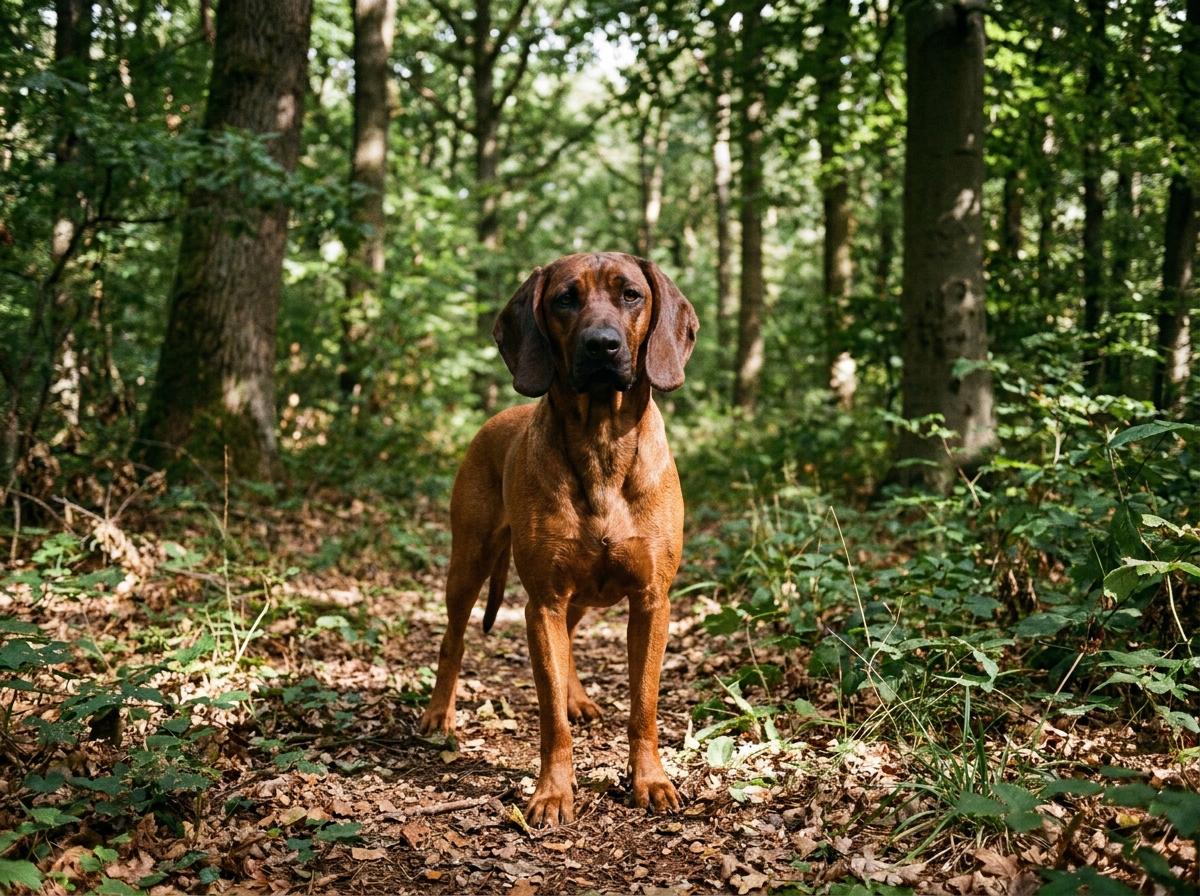
Hanover Hound
The Hanover hound is another English name for the Hanoverian Scenthound, the German Hannoverscher Schweisshund. It developed in the Hanover region from old leash hounds used to track wounded deer and boar after the shot. Heavier and more deliberate than many running hounds, it has a deep chest, strong bone, long ears, and a short coat usually seen in deer-red shades, sometimes with brindling or a dark mask. Its defining trait is not speed, but a cold nose and concentration on an old blood trail.
In Europe, Hanover hounds are most often associated with hunters, game managers, and handlers who recover wounded game. They can be calm and attached in the home, but they are specialist working dogs that need structured scent work and close handling rather than casual roaming. Weight control, ear care, and steady conditioning help keep them fit for tracking. Because puppies are relatively scarce and many breed clubs prioritize working homes, prospective owners should expect careful screening and should be honest about whether they can provide real trailing work.
Colors: Albino, Apricot, Bicolor, Black, Black and Tan, Black and White, Black Mask, Blue, Blue and Tan, Blue Merle, Blue Roan, Blue Tick, Brindle, Brown, Brown and Tan, Brown and White, Chocolate, Cream, Dapple, Domino, Fawn, Fawn and White, Gold, Gray, Grey, Harlequin, Irish Marked, Leucistic, Liver, Liver Mask, Mantle, Mask, Melanistic, Merle, Mottled, Parti-Color, Piebald, Red, Red and White, Red Merle, Red Roan, Red Tick, Reverse Brindle, Roan, Sable, Saddle, Silver, Speckled, Spotted, Tan, Ticked, Tricolor, Tuxedo, White, Yellow