Xiasi Dog
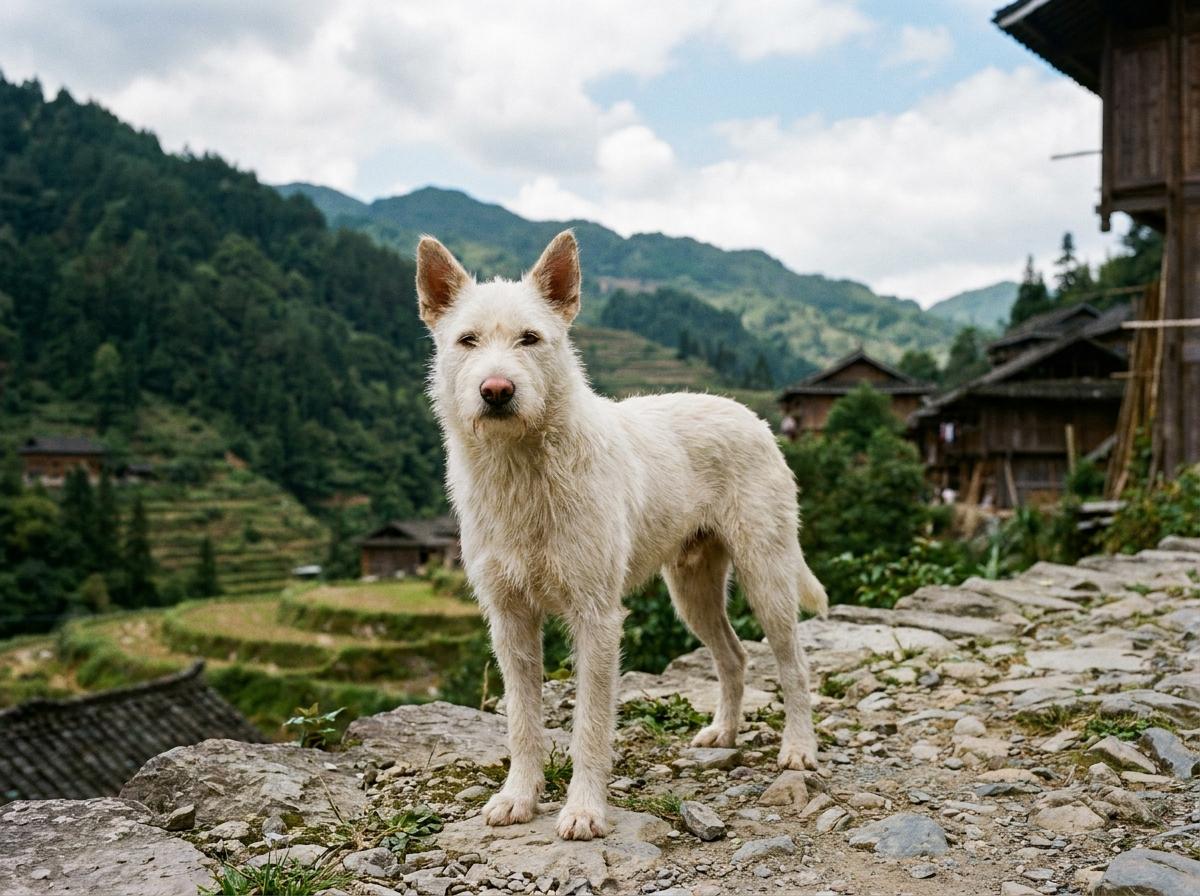
The Xiasi dog, or Xiasi Quan (下司犬), is a rare Chinese hunting landrace from the mountains of eastern Guizhou province, named for the town of Xiasi in Qiandongnan prefecture and long kept by Miao communities there. You can recognise it by one striking combination: a lean, racy, deep-chested hound body under a coarse, harsh, bristly white coat, with small prick ears, a long tapered muzzle, a pale pink nose, and wiry hair on the face that reads almost like a beard. It is a working dog first, bred for scenting and pursuit in steep subtropical hill country, and it remains scarce and largely confined to its home region.
This page covers what the breed actually is, what is verifiable about its recognition status (less than the internet suggests), how it looks and behaves, what keeping one demands, and what the honest picture is for anyone outside China who wants one. If you are still orienting yourself among breeds, the Creatures dog species page is the place to compare it against better-documented working breeds.

Browse listings, public profiles, breeders, or add your animal.
What is a Xiasi dog?
The Xiasi is a Chinese village hunting dog that became distinct enough, in a small enough area, to be treated as a breed. Its home is Xiasi town in the Qiandongnan Miao and Dong Autonomous Prefecture of Guizhou, a province of steep karst hills, dense subtropical woodland and terraced farmland in China’s southwest. The town’s own administration has shifted: the breed’s foundational documents and surveys are tied to Majiang County, while recent coverage places Xiasi under Kaili City, so both county names attach to the same place at different times. Miao households in that area kept these dogs to hunt and to guard property, and the type takes its name from the town rather than from any founder or club.
Two things separate it from the general run of Chinese village dogs. The first is its appearance, which is unusually consistent and unusually distinctive: a white to cream dog with a hard, wiry coat and a pink nose is not a common combination anywhere. The second is that it has been the subject of a deliberate, government-backed conservation programme since the mid 2000s, which is more attention than most regional Chinese dog types have ever received.
It is worth being clear about what it is not. The Xiasi is not an ancient pedigree breed in the Western registry sense, with a studbook running back generations. It is a landrace, meaning a local population shaped mostly by what worked for the people who kept it, and only recently given a written standard. Claims that it is “one of China’s four famous dogs” or ranks third among the world’s hunting breeds circulate widely in Chinese popular writing and in English breed listings copied from it. Those are folk and promotional framings with no governing body behind them, and no ranking of that kind exists.
Where the breed comes from
Chinese accounts of the breed describe Xiasi as a river trading town, where merchant households wanted guard dogs alongside the hunting dogs that hill farming families already kept. That is the traditional explanation for why a distinctive local type came to be kept in numbers in one small place, and it is a reasonable one, though it rests on local history writing rather than on anything independently documented. The traditional local name for the dog was the White Dragon dog, and a story attaching that name to an imperial visit is repeated in most Chinese accounts. Treat that as local tradition rather than history; it has the shape of a founding legend, and nothing in the record confirms it.
The more substantiated history is recent and administrative. A conservation base was set up in the early 2000s and local agricultural authorities in Majiang County began a conservation and development programme in the middle of that decade. In 2007 the Guizhou provincial quality and technical supervision bureau issued a local standard for the dog, DB52/T 530-2007, titled Guizhou Xiasi Dog, published on 16 August 2007 and in force from 30 September 2007. It was proposed by the provincial department of agriculture and drafted by provincial, prefectural and county livestock bodies, and it remains current. This is an agricultural product standard rather than a kennel club breed standard, and it is the closest thing the breed has to an official definition.
Recognition then moved up a level. Chinese accounts record the breed passing national livestock genetic resources review around 2009 and being added to the national list shortly after. That route has since closed behind it: when the Ministry of Agriculture and Rural Affairs published China’s National Catalogue of Livestock and Poultry Genetic Resources in 2020, dogs as a whole were deliberately left out, on the reasoning that dogs have become companion animals rather than livestock and are not managed as livestock internationally. So the Xiasi occupies an unusual position. It has real standing with Chinese agricultural authorities, that standing rests on a framework that no longer treats dogs as livestock at all, and none of it carries any weight with the international kennel clubs.
What a Xiasi dog looks like
The build is that of a working hound rather than a terrier or a spitz, despite the wiry coat suggesting the first and the prick ears suggesting the second.
- Lean, racy body. Deep but narrow chest, well tucked-up abdomen, long clean legs, and a light frame that reads as built for endurance and agility on broken ground rather than for power.
- Coarse, wiry white coat. The hair is thick and hard rather than soft, frequently standing away from the body instead of lying flat. Chinese descriptions record it in three lengths, short, medium and long. The provincial standard calls for a wholly white coat, though secondary descriptions and photographs often show cream and off-white tones.
- Pale pink nose. The unpigmented or lightly pigmented nose is one of the breed’s most-cited features and pairs with the white coat.
- Erect ears. Small to medium triangular ears carried upright. This is diagnostic, and it is the feature most often lost in photographs of crossbred or misidentified dogs.
- Wiry face furnishings. Bristly hair on the muzzle and above the eyes gives many individuals a short beard and shaggy eyebrows.
- Tail carried high. Usually held up above the level of the back.

On size, almost every figure you will find online is misattributed, so it is worth going to the source. The Guizhou provincial standard sets adult males at 43.0 to 55.0 cm at the withers and 14.0 to 26.0 kg, and adult females at 41.5 to 52.3 cm and 13.5 to 23.0 kg. Its grading tables reward the upper end, scoring males of 50 cm and above and 21.5 kg and above in the top bands, so a good specimen sits high in those ranges rather than in the middle of them.
Two other figure sets circulate widely and are both commonly credited to that standard. Neither belongs to it. The familiar “males 46 to 50 cm and 16 to 20 kg” comes from a China Working Dog Management Association article, not from the standard; it is a reasonable description of a typical dog and it sits inside the standard’s envelope, but it is narrower than what the standard actually permits. A second set giving weights of 25 to 30 kg for males is simply wrong, since it runs past the standard’s own ceiling of 26.0 kg. If you see a precise pair of numbers presented as “the breed standard,” check which of these three it actually is.
The standard is also stricter on colour than most secondary descriptions. It requires a wholly white coat with no off-colour markings, where breed pages routinely describe the dog as white or cream and allow occasional other shades. It confirms the ear, calling for a thin, erect, triangular ear and comparing it to a cat’s.
The wiry coat, and what genetics can and cannot tell you
The coarse coat and the bristly face furnishings are the breed’s signature, and they belong to a trait that is reasonably well understood in dogs generally. In Western wire-haired breeds, the presence of a moustache and prominent eyebrows, together called furnishings, together with wire texture, tracks to variants in the RSPO2 gene, identified in a study of coat variation across purebred dogs published in Science (Cadieu et al., 2009).
A genome-wide study of fifteen Chinese indigenous dog breeds, which sampled twelve Xiasi hounds, flagged RSPO2 among the loci carrying selection signals in this breed, alongside MSRB3, a gene associated with ear carriage (Yang et al., Frontiers in Genetics, 2019). That is a suggestive match to the two features an observer would pick out first, the coat and the upright ears, but a selection signal is not the same as a confirmed causal variant, and nobody has published the Xiasi’s coat genetics in that detail.
A later comparative study that used the Guizhou Xiasi as its white-coated reference group reached a somewhat different reading of RSPO2 in this population, describing the dogs it worked with as having long, soft hair and suggesting the gene was acting on hair length (Li et al., Frontiers in Veterinary Science, 2023). Given that Chinese descriptions recognise short, medium and long coat lengths within the breed, the two findings may simply be looking at different coat types. The honest position is that the wiry coat is the breed’s most reliable visual marker, and its genetic basis has not been settled.
Which registries actually recognise the breed
This is where English-language breed pages are least reliable, so it is worth stating plainly what can and cannot be confirmed.
The Xiasi does not appear in the breed nomenclature of the Fédération Cynologique Internationale, on either a definitive or a provisional basis. It does not appear in the American Kennel Club’s breed listings, and specifically it is not in the AKC Foundation Stock Service, the programme through which rare breeds are recorded on the way to possible recognition. It is not on the United Kennel Club’s recognised breed list either. Some breed pages assert AKC or UKC recognition; that is incorrect, and it appears to come from content copied between sites without checking.
Inside China the picture is more interesting, and also weaker than “recognised” implies. The China Kennel Union, which is China’s full member organisation in the FCI, set up a single-breed standards committee for the Xiasi in 2014, charged with drafting a domestic CKU standard and applying to the FCI in future. The wording of that decision is telling: committees for the Tibetan Mastiff, Chow Chow, Pekingese and Shih Tzu were tasked with updating those breeds’ existing FCI standards, while the Xiasi committee was tasked with writing one from scratch. In other words, more than a decade ago the breed was placed on a path toward recognition rather than given it, and no CKU studbook or finished breed standard for the Xiasi is publicly verifiable today.
The recognition the breed does hold in China is agricultural rather than cynological: the provincial product standard, and the national livestock genetic resources listing that predates the 2020 exclusion of dogs. Neither gives a Xiasi any standing with the FCI, the AKC or the UKC.
The practical consequence for a buyer is direct. There is no international studbook, no registry-issued pedigree, and no independent body verifying that a given dog is what a seller says it is. Whatever documentation comes with a Xiasi outside China is a private claim, and should be treated as one. Recording an animal’s parentage, health history and provenance yourself is the only version of that information you control, which is one reason owners of unregistered and landrace breeds keep their own pedigree and health records rather than relying on paperwork from a single seller.
How the breed is used
Hunting is the breed’s original job and remains its defining one. In the hills around Majiang, Xiasi dogs were used to find and pursue game in dense cover, and Chinese accounts consistently emphasise scenting ability, stamina and drive over size or strength. That is a legitimate working history, and it is the context in which the dog’s physical type makes sense: a light, fast, deep-chested dog that can keep moving through steep, humid, thickly vegetated country. Guarding was the parallel job in the town itself.
More recently, the breed has been trialled in Chinese police and working dog programmes. Chinese state media reported in 2025 that a cohort of Xiasi dogs was in police canine training in Guizhou in tracking and related work, and that an individual Xiasi had been entered into China’s national police dog system the previous year. Those reports come from state outlets and provincial government channels, so treat the details as reported rather than independently verified, but the direction is consistent with what handlers describe: a high-drive scenting dog with unusual endurance.

What follows from all of this is the part prospective owners should sit with. This is a purpose-bred hunting animal from a rural working context, selected across generations for independence, prey drive and the willingness to keep going. Those traits do not switch off in a suburban home.
Temperament and what living with one involves
Descriptions of Xiasi temperament come from keepers, handlers and Chinese breed literature rather than from formal behavioural research, so treat them as practitioner observation. The consistent themes are strong attachment to a handler, marked wariness of strangers, high energy, and considerable independence when working.
For a household, the honest translation of that profile is:
- Exercise demand is high and non-negotiable. A dog selected for hours of hill work does not settle on two short walks. Expect to build daily hard exercise plus scent and problem-solving work into your routine permanently.
- Prey drive should be assumed to be high. Cats, poultry, and small pets are a real consideration, and off-lead reliability around wildlife is not something to count on.
- Guarding instinct needs managing, not suppressing. Early, sustained, positive socialisation with people and other dogs matters more in a breed like this than in a low-reactivity companion breed.
- Independence is a training reality. A dog bred to make its own decisions at a distance is not the same proposition as a breed selected for close biddable teamwork, and training should be built around that rather than against it.
None of this makes the breed unsuitable for a committed owner; it makes it unsuitable for a casual one. If you want the phenotype without the workload, this is the wrong breed, and that is worth deciding before rather than after.
Care and husbandry
Exercise, containment and space
Plan for secure fencing and plan for it to be tested. A fast, agile, high-drive dog with a hunting background is exactly the profile that finds gaps, and a dog that self-releases to hunt is a danger to itself, to livestock and to wildlife. Height, sound construction, and a check of the ground line all matter more than they would for a lower-drive breed. Housing should be dry, shaded, generously sized and clean, with constant access to fresh water. Tethering or chaining as a containment method is not an acceptable substitute for fencing.

Coat and skin
The harsh coat is relatively low-maintenance in the sense that it does not mat like a soft one, and regular brushing plus checking for burrs, ticks and grass seeds after time in cover is most of the job. Bathing should be occasional, since frequent washing softens a harsh coat.
Skin needs more thought than coat. A predominantly white dog with an unpigmented pink nose has less natural protection from sunlight than a pigmented one. In dogs, nasal solar dermatitis affects the unpigmented areas of the nose first, and the Merck Veterinary Manual notes that lesions are worse in summer and that this condition is less common than once thought and is easily confused with other nasal diseases such as the lupus variants, so a persistent sore or depigmenting nose warrants a veterinary diagnosis rather than an assumption (nasal dermatoses in dogs). Practically: provide real shade, avoid the strongest midday sun in high-UV conditions, and ask your veterinarian about a dog-safe sun product for the nose if your climate warrants one.
Hearing
There is no published prevalence figure for congenital deafness in the Xiasi, and it would be wrong to assert one. What is established more broadly is that congenital deafness in dogs is associated with white and particolour coat patterns, and the Merck Veterinary Manual lists a set of predominantly white-marked breeds as predisposed (deafness in dogs). For any largely white breed, that makes hearing a sensible question to ask a breeder about, and a BAER hearing test on breeding stock a reasonable thing to request. Ask; do not assume either way.
Health, feeding and records
No breed-specific health survey for the Xiasi has been published, so any list of “breed health problems” you find online is inference rather than data. Routine care applies: a vaccination and parasite plan appropriate to your region, dental care, weight management, and prompt attention to the injuries a hard-running dog picks up in cover, particularly to feet, eyes and ears. Feed to condition and to workload, and keep a lean working dog lean.
Because the documented base for this breed is thin, individual records carry more weight than usual. Logging vaccinations, weights, injuries, heat cycles, litters and behaviour notes builds the evidence that does not otherwise exist for a landrace, and it is what lets a future owner or veterinarian understand the animal in front of them. Creatures gives you somewhere to keep health and medical records and reminders for upcoming care attached to the animal rather than scattered across notebooks and phone photos. Defer every medical decision to a veterinarian who can examine the dog.
How many Xiasi dogs are there?
Population numbers for this breed should be handled carefully, because the figures in circulation disagree by two orders of magnitude and none of them is an audited census.
The number most often repeated in English is that only around 270 purebred Xiasi remain, presented as the current situation. It is not current, and it does not mean what it is usually taken to mean. The underlying figure is 271, and it comes from the first breed resource survey in 1999. That survey counted adult dogs matching the purebred phenotype within Majiang County alone. It was a county-scoped visual count of grown dogs, not a headcount of the breed, and it is now more than twenty-five years old.
A second survey in 2002 found 98 by the same measure, and that number is almost never quoted. It matters, because it is the actual low point and it sits between the famous figure and the recovery story.
Chinese reporting then describes the recovery, and is no more auditable. After the conservation base and the county programme, those accounts describe a breeding base producing more than a thousand purebred dogs in 2008, numbers past ten thousand by 2012, and a local sector of breeding bases and smallholders by the late 2010s. Read the 2008 figure carefully: it is the output of one breeding operation, not a census. The 2012 figure carries no stated method at all. These are official and semi-official local numbers, published by people with an interest in the programme’s success.
So the defensible statement is a qualitative one. The Xiasi fell to a very small phenotypically purebred population in its home county around the turn of the century, a sustained conservation effort followed, and the population is now far larger than at that low point while remaining geographically concentrated and rare outside its home region. Anyone quoting you a precise current headcount, in either direction, is quoting something they cannot support.
There is one indirect check available. The genome-wide study noted above found the twelve Xiasi it sampled to carry diversity comparable to the other Chinese indigenous breeds it examined, while also reporting a moderate inbreeding coefficient for them (Yang et al., 2019). Diversity at that level is not what you would expect from a population that had passed through an extremely narrow bottleneck and stayed in it. Twelve dogs is a small sample, and this is a soft indication rather than proof, but it points the same way the recovery accounts do.
Cost and availability outside China
Inside its home region the Xiasi is a working farm and village dog, traded locally, and priced on the things buyers there care about: working ability, type and lineage as the seller describes it. There is no reliable public price series, and inventing one would not help you.
Outside China, the picture is simpler and less encouraging. There is no established export pipeline, no international registry to work through, and no meaningful population in North America or Europe. Anyone offering you a Xiasi in the West is asking you to trust an unverifiable claim about an animal from a breed with no international studbook, and misidentification is a live risk given how many white, prick-eared, rough-coated dogs exist.
Importing a dog from China into the United States is also a regulated process rather than a formality. Under CDC rules that took effect in August 2024, every dog entering the United States must be at least six months old and microchipped, and must have a CDC Dog Import Form. Dogs that have been in a country the CDC classifies as high risk for dog rabies within the previous six months face additional requirements, which for foreign-vaccinated dogs include arriving at a specific airport with a reservation at a CDC-registered animal care facility. China has appeared on that high-risk list, and the list is revised from time to time, so confirm the current classification on the CDC’s own page rather than trusting any secondhand summary, this one included. Check your own country’s rules as well before making any commitment, because these requirements changed recently and can change again.
If you want a dog of this general type and temperament and are not committed to this specific breed, you will find far better-documented options with health testing, breed clubs and traceable pedigrees. That is a real trade-off worth weighing rather than talking yourself past.
Buying considerations
- Ask what the claim of breed identity rests on. With no international registry, the answer is the seller’s word, local documentation, or a conservation-programme link. Any of those can be honest; none is independently verifiable from abroad. Get it in writing regardless.
- See the parents, and see them move. For a working landrace, temperament and soundness in the parents tell you more than any paperwork. Watch for the diagnostic features in both: erect ears, harsh coat, correct light build.
- Ask about hearing. For a predominantly white breed, ask whether breeding stock has been hearing tested, and what the breeder does when a deaf puppy appears.
- Be honest about the exercise and containment you can provide before you commit, not after. This is the single most common reason high-drive working dogs are rehomed.
- Verify import rules first, not last. For any cross-border purchase, confirm the current requirements with the official authority in your country before money changes hands.
- Start records from day one. Parentage as told to you, arrival weight, vaccination history, and everything after it. For a breed like this, the record you build is the only documentation that will exist.
You can also watch for dogs of any breed appearing on the Creatures marketplace and look for breeders and kennels in the Creatures directory. Because genuine Xiasi are so rare outside China, a saved listing alert is the practical way to catch one if it ever appears.
Related breeds worth comparing
If what draws you to the Xiasi is a regional landrace shaped by a working job rather than by a show ring, two other dogs on Creatures sit in the same position and are worth reading alongside it. The Gull Terrier is a Punjabi landrace with the same missing herdbook and the same absent written standard, and it shows what that absence does to a type over time: variation wide enough from line to line that the name tells a buyer very little on its own. The nureongi is the far end of the same problem, a Korean word for a yellow native-type dog that no registry stands behind at all, where even the type is elastic. Read together they make the point this page keeps returning to: with no studbook behind a name, the only record of an individual dog is the one somebody chooses to keep.
Frequently asked questions
Is the Xiasi dog recognised by the AKC?
No. It does not appear in the American Kennel Club’s breed listings, including the Foundation Stock Service, the programme rare breeds enter on the way to possible recognition. It is not recognised by the FCI or the UKC either. Pages claiming otherwise are mistaken.
Why is the Xiasi dog white with a pink nose?
The white to cream coat and the pale, often unpigmented nose are established features of the type and have been selected for locally over a long period. The genetics behind the breed’s specific coat have not been published in detail, though a genome-wide study of Chinese indigenous breeds flagged RSPO2, the gene behind wire coats and facial furnishings in Western breeds, among the loci under selection in this one.
Are Xiasi dogs good family pets?
For an experienced, active household prepared to meet a working hunting dog’s exercise, containment and socialisation needs, they can be. They are high-drive, independent, wary of strangers and strongly attached to their people, which is a demanding combination for a first dog or a low-activity home.
How many Xiasi dogs are left?
There is no trustworthy current figure. The widely quoted “around 270” is a 1999 count of adult dogs matching the purebred phenotype in one county, and a follow-up survey in 2002 found 98 by the same measure. Chinese reporting describes far larger numbers after the conservation programme, though those figures come from interested parties and one of the most-quoted is a single breeding base’s output rather than a census. The breed is best described as recovered from a severe low point but still rare and geographically concentrated.
Can I buy a Xiasi dog in the United States or Europe?
Realistically, no. There is no established export route, no international registry, and no meaningful population outside China. Importing a dog into the United States also means meeting the CDC’s minimum age, microchip and import form requirements, plus whatever additional conditions apply if the country of origin is on the CDC’s high risk list for dog rabies at the time you travel.
Is the Xiasi related to the Tibetan Mastiff?
An older mitochondrial DNA study raised a possible relationship, but a later genome-wide analysis placed the Xiasi with other southwestern Chinese dogs rather than with plateau breeds. The southwestern grouping is the better-supported picture.
What does the wiry coat need?
Regular brushing, checks for burrs, ticks and grass seeds after time in cover, and infrequent bathing, since washing a harsh coat often softens it. Give more attention to sun protection for the pale nose than to the coat itself.
Do this next on Creatures
Whether you are researching the breed, keeping a Xiasi or a similar landrace, or running a kennel, Creatures is the records, marketplace and directory layer to do it in one place.
Add your dog. Keeping a Xiasi or another undocumented landrace? Create a free animal profile and give the dog the record no registry will provide. No account needed to start. The walkthrough is in adding an animal to Creatures, and the profile page tabs explains what each section holds.
Keep the health history. Add a health or care record. The record sheet opens for any visitor to look around, and a free account saves what you enter. See adding a record and health and medical records for the detail, and set reminders for upcoming care so vaccinations and parasite treatments do not slip.
Get alerted. Xiasi dogs are effectively unavailable outside China, so set a free Xiasi dog listing alert and we will tell you if one is posted. No account needed to start. See saving searches and using your watchlist.
Look for stock and breeders. Browse dogs on the marketplace and search trusted breeders and kennels in the Creatures directory.
List your kennel. Breeding rare or landrace dogs? Create a free breeder or kennel profile, no account needed to start, then read getting listed in the breeder directory so buyers can find you.
Compare across the species. Start from the Creatures dog species page to see how the Xiasi sits against better-documented working breeds.