


Peacock Goat
The Peacock goat (German Pfauenziege) is a hardy Swiss mountain breed from the cantons of Graubünden (the Grisons) and Ticino, instantly recognizable by its split color pattern: a snow-white front half and a black rear half, set off by bold black stripes running from the horns through the eyes to the muzzle. It is a dual-purpose landrace, kept for milk and meat, that nearly vanished in the twentieth century and survives today only because a small group of breeders and the Swiss conservation organization ProSpecieRara pulled it back from the brink. This page covers what the breed is, where it comes from, how to tell a true Peacock goat by its markings, what it produces, its conservation status, and what to weigh before you try to find one.

Browse listings, public profiles, breeders, or add your animal.
What is a Peacock goat?
The Peacock goat is a Swiss mountain breed native to the cantons of Graubunden and Ticino in the southeast of the country. It is a landrace, meaning it developed as a regional working goat rather than being engineered to a fixed standard, and it is kept for both milk and meat. The Swiss conservation organization ProSpecieRara, which works to preserve rare Swiss livestock breeds, lists it among the country’s endangered goats and is the main reason it still exists.
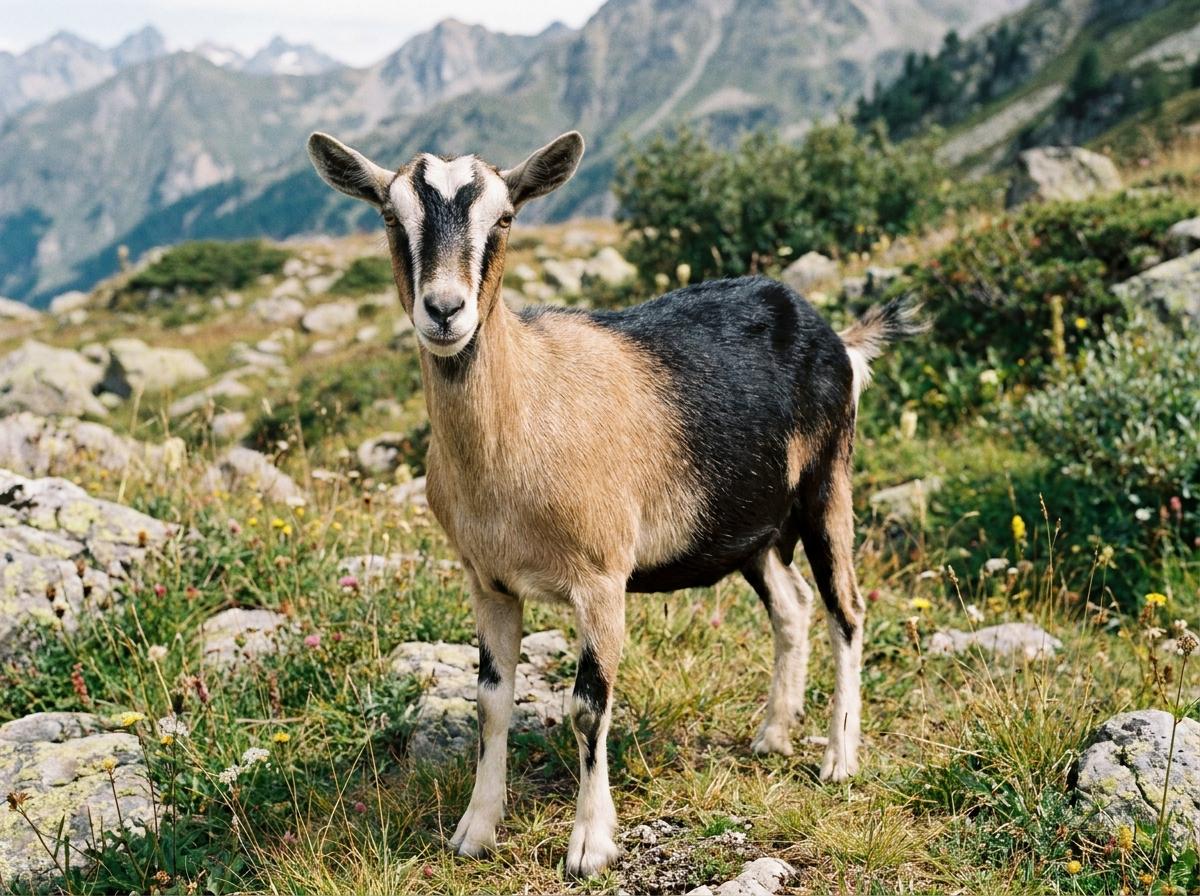
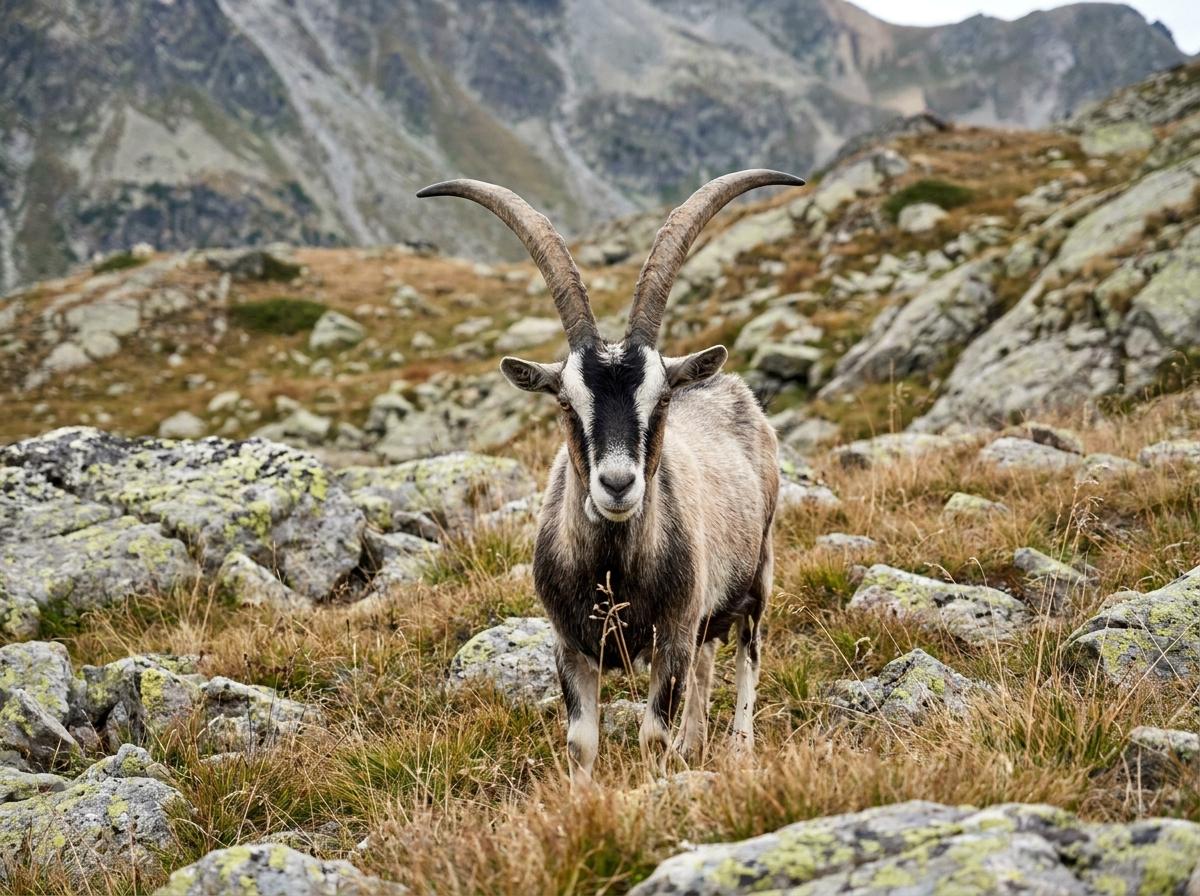
What makes the breed unmistakable is its color. The front half of the body, including the head, neck, and shoulders, is white, and the rear half is black, with white thighs, a white belly stripe, and white markings on the flanks and tail. The face carries bold black bands running from the base of the horns, down over the eyes, to the muzzle, and the ears and muzzle are black as well. Those facial markings, called “Pfaven” in the local Romansh-influenced dialect, are the feature the breed was originally named for. If you are weighing this breed against other goats, the broader Creatures goat species page is a good place to compare it with dairy and meat breeds side by side.
This is a hardy, surefooted mountain animal first and a milk producer second. Breeders value it for its robust, frugal nature and its ability to work steep, rough alpine terrain, which makes it well suited to extensive grazing and landscape management rather than intensive dairy production.
Where the name comes from
The “Peacock” name is one of the more charming accidents in livestock history, and it is worth getting right because it explains the breed’s defining feature.
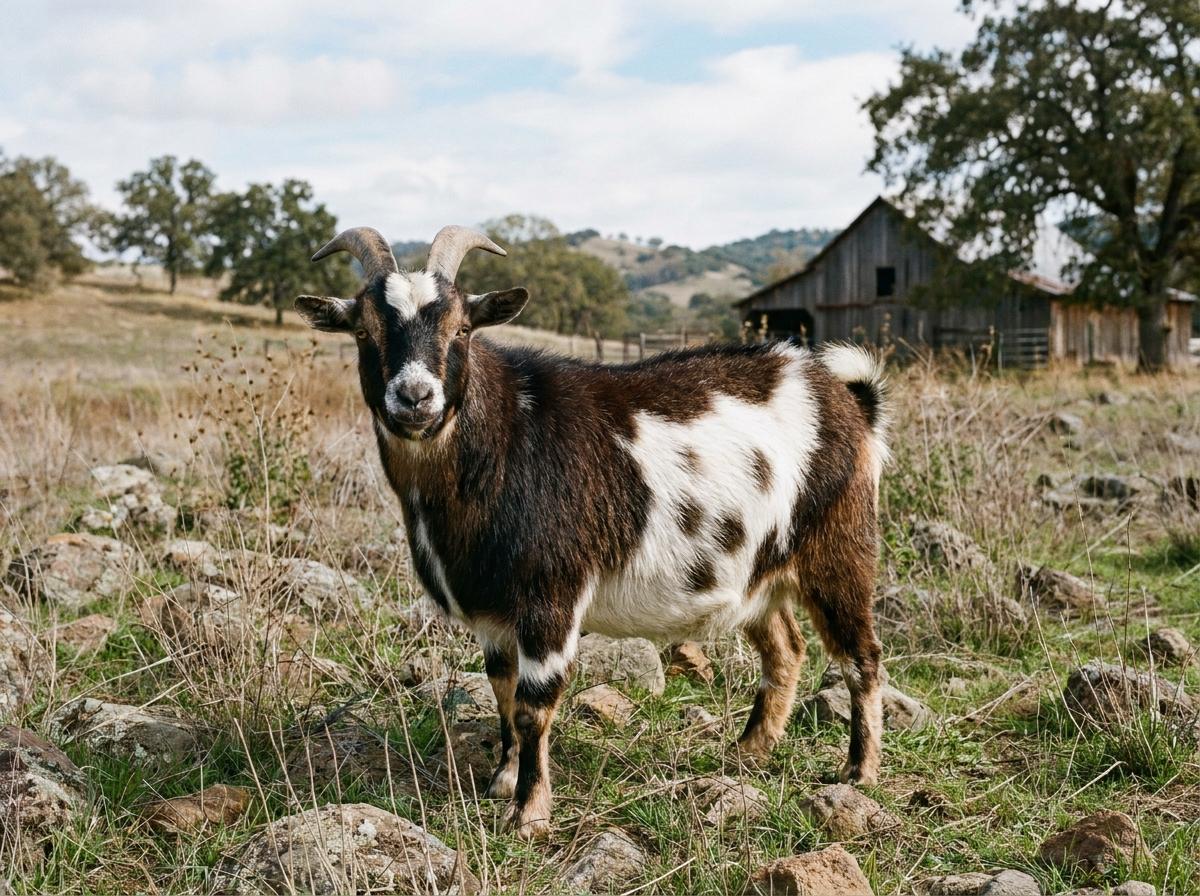
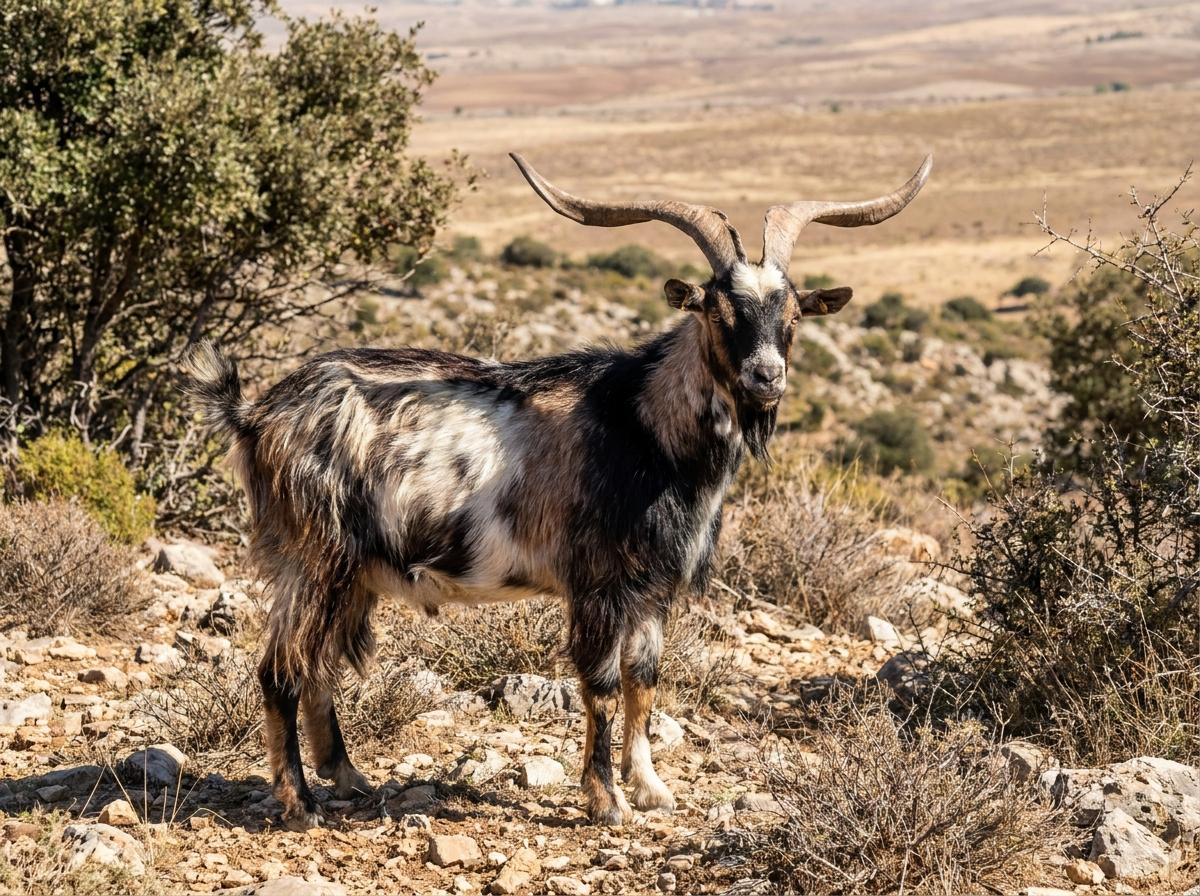
The black facial stripes are called “Pfaven” in the local dialect, so the goat was originally known as the Pfavenziege, which translates roughly to the “striped goat.” According to Swiss breed sources, a journalist misspelled the name as Pfauenziege, the German word for “peacock goat,” and the prettier mistake stuck. So the name does not refer to peacock-like plumage or a fan of tail feathers. It is a typo that happened to suit a striking animal. The stripes that earned the breed its original “striped” name are the same black bands you see crossing the face in the portrait below.

Origin and history
The breed traces to the mountain valleys of Graubunden and the upper Ticino. The first written description usually cited dates to 1887, when an animal matching the modern Peacock goat was recorded in the Prattigau valley, which is why it was historically also called the Prattigau goat.
Its modern history is mostly a survival story. In the Swiss livestock breed reorganization of 1938, the Peacock goat lost federal breeding recognition. It was at one point treated as merely a color variant of the related Grisons Striped goat, an assumption that later blood typing did not support. Losing official status meant losing support, and the population fell sharply over the following decades.
By the early 1980s the breed was nearly gone. Swiss breed sources record that only around ten breeders remained, many keeping fewer than five animals each. Those breeders joined forces with ProSpecieRara, which had been founded in 1982 specifically to rescue endangered Swiss livestock and crop varieties. Together they promoted the breed, shared young stock to seed new breeding groups, organized a breed association around 1992, and rebuilt the herd book. That effort brought the population back up to roughly 1,000 animals, which is why the breed is alive today but still classed as rare.
This history matters for a practical reason. The Peacock goat is a conservation breed with a small, closely managed gene pool concentrated in Switzerland, so anyone interested in the breed should understand from the start that availability is the central challenge.
What a Peacock goat looks like
The Peacock goat is a medium to large, well-built mountain goat with a thick, mid-length coat. Its diagnostic trait is the two-tone body, and the markings follow a consistent pattern.
- White front, black rear. The front half of the body, up to roughly the shoulder, is white. The rear half is predominantly black. The thighs, however, stay white, along with a white belly line, white flank patches, and a white tail.
- Black face stripes. Bold black bands, the “Pfaven,” run from the base of the horns, through the eyes, to the muzzle. The ears and muzzle are black. These facial markings are the single most reliable way to identify the breed.
- Black legs and feet. The legs are dark, giving the white front half its characteristic black “boots.”
- Large horns. Both does and bucks are typically horned, and the horns are substantial. This is a normally horned breed, not a polled one.
- Thick coat. The hair is mid-length and dense, suited to a goat that works exposed mountain pasture in variable weather.
Does stand roughly 70 to 80 cm at the withers and weigh about 50 to 60 kg. Bucks are larger, around 75 to 85 cm tall and 75 to 85 kg. Sources vary slightly on the exact figures, so treat these as typical ranges rather than fixed standards.
A common point of confusion is worth correcting directly: some quick summaries describe the breed as only “often horned.” Swiss breed authorities are clearer than that. The Peacock goat is a strongly horned breed in both sexes, and large horns are part of the normal type rather than an occasional trait.
How productive is the breed?
The Peacock goat is officially a dual-purpose, or multi-use, breed, kept for milk and meat. It is honest to say that production is not the headline here. Modern milk yields are modest by dairy-breed standards, with Swiss sources giving roughly 400 to 500 liters per lactation. Compared with a specialist dairy goat, that is a secondary trait.
What the breed is genuinely prized for is hardiness, surefootedness, and an ability to thrive on rough, steep, low-input pasture. That combination makes it valuable for extensive grazing, alpine landscape management, and keeping marginal terrain open, alongside meat and a useful amount of milk for a small holding. In other words, this is a robust working mountain goat that also milks, not a high-output dairy animal that happens to live in the mountains.
If you keep the breed, that practical profile shapes what is worth recording. Tracking kidding dates, milk where you milk, growth, and health over time is how a small conservation herd makes sound breeding and culling decisions, especially when the goal is preserving a rare breed rather than maximizing yield.

Temperament and management
Keepers describe the Peacock goat as a robust, frugal, good-natured mountain breed that is easy to manage on extensive pasture. We flag that as practitioner and breed-association observation rather than formally studied behavior, since the literature on this rare breed is thin and focused on conservation rather than temperament studies. As with any goat, individual character varies with handling, housing, and how much time the animals spend with people, and intact bucks in the breeding season are a different proposition from does and wethers.
Day-to-day care follows standard good goat husbandry. The breed needs dry, draft-free shelter and sound footing, clean water, appropriate minerals, and feed matched to the workload, with more support for does in late pregnancy and lactation. Because this is a horned breed, fencing, feeders, and handling facilities should account for horns, and disbudding is a decision to discuss with a veterinarian in the context of a conservation breed where the horns are part of the standard type. Routine parasite control, hoof care, clean kidding, and the core vaccinations your veterinarian recommends for your region all apply. Defer all medical decisions to a veterinarian who can examine the animal.
For a rare breed, good records are not just good husbandry, they are part of conservation. Keeping clear, dated records of kiddings, lineage, health events, and treatments lets a small breeding network make evidence-based decisions and maintain genetic diversity across a limited pool.
Conservation status and where to find one
This is the part where the Peacock goat differs most from a mainstream breed. It is rare, it is concentrated in Switzerland, and its survival depends on active conservation breeding.
After the 1980s low point, ProSpecieRara and the breeders’ association rebuilt the population to roughly 1,000 animals, which is a real recovery but still a small, carefully managed number. Switzerland classifies its native breeds by endangerment level, and the Peacock goat sits among the rare and monitored breeds rather than the secure ones. There are also breeding populations in parts of Germany and Austria, where conservation-minded keepers have taken up the breed, but it remains uncommon everywhere outside its Swiss home.
For most people reading this outside Switzerland, the honest picture is that you will not stumble across Peacock goats for sale. Genuine stock is scarce, it is tied to conservation breeding programs, and importing live goats across borders involves animal-health rules that make casual acquisition impractical. If you are serious about the breed, the realistic path is to connect with conservation breeders, join or follow a breed association, and be patient. A saved listing alert (in the hub below) is a sensible way to catch the breed if and when stock appears, precisely because it is so rarely available.
Because the gene pool is small and the breed is defined by a specific marking pattern, provenance matters. If you do find an animal presented as a Peacock goat, confirm its breeding records and that its markings match the breed standard rather than buying on the strength of an eye-catching coat alone.
Frequently asked questions
Why is it called a Peacock goat?
Not because it looks like a peacock. The breed’s black facial stripes are called “Pfaven” in the local dialect, so it was originally the Pfavenziege, the “striped goat.” A journalist’s misspelling turned that into Pfauenziege, the German for “peacock goat,” and the name stuck.
What does a Peacock goat look like?
The front half of the body is white and the rear half is black, with white thighs, a white belly line, and white flank and tail markings. The face has bold black stripes from the horns through the eyes to the muzzle, with black ears and muzzle and black legs. Both sexes are typically horned with large horns.
Where does the breed come from?
The mountain valleys of Graubunden and Ticino in southeastern Switzerland. It was first described in 1887, historically as the Prattigau goat.
Are Peacock goats good milk producers?
They are dual-purpose, kept for milk and meat, but milk yield is modest, around 400 to 500 liters per lactation in Swiss sources. The breed is valued more for hardiness, surefootedness, and frugality on rough mountain pasture than for high output.
Are Peacock goats rare?
Yes. The breed nearly disappeared in the twentieth century and was rebuilt to roughly 1,000 animals through ProSpecieRara and a dedicated breeders’ association. It is still classed as a rare conservation breed and is hard to find outside Switzerland.
Do Peacock goats have horns?
Yes. Unlike some quick summaries that call the breed only “often horned,” Swiss breed authorities describe both does and bucks as strongly horned, with large horns as part of the normal type.
Do this next on Creatures
Whether you are researching the Peacock goat, helping conserve a rare breed, or already keeping one, Creatures is the records, marketplace, and directory layer to do it in one place.
Compare goat breeds. See the parent Creatures goat species page, and compare this breed against other hardy and dairy goats like the Russian White, the British Alpine, and the Damascus goat.
Find stock. Browse Peacock goats on the marketplace and search trusted breeders and farms in the Creatures directory.
Get alerted. Genuine Peacock goats are rare and rarely listed, so set a free Peacock goat listing alert and we will tell you when one is posted. No account needed to start. New to saved searches? See saving searches and using your watchlist.
Add your goat. Already keeping a Peacock goat? Create a free animal profile in a few minutes, no account needed to start. The walkthrough is in adding an animal to Creatures.
Track breeding and health. For a rare breed, records are conservation. Track kidding, lineage, and health records on Creatures. The record sheet opens for any visitor to look around, and a free account saves what you enter. See adding a record for the full how-to.
List your farm. Run a conservation herd? Create a breeder or farm profile, no account needed to start, so people searching for this hard-to-find breed can reach you. Read getting listed in the breeder directory and creating an organization and adding your team to set it up.
If you keep or conserve rare goats, you can also list your operation in the Creatures directory so people searching for this breed can find you.