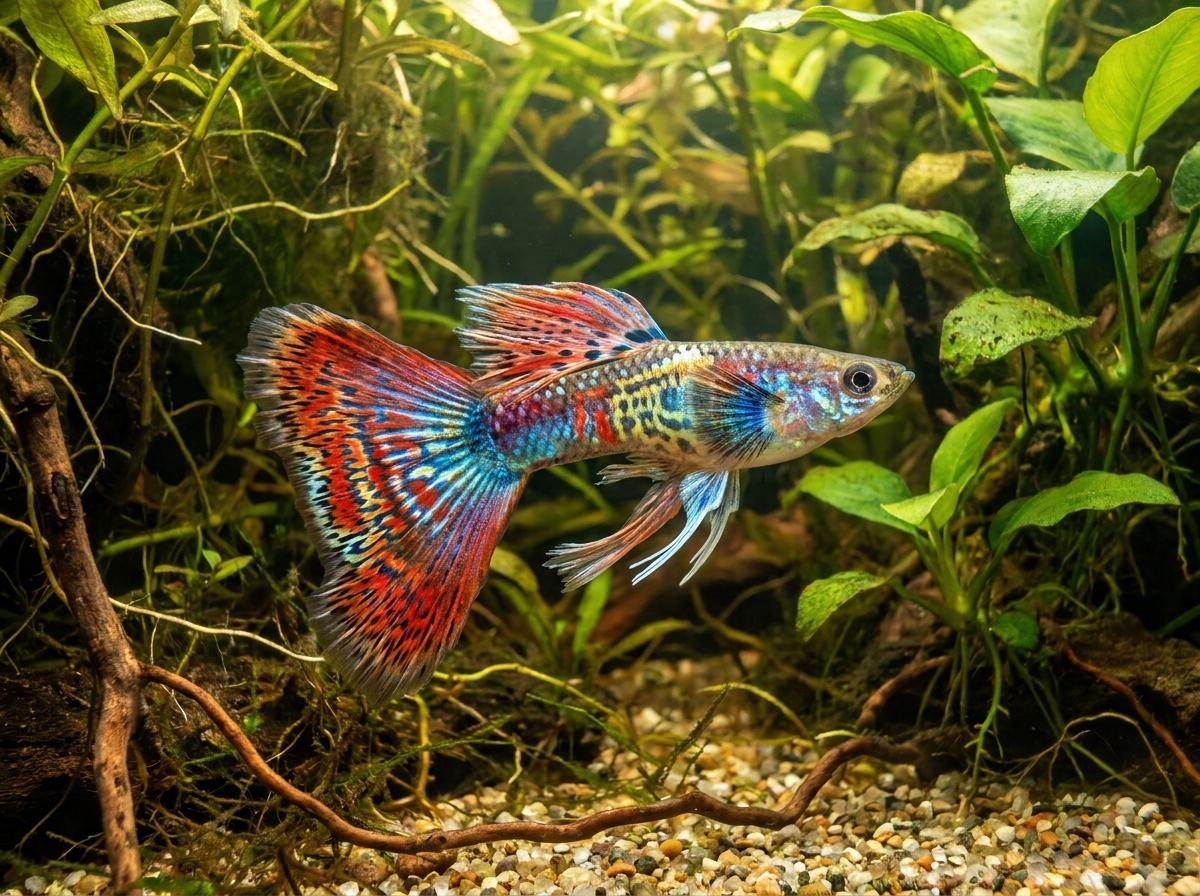
Delta
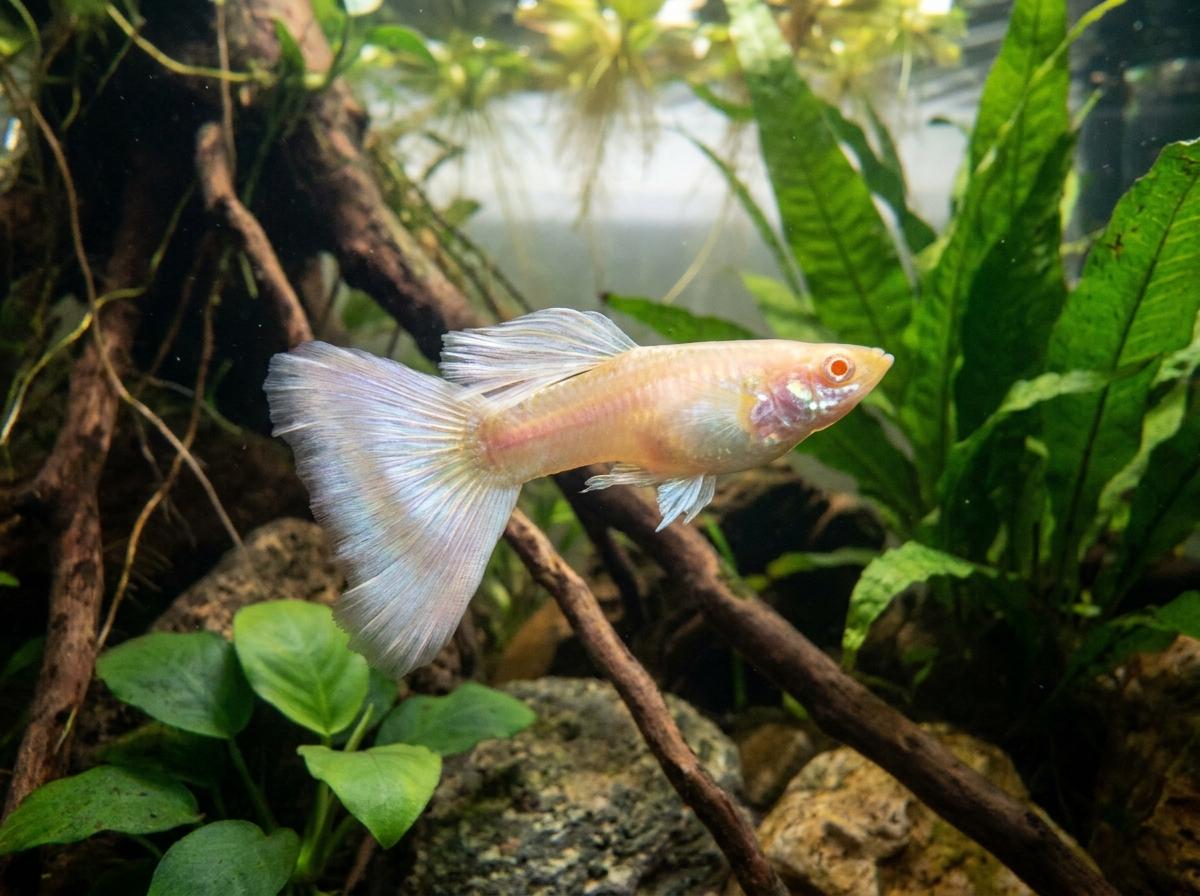
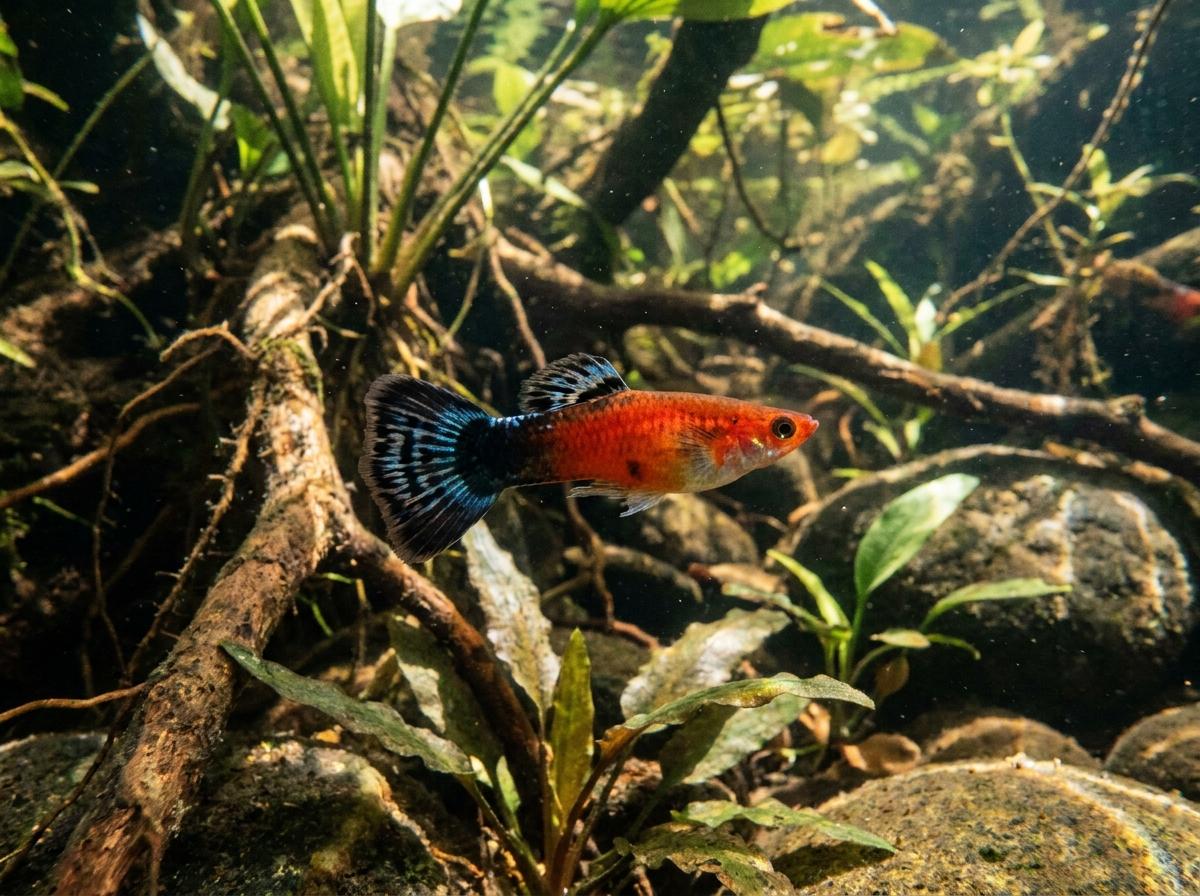
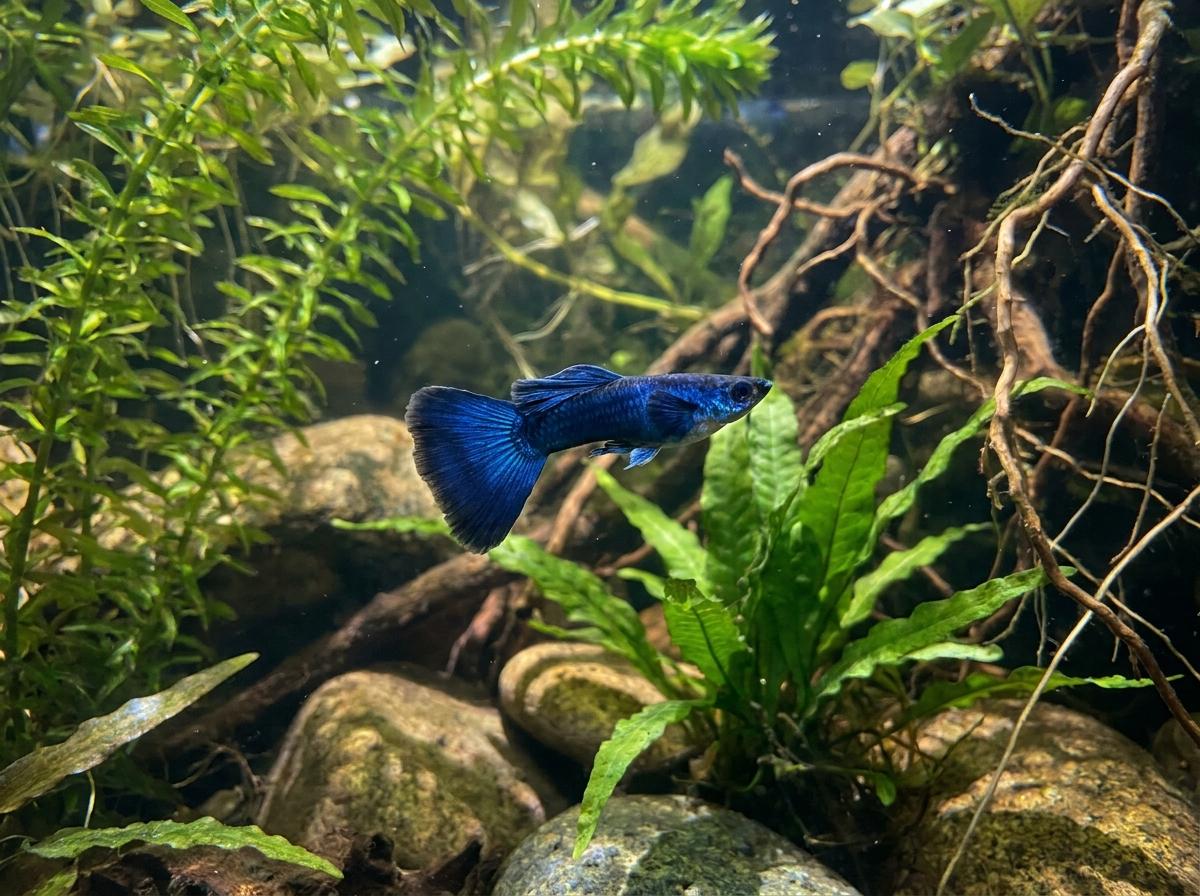
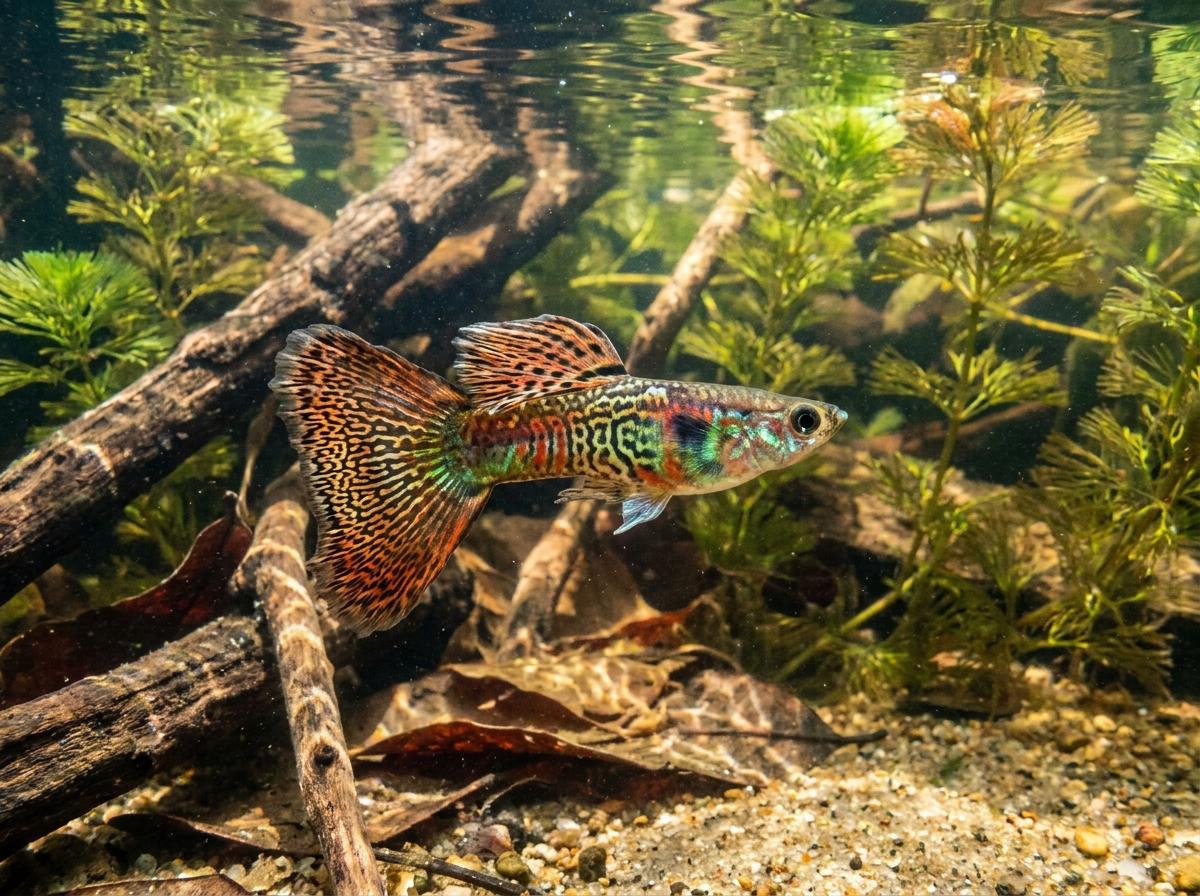
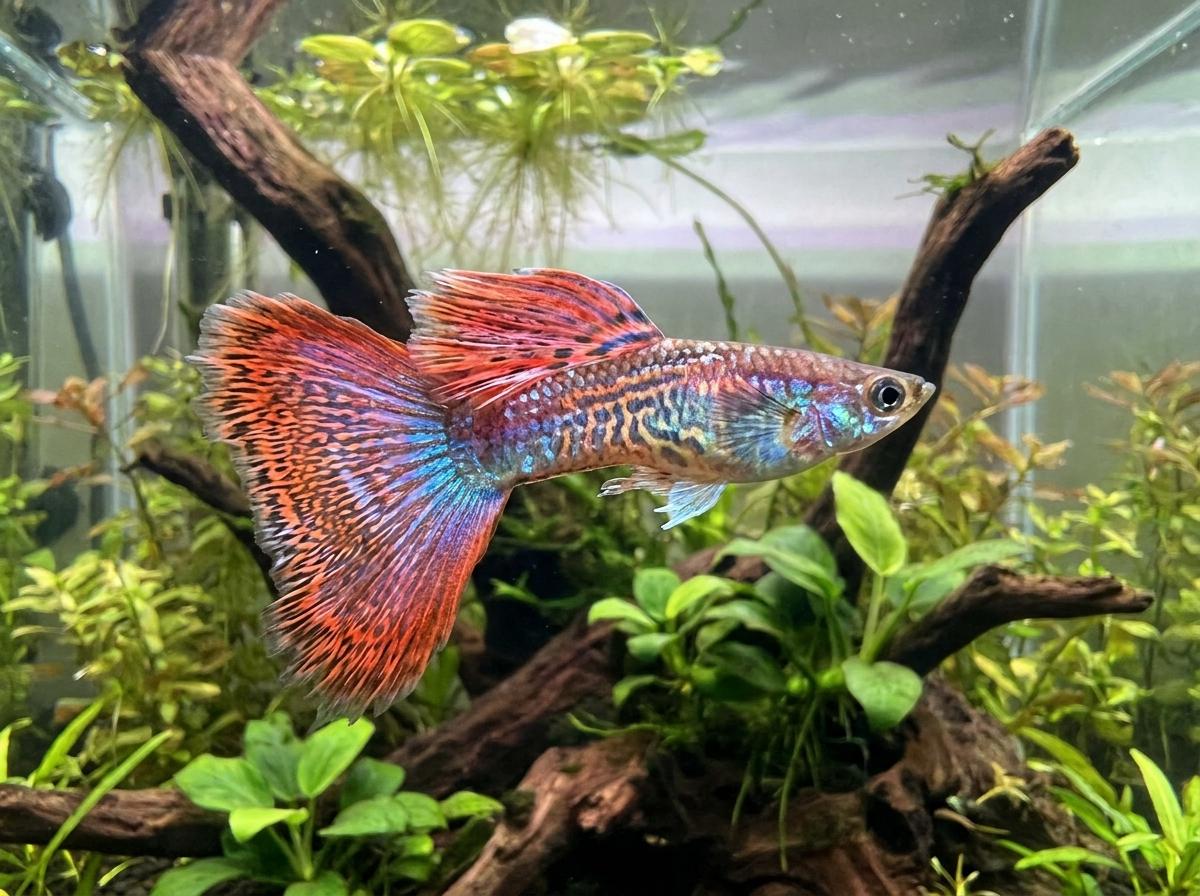
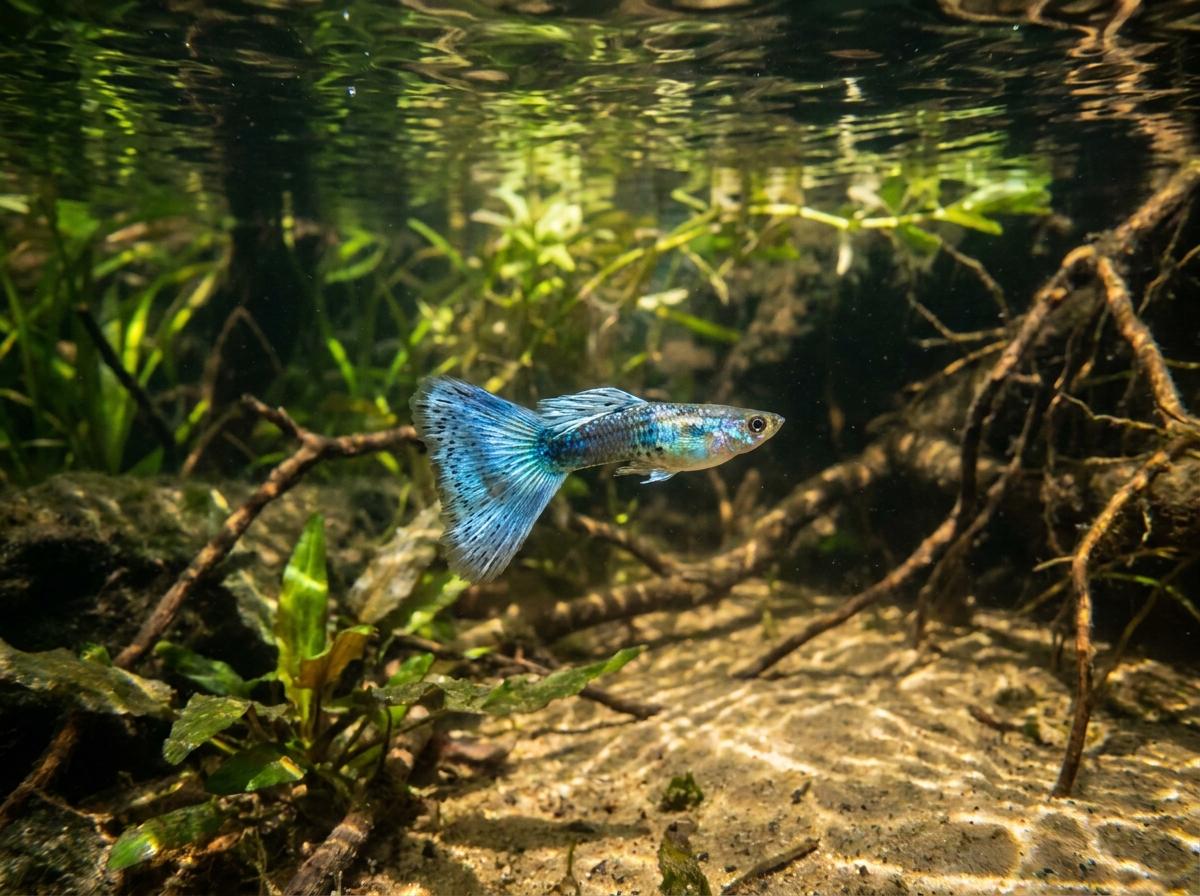
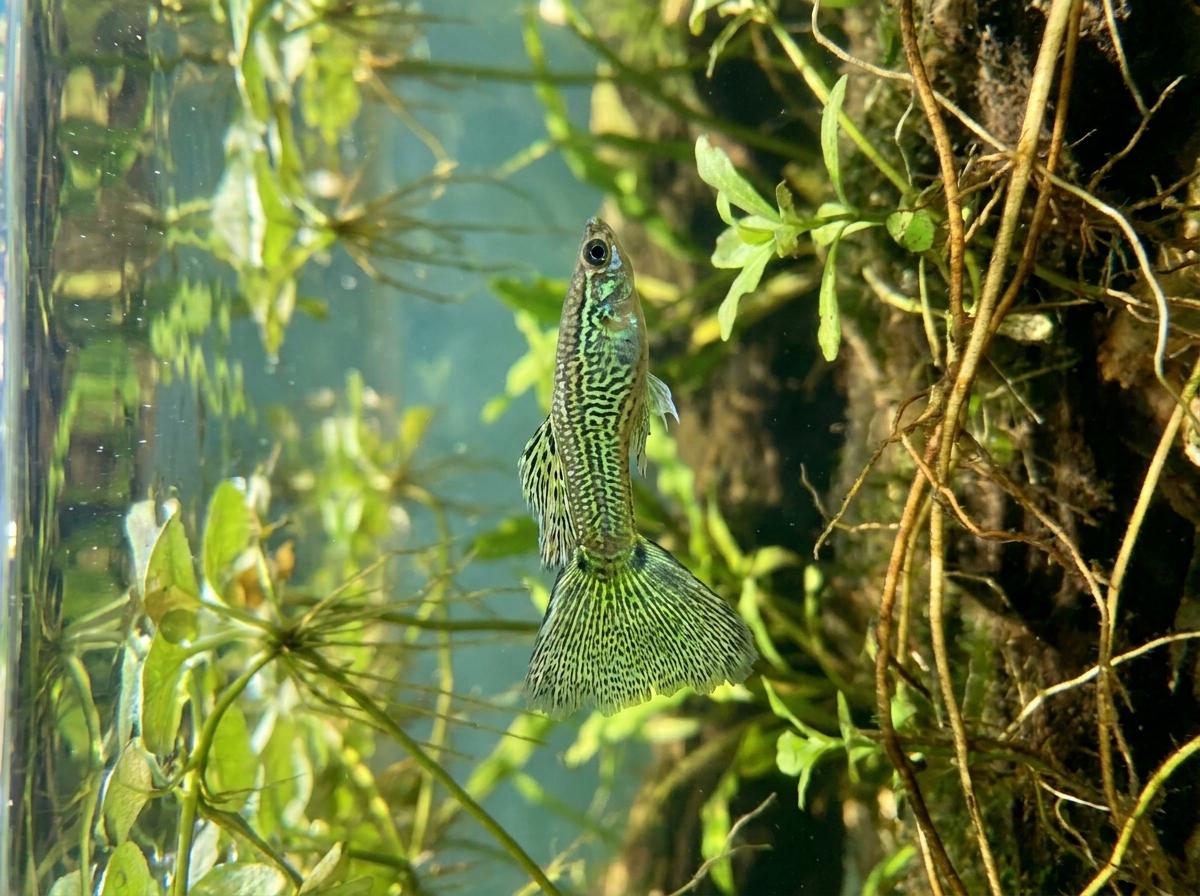
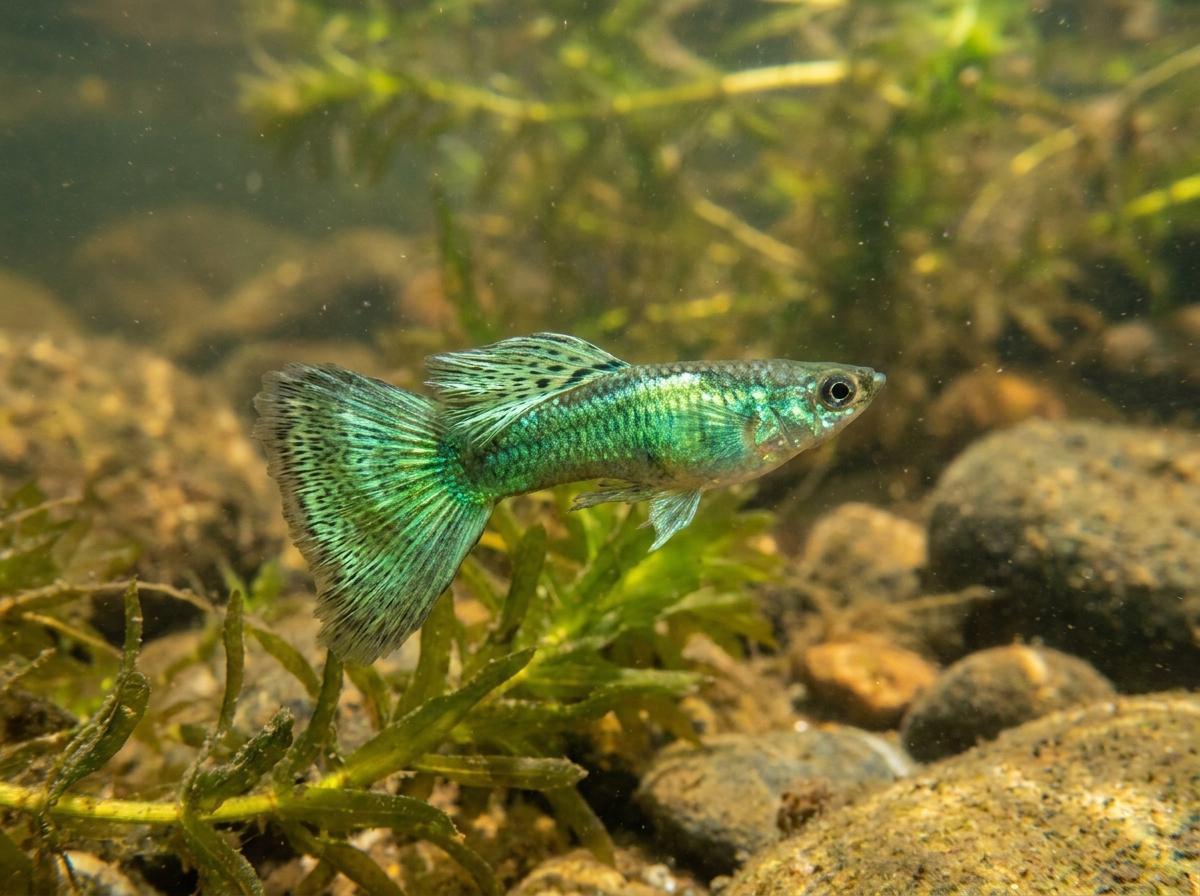
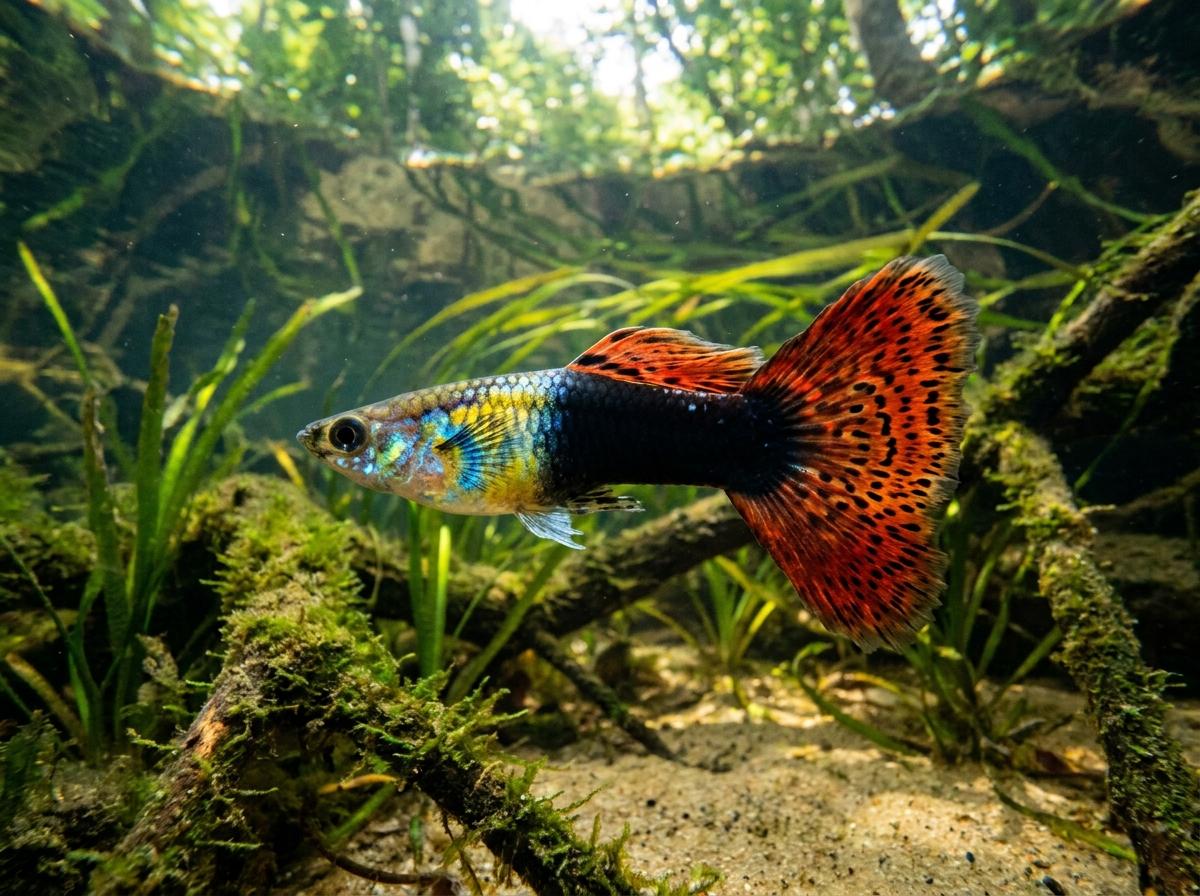
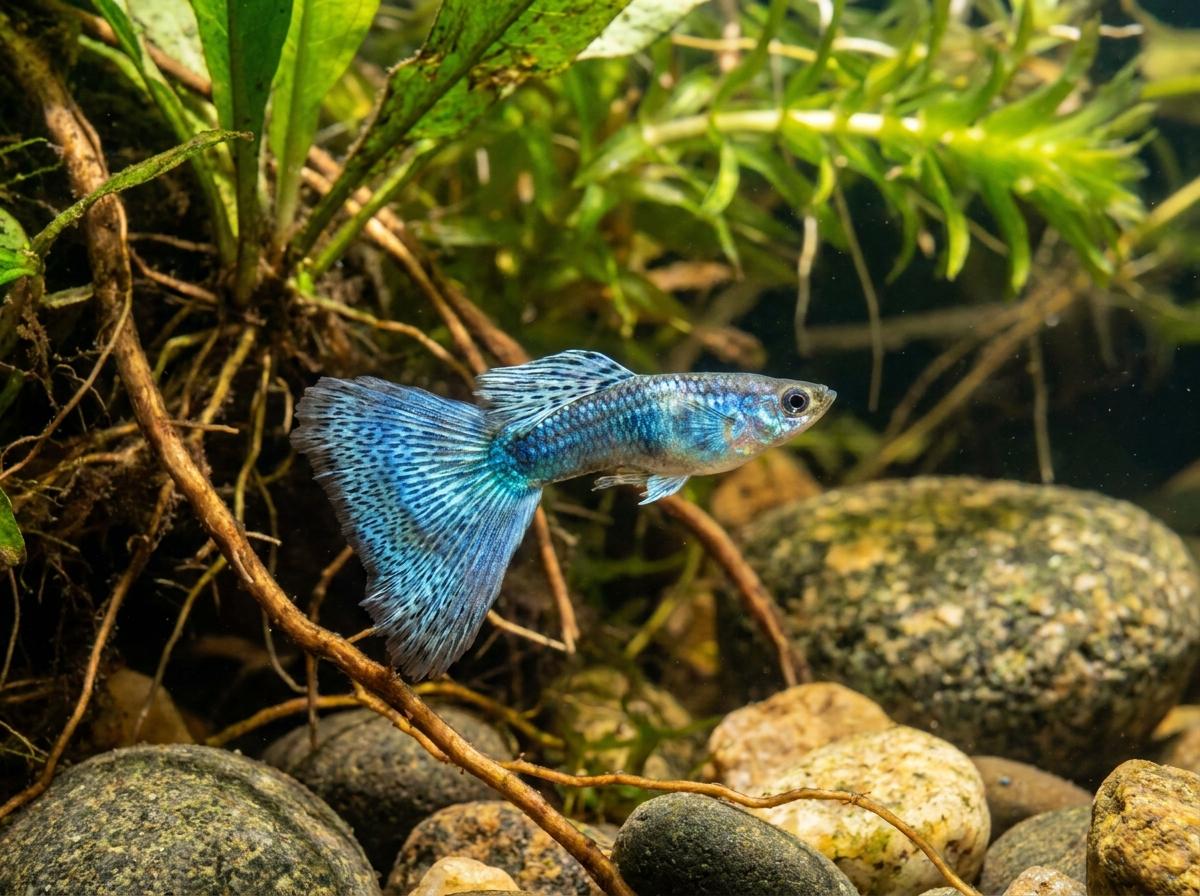
Delta is a tail shape, not a breed. A delta guppy is an ordinary guppy, Poecilia reticulata, whose caudal fin opens into a broad triangle: wide across the trailing edge, straight along the top and bottom, spreading from a narrow tail base like the Greek letter it is named after. Everything else about the fish, its colour, its pattern, its scale type, its size, its behaviour and its care, is described by other words entirely. You can see how the shape sits alongside the colour and pattern names on the Creatures guppy species page, or look at what is currently listed as delta on the marketplace.
That distinction matters more here than it does for most animals, because guppy show classification deliberately crosses two or three independent axes and the pet trade then flattens them back into one list. The World Guppy Contest judging standard classifies an entry by three things in order: caudal fin standard, base colour, and body or tail colour. So a fish is a tail shape and a base colour and a pattern, all at once. A shop listing that says “delta” has told you one of those three.
The second thing worth knowing before you buy is that guppies are relentless breeders and a documented invasive species in a long list of countries, and that fancy show strains are, on the published evidence, less able to fight off parasites than wild stock. None of that is a reason to avoid the fish. It is a reason to set the tank up properly before it arrives, and to have a plan for the fry, because there will be fry.

Browse listings, public profiles, breeders, or add your animal.
What “delta” actually means
The clearest published definition of the shape does not use the word delta at all.
The World Guppy Contest standard, published by the World Guppy Association, calls it a Triangletail and specifies it in one line: the caudal fin should have the shape of a triangle having 70 degrees coming off the peduncle, or more, with edges straight and even and corners that can be slightly rounded. It sets the target tail length at 8/10 of the body length. Search that document for “delta” and you get nothing. The word is not in it.
Delta is the North American show word for the same idea. The International Fancy Guppy Association, which sanctions guppy shows across the United States, runs “Delta Classes” as a named block on its show class sheet. Its full judging book is a members-only document, so the exact angle an IFGA judge works to is not something a reader can look up, and this page will not invent one. What is public is the class structure, and the class structure tells you plenty on its own.
Three things follow from that geometry, and they are the practical reasons the shape is worth naming:
- The triangle is a straight-edged shape. Upper and lower edges run straight from the tail base. A tail with gently curving edges and a concave rear edge is a veiltail under the same standard, and it is a different class.
- The angle is what separates it from a fantail. The same document defines a Fantail as a triangle of 45 degrees off the peduncle. Both are straight-edged triangles. The difference is how wide they open, plus the target length: a fantail is scored against a tail as long as the body, a triangletail against a tail at 8/10 of body length. Hobby usage of “fantail” as a loose synonym for “rounded tail” does not match the standard.
- The tail carries most of the score. In the World Guppy Contest’s 100 point card, caudal shape is worth 20 points and caudal colour another 14. More than a third of the fish’s score rides on the tail alone, which is why show breeders select so hard for it.

Why delta dominates the show bench
The IFGA’s published show class sheet is the plainest evidence of how far the shape has taken over competitive guppy keeping in North America. Deltas get their own column of 25 named colour classes, from Red and Blue and Green through Half Black Pastel, Snakeskin Solid and Snakeskin Variegated, plus Novice and Junior classes, and the same colour list is repeated again for two-male tank entries. Every other tail type in the hobby shares a single column headed “Other Caudals”, which holds five single-fish classes between them: All Color Veil, Single Sword, Double Sword, and a Novice and a Junior class covering veils and swordtails together.
That is not an opinion about which tail is prettiest. It is a count of the classes a North American show actually offers, and it says that when a modern fancy guppy is bred for competition, the default assumption is a delta.
The variety list mixes three different kinds of word
Look at the breed list on the Creatures guppy page and you will find delta sitting next to albino, snakeskin, cobra, half black, moscow, dumbo ear, wild type and koi. Those are not thirty two versions of the same kind of thing. They are names drawn from at least four separate axes, collapsed into one alphabetical list because that is how the trade sells them.
The World Guppy Contest standard keeps them separate on purpose, and once you see the split, guppy listings stop being confusing:
Caudal fin standard is the shape axis. The standard recognises sixteen, sorted into four families: large tails (fantail, triangletail, veiltail, scarftail), sword tails (double swordtail, top swordtail, bottom swordtail, lyretail), short tails (cofertail, speartail, roundtail, pintail) and extended fins (ribbon, swallow, hi-fin, sailfin). Delta lives here, and so does the round tail, whose standard is a circle with a diameter of 5/10 of the body length. Two shapes, one species.
Base colour is the genetic background axis: grey (the dominant wild background), gold, blond, blau, pink, albino, white, silver, cream and lutino, each defined by which pigment is reduced or missing. This is a statement about the fish’s genetics, not about its tail.
Body and tail colour, the third axis, is where most trade names live: red, blue, green, snakeskin and filigran, half black, moscow, japan blue, grass, neon, metallic and so on. The standard allows up to two of these to be combined in naming an entry, which is exactly why so many shop listings read like a string of adjectives.
Fin extensions are a fourth axis in practice. Ribbon and swallow are defined as elongations of the pectoral, ventral and anal fins, or of the caudal, applied on top of whichever tail standard the fish already belongs to. The standard spells this out: for triangles you may have triangle ribbons, triangle hi-fin ribbons and triangle sailfin ribbons.
So a “red delta” is a body and tail colour plus a tail shape. A “half black snakeskin delta” is two patterns plus a tail shape. An “albino red delta” adds the base colour. Every one of those is a real description, and none of them is a breed.
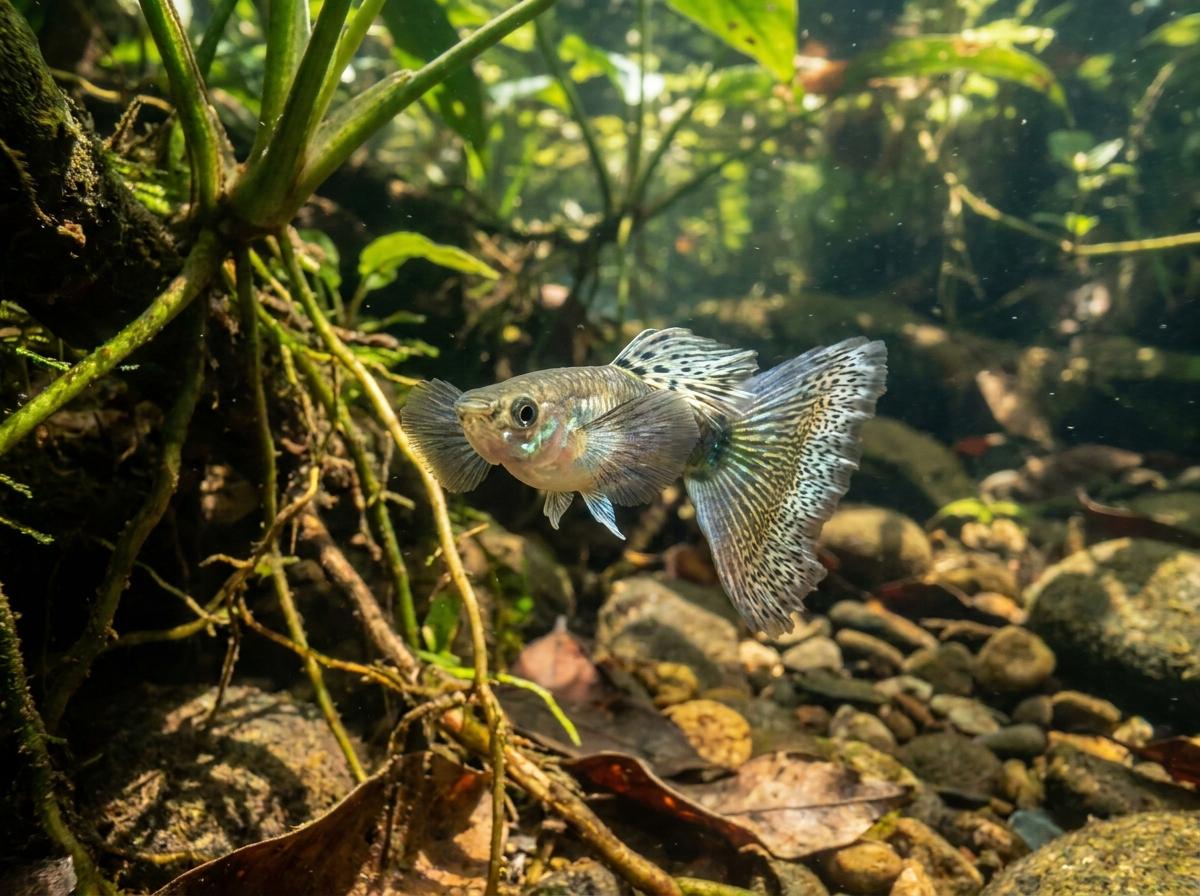
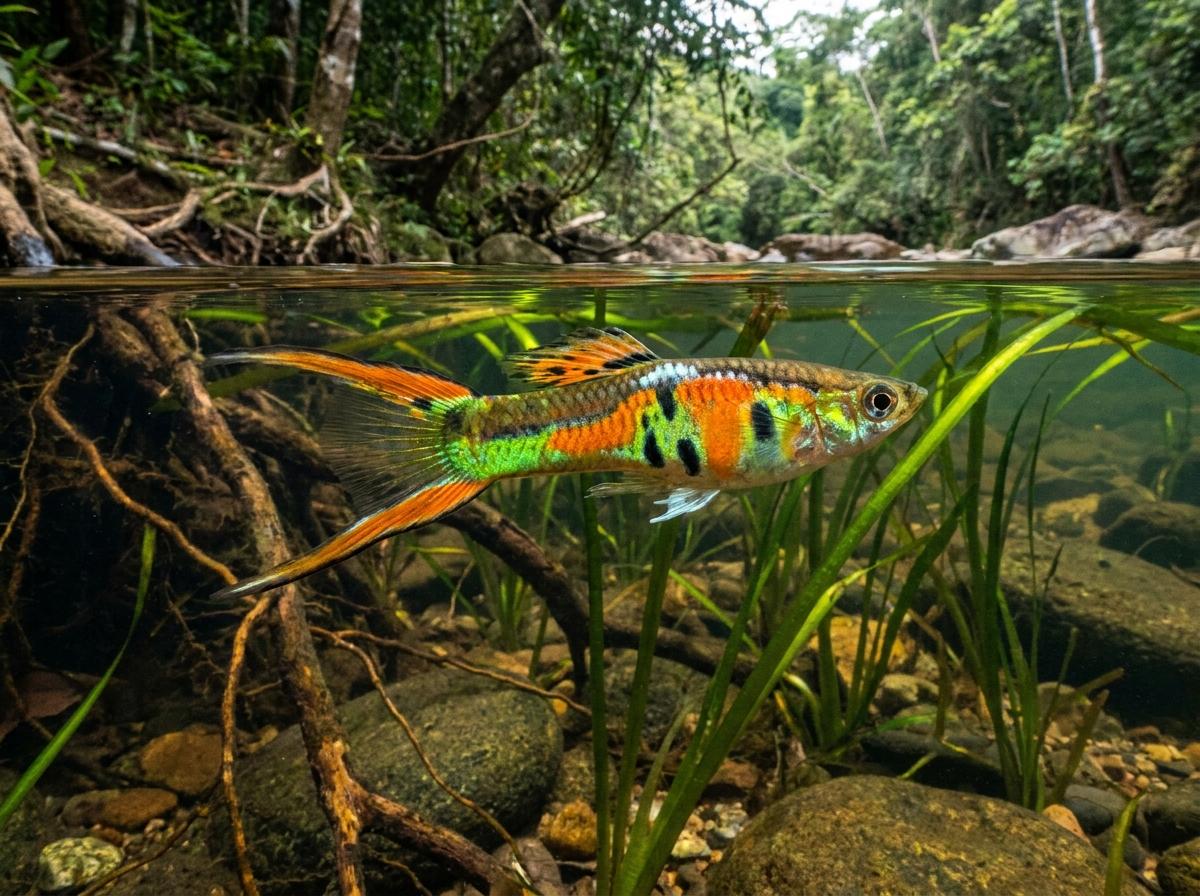
Two things on that list deserve a flag. Wild type is not a variety in the same sense at all: it is the unselected starting point, the grey background the standard treats as dominant, and wild males are far smaller and more modestly finned than any show delta. And Endler’s livebearer, which appears on many guppy variety lists, is usually treated as a separate species whose status has been argued over in the literature; the two interbreed readily, which is part of why the argument continues. Neither is a tail shape, and neither belongs in a sentence that starts “delta versus”.
If you want to watch the same confusion play out in a different species, the super delta betta page covers a fin shape sold as though it were a variety, and the Cambodian betta page covers the colour pattern equivalent. The pattern repeats across every ornamental fish that has a show standard behind it.
The fish underneath the tail
Whatever the tail looks like, you are buying Poecilia reticulata, a small livebearing fish from the family Poeciliidae. The US Geological Survey’s species profile gives the native range as the southern Lesser Antilles and northern South America from western Venezuela to Guyana. Older names still turn up on labels, including Lebistes reticulatus, and the US Fish and Wildlife Service ecological risk screening summary lists a string of trade names for it, among them “millions fish”, which will make more sense by the end of the breeding section below.
The sexes are easy to tell apart and it is worth doing before you buy, because it determines what happens in your tank three weeks later. Males are the small, colourful, heavily finned sex, roughly 2.5 to 3.5 cm in standard length, and their anal fin is modified into a slender rod, the gonopodium, used for internal fertilisation. Females are larger, deeper bodied and plain, from about 4 to 6 cm, with a normal rounded anal fin. University of Florida extension describes livebearers as the foundation species of Florida’s tropical fish industry and notes that mating is promiscuous, so a female may carry the sperm of several males.
The show fish is a long way from the wild fish. Guppies have been bred ornamentally since the early twentieth century, and modern strains have been selected for well over a hundred generations. That history is the reason a delta male’s tail can be wider across than his whole body is long, and it is also, as the health section below explains, the reason his immune system is not what a wild guppy’s is.
What a delta guppy actually needs
The tail shape changes nothing about husbandry. A delta needs what any guppy needs, and the reason this section runs long is that guppies are sold as the beginner fish that will survive anything, which quietly licenses a lot of bad tanks.

A real tank, planted and cycled
Not a bowl. Not a vase, not an unheated desk cube, not a plant pot with a fish in it. Guppies are a shoaling species that need a group and open water to use, and the fish are the small part of the equation: the tank has to hold enough water to stay chemically and thermally stable, which a bowl cannot do.
Cycling is the step new keepers skip, and it is the one that kills fish. The Merck Veterinary Manual notes that a biofilter in a tropical tank can take up to eight weeks to establish, and describes fishless cycling, adding ammonia to 1 to 5 mg/L and monitoring ammonia, nitrite and nitrate until the tank processes it. The University of Illinois College of Veterinary Medicine puts the practical figure at two to four weeks before a new tank is ready for fish, and recommends daily checks of temperature and dissolved oxygen in a young tank, dropping to weekly monitoring of nitrogenous waste and pH once it is established. Set the tank up first, then buy the fish.
Furnish it properly, because there is direct evidence that it matters. A 2025 study in Frontiers in Fish Science by Manenti and colleagues compared guppies in 60 litre tanks with no enrichment, with substrate and wood, and with substrate, wood and two ornamental plants, at 24 degrees Celsius and one fish per three litres of water. The high enrichment groups showed significantly more of the behaviours the authors treat as good welfare indicators, including feeding from the wood, the surface and the plants, and significantly more courting. They also showed less hiding, which the authors treat as a stress behaviour, and water cortisol was significantly higher in the low enrichment tanks. Plants and cover are not decoration in this species.
Heat, and an actual heater
Guppies are tropical. The species tolerance data compiled in the federal screening summary is blunt about the floor: P. reticulata cannot tolerate water below 15 degrees Celsius, and in temperate regions it is found only in artificially warmed water. That is a survival limit, not a target.
For a working range, the IFGA’s own basic care page gives 75 to 82 degrees Fahrenheit, about 24 to 28 Celsius. The welfare study above ran at 24 degrees and describes 22 to 26 as the optimal range. Anywhere in that band is defensible. What is not defensible is leaving it to the room, because an unheated tank tracks the house temperature and puts the fish through a swing every day and night. Buy a heater sized for the tank, and a separate thermometer so you can see when the heater lies to you.
Water chemistry, and why stability beats numbers
Guppies are associated with neutral to slightly alkaline, moderately hard water. The reference values compiled in the federal screening summary give a pH range of 7.0 to 8.0 and a hardness range of 9 to 19 dH, while noting that the species can live and breed across a far wider band, roughly pH 5 to 9.
The IFGA care page is the more useful guidance for a keeper: hardness and pH are not critical as long as they do not suddenly vary over a wide range, and guppies handle anything from 6.5 to 7.8. Chasing a number with chemicals causes more losses than the number ever did. One thing worth watching is alkalinity, since Merck notes that total alkalinity at or below 50 mg/L of calcium carbonate inhibits normal biofilter function and recommends buffering to at least 100 mg/L. Very soft tap water can therefore stall a cycle.
Change water regularly. Show breeders run this hard: the IFGA describes weekly changes of 30 to 40 percent, with some breeders on automatic daily systems. A home tank does not need a show schedule, but it does need a routine you actually keep, and tap water needs treating for chlorine and chloramine before it goes in.
Filtration and flow
Filter the tank, and keep the current gentle. A sponge filter is the standard answer for a guppy tank for two reasons that have nothing to do with fashion: it produces broad, slow flow rather than a jet, and its foam surface cannot draw fry into an impeller. Keepers of heavily finned show males commonly report that they struggle in strong flow, which is consistent with what those fins are, though we are not aware of a controlled study on guppy fin size and swimming in aquarium currents, so treat that as practice rather than proof.
Feeding
Guppies are omnivores with a real plant component. Compiled dietary data for the species describes algae making up roughly half the wild diet, alongside invertebrate larvae and benthic detritus, and the University of Florida extension summary lists poeciliid food as algae, insects and crustaceans. A good tank diet is a quality flake or micro pellet as the base, with some vegetable content, plus small frozen or live foods such as daphnia or newly hatched brine shrimp a few times a week.
Feed small amounts. Overfeeding is a water quality problem before it is a nutrition problem, and the Illinois veterinary guidance flags it directly. The IFGA’s show breeding regime of six to eight small feeds a day exists to grow competition fish fast and comes paired with heavy water changes; it is not a template for a display tank.
The group, and the sex ratio
Never keep one guppy alone, and think carefully before keeping a mixed group at even numbers.
The reason is male behaviour. The compiled species biology in the federal screening summary describes males as continuously chasing and mating females. That is not a figure of speech: a comparative study of six poeciliid species published in Frontiers in Psychology and available on PubMed Central records male sexual activity in this family reaching one sexual act per minute, and notes that intense male sexual activity costs females in conspicuousness to predators, foraging efficiency and offspring fitness. Work on guppies specifically, published in Functional Ecology by Killen and colleagues, describes females in some populations receiving more than one coercive mating attempt per minute, lists increased energy expenditure, reduced foraging and increased predation risk among the costs, and found that females from high harassment conditions were nearly twice as active and performed more than twice as many burst swimming movements per minute as females from low harassment conditions.
In a tank, all of that pressure lands on however many females are present. The two usual answers among keepers are to keep clearly more females than males, so no single female absorbs it, or to keep a single sex group and avoid the problem. Both are sound. We are not aware of a controlled study establishing an optimal aquarium ratio, so treat the specific numbers you see quoted online as convention rather than evidence, and judge by the fish: a female who is being driven off food, hanging in a corner or hiding constantly is telling you the ratio or the cover is wrong.
Cover helps either way, because it lets a female break line of sight. This is one of the places where the planting from the enrichment study earns its keep twice over.
They breed constantly, whether you planned it or not
This is the part that turns a tidy tank into a management problem, and it is the single most common reason a new guppy keeper ends up with more fish than they can house.
The numbers, from the biology compiled in the federal screening summary: after a gestation of four to six weeks a female gives birth to 20 to 40 live young, she may produce young every four weeks, and she can store sperm for later fertilisation. There is no parental care, and parents may prey on their own young. Females mature at about three months and males at about two, so a spring brood is breeding by midsummer. Reference data compiled for the species has females continuing to reproduce to 20 to 34 months old with no significant reproductive senescence.
Three consequences follow, and they are all worth deciding on before the fish arrive:
- A single female may already be pregnant when you buy her. Sperm storage means a female bought from a mixed shop tank can drop broods for months with no male in your tank at all. This is not a failure of the shop; it is how the species works.
- A mixed tank compounds. Twenty to forty fry a month per female, maturing in two to three months, is a geometric curve. The old trade name for the species, “millions fish”, was not marketing.
- You need a plan before you need it. The workable options are a single sex group, a heavily planted community tank where predation thins the fry naturally, or grow out space plus a real outlet: a local aquarium society, a shop that takes stock, or another keeper. Working out which one you are doing while standing over a tank of eighty juveniles is the wrong time.

Never release a surplus guppy
Whatever you do with extra fish, do not put them in a pond, a creek, a ditch, a storm drain or a canal, anywhere, ever. This is not a general environmental sentiment. It is specific to this species, and it is well documented.
The USGS species profile records the guppy as locally established in warm water sites in Hawaii, Idaho, New Mexico, Nevada, Texas and Wyoming, and reported from several more states, with most introductions attributed to fish farm or aquarium releases and some deliberate releases for mosquito control. The recorded impacts are not hypothetical: the guppy is considered a threat to native cyprinids and killifishes, it adversely affected the White River springfish, Crenichthys baileyi, in a Nevada spring (two subspecies of that fish are now federally endangered), it has been implicated in the decline of the Utah sucker in a thermal spring in Wyoming, it is a known carrier of exotic trematode parasites, and introduced poeciliids including guppies have been implicated in the decline of native damselflies on Oahu through predation on the insects. The Fish and Wildlife Service screening summary puts the overall risk category at high, scoring both the species’ history of invasiveness and its climate match to the contiguous United States as high, with medium certainty.
The invasive record also includes a detail that ought to land for anyone who has read the sex ratio section above. Work cited in that screening summary found that male guppies in Mexican waters courted and attempted forced copulations with females of Skiffia bilineata, an endangered native goodeid, even when females of their own species were in excess, placing an additional burden on fish already at risk of extinction.
Cold winters are not a safeguard either. The species persists in temperate regions in artificially warmed water, which is why established populations turn up in thermal springs, power station outflows and warm effluent channels a long way outside the tropics.
Health: fancy strains are not the hardier fish
Guppies have a reputation as bulletproof beginner fish. That reputation was earned by a different fish from the one in most shops today, and there is published evidence for the difference.
A study by Smallbone, Ellison, Poulton, van Oosterhout and Cable, published in Molecular Ecology in 2020 and available on PubMed Central, compared ornamental guppies against descendants of wild caught fish. The ornamental fish had significantly fewer MHC alleles per individual, had lost three of thirteen immune supertypes, and were significantly more susceptible to the skin parasite Gyrodactylus turnbulli, accumulating peak infection intensities ten times higher than their wild type counterparts. The authors attribute it to selective breeding over more than a hundred generations combined with reduced parasite exposure in captivity, eroding immune diversity through artificial selection, drift and inbreeding.
That does not mean a fancy delta is a fragile animal. It means the safety margin is thinner than the species’ reputation suggests, and that the husbandry above is doing real work rather than being optional polish.
The disease list compiled for the species in the federal screening summary is the familiar aquarium set: fin rot, columnaris, white spot, fish tuberculosis, Tetrahymena, skin flukes including two Gyrodactylus species recorded from aquarium guppies, and Camallanus nematodes, which have travelled internationally with the ornamental trade. Most of these track back to water quality, temperature and stress rather than bad luck.
Two practical habits cover most of the risk. Quarantine every new fish: Merck gives 30 days as the minimum, longer if needed, and the Illinois column emphasises the same thing. And write things down, because in a small short lived fish the record is the only thing that will tell you whether this is the third outbreak in six months or the first. Medical decisions belong to a veterinarian, ideally one who sees fish, and the Illinois guidance says plainly that internet advice can make a sick fish worse.
Buying a delta guppy
- Look at the tail before you look at the colour. A delta should read as a broad triangle with straight upper and lower edges. If the edges curve and the rear edge is concave, you are looking at a veiltail. If it opens narrowly, it is closer to a fantail under the world standard. Sellers use the words loosely.
- Look at how the stock is being kept. Heated, filtered, planted holding tanks tell you something a photograph cannot. Unheated jars on a shelf tell you something too.
- Check the fins for damage, not just shape. Look for intact, unbroken edges, no ragged margins, no white cottony patches, no clamping. A heavily finned male takes weeks to regrow damage, and torn fins in a shop tank usually mean crowding or aggressive tankmates.
- Ask about the females. If you are buying a mixed group, assume any female is already carrying. Ask what the seller’s ratio was, and how many fish were in the tank.
- Ask what the line is. A named colour strain bred in a closed line has different expectations from mixed shop stock. Neither is wrong, but only one of them will breed true, and paying strain prices for the other is a common way to be disappointed.
- Record what you bought. Tail shape, colour strain, seller, arrival date, water parameters, quarantine dates and any treatment. Guppies are cheap enough that nobody keeps paperwork, which is exactly why nobody can answer basic questions about their own line two years later.
You can browse delta guppies on the Creatures marketplace and look for trusted breeders and shops in the Creatures breeder directory.
Frequently asked questions
Is a delta guppy a different species from a normal guppy?
No. It is Poecilia reticulata, the same species as every other domestic guppy. Delta names the shape of the tail, a broad triangle spreading from a narrow tail base.
What is the difference between a delta and a fantail guppy?
Under the World Guppy Contest standard both are straight-edged triangles and the difference is how far they open and how long they are. A fantail is specified as a triangle of 45 degrees off the peduncle with a target length equal to the body; a triangletail, the standard’s name for the delta, is 70 degrees or more with a target length of 8/10 of the body. In shop usage the words are often swapped, so judge the fish rather than the label.
What is the difference between a delta and a veiltail?
Edge shape. A delta has straight upper and lower edges. A veiltail is defined by gently curving upper and lower edges and a concave rear edge, highest at three quarters of its length.
Are delta guppies harder to keep than other guppies?
The tail shape itself does not change care. What can matter is that heavily finned males are more vulnerable to fin damage from strong flow, sharp decor and nipping tankmates, so gentle filtration and smooth furnishings earn their place.
How many delta guppies should I keep together?
More than one, always, since this is a shoaling fish. Beyond that the important decision is not the total but the mix: keep clearly more females than males, or a single sex group, because males chase females continuously and that harassment carries measurable costs.
Will my guppies breed if I only buy females?
Very possibly, for months. Females store sperm from earlier matings, so a female from a mixed tank can keep producing broods with no male present.
What do I do with all the fry?
Decide before you have them. A single sex group avoids the question entirely. In a mixed tank, plan for grow out space and a real outlet such as a local aquarium society, a shop or another keeper. Never release surplus fish into any waterway: the guppy is an established invasive species with documented impacts on native fish and insects.
Are guppies good beginner fish?
They are forgiving of small mistakes and they do not need a large or complicated tank, which is a fair reason to recommend them. They are not forgiving of an uncycled tank, no heater, or a bowl, and published work shows ornamental strains are markedly more susceptible to parasites than wild type fish, so the old “they survive anything” framing is out of date.
Do this next on Creatures
Whether you are working out what a listing actually means, hunting for a specific line, or already keeping a tank of them, Creatures is the records, marketplace and directory layer to do it in one place.
Read across the axes. Start from the guppy species page, then compare a different tail shape on the round tail page, a pattern on the snakeskin page and a base colour on the albino page. The same split runs through other show fish, including the super delta betta.
Find a fish. Browse delta guppies on the marketplace and search trusted breeders and shops in the Creatures directory. New to the marketplace? See saving searches and using your watchlist.
Get alerted. Named guppy lines appear and sell fast, so set a free delta guppy listing alert and we will tell you when one is posted. No account needed to start.
Add your fish. Already keeping them? Create a free animal profile in a few minutes, no account needed to start. The walkthrough is in adding an animal to Creatures.
Track water, broods and treatments. Add a record for a water test, a quarantine date, a brood or a treatment. The record sheet opens for any visitor to look around, and a free account saves what you enter. See adding a record and health and medical records for the how-to, then use reminders and upcoming care to put the next water change on a schedule.
List your fishroom. Breeding guppies or running a shop? Create an organization profile, no account needed to start, then read getting listed in the breeder directory so buyers looking for a specific line can find you.