Blanc de Hotot
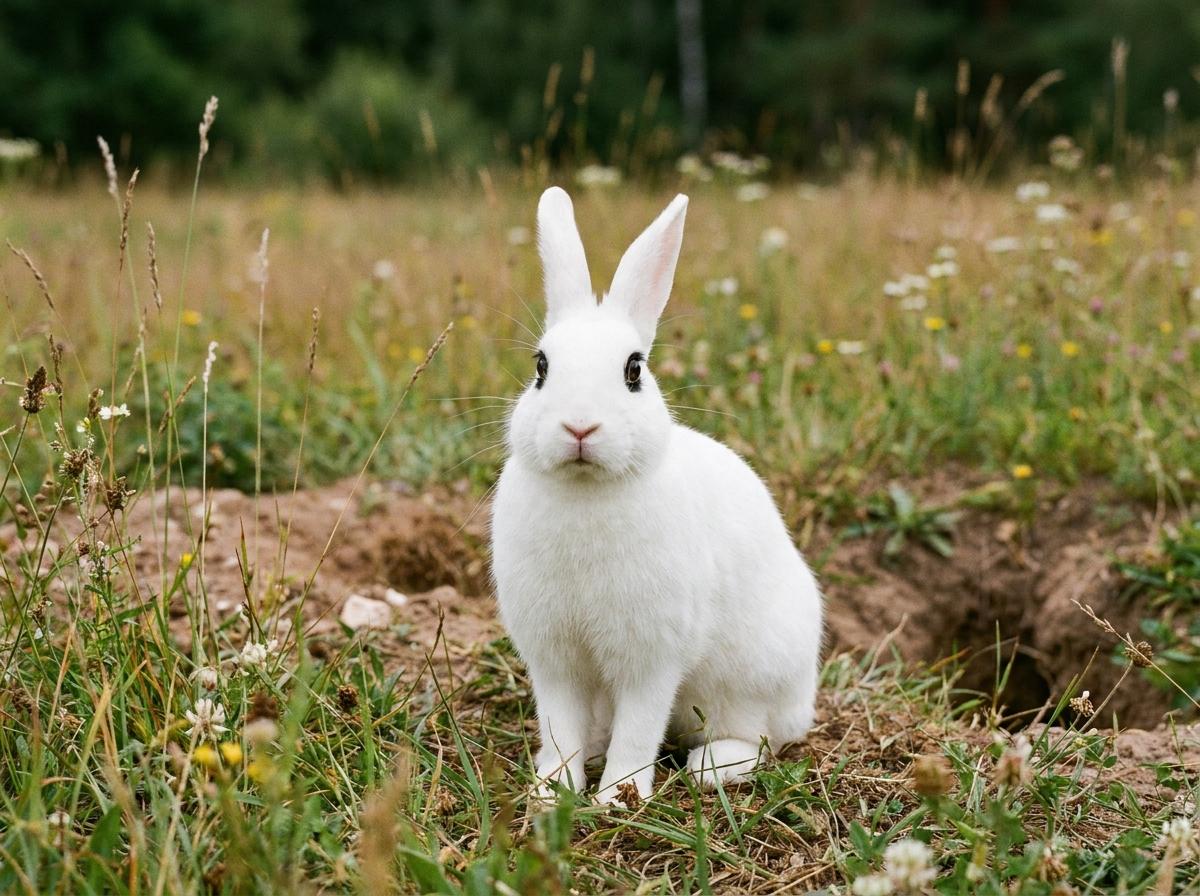
The Blanc de Hotot is a large, pure-white rabbit whose one defining feature is a narrow band of black fur around each eye, giving it the look of a rabbit wearing fine eyeliner or a pair of spectacles. It was developed in Normandy, France, in the early 1900s as a dual-purpose meat and fur breed, and today it is a rare heritage rabbit that the American Rabbit Breeders Association recognizes and that conservation groups track closely. If you have found this page because you saw a striking white rabbit with black-rimmed eyes and wanted to know what it is, this is the breed. Below you will find what the Blanc de Hotot is, where it came from, exactly what those eye bands should look like, how it differs from the much smaller Dwarf Hotot it is often confused with, how to care for one, what its size and lifespan really are, and what to check before you buy.

Browse listings, public profiles, breeders, or add your animal.
What is a Blanc de Hotot rabbit?
The Blanc de Hotot is a medium-to-large domestic rabbit with a solid white coat and a single dramatic marking: a thin ring of black fur around each eye. The American Rabbit Breeders Association (ARBA), the governing body for the breed’s standard in the United States, describes it simply as a white rabbit distinguished by black eye bands. The name is French and translates roughly to “white of Hotot,” after the Normandy village of Hotot-en-Auge where the breed was created.
It is a commercial-type rabbit, meaning a broad, deep, well-muscled body rather than a slender racy one, and it was developed as a working farm animal for meat and fur. What sets its coat apart is an abundance of guard hairs (the longer, coarser outer hairs of the coat) over the white undercoat, which The Livestock Conservancy notes gives the fur a distinctive frosty sheen and helped make the pelt valued historically. If you are weighing the Blanc de Hotot against other rabbits, the broader Creatures rabbit species page is a good place to compare it with other breeds side by side.
Two things are worth clearing up right away. First, the black around the eyes is a band of dark fur, not a health problem or a coincidence of albinism; the eyes themselves are dark brown, not the pink or ruby eyes of a true albino white rabbit. Second, the Blanc de Hotot is a full-size rabbit. It is regularly confused with the tiny Dwarf Hotot, a separate and much smaller breed we cover in detail below.
Origin and history
The breed was created in Hotot-en-Auge in the Calvados region of Normandy, in northern France near the port of Le Havre. It is credited to Eugenie Bernhard, and according to The Livestock Conservancy she is recognized as only the second woman ever credited with developing a rabbit breed. Her goal was a practical animal: a large white rabbit with dark eyes that would serve for both meat and fur, and would stand out at market.
Bernhard began the project around 1902. Historical accounts, including The Livestock Conservancy and the Hotot Rabbit Breeders International club, describe her crossing large marked and white breeds of the day, among them the Checkered Giant (Papillon), the White Vienna, and the white Flemish Giant, then selecting relentlessly for animals that were white except for the eye bands. The eye markings proved the hardest trait to reduce and stabilize. After a breeding program said to run to more than 500 crosses, she had fixed the modern look by about 1912, keeping only the lightly marked animals that carried the clean bands and little else.
The breed made its public debut in 1920 at the Exposition Internationale d’Aviculture in Paris and was officially recognized in France on October 13, 1922. It then went through a precarious century. The Blanc de Hotot was nearly lost during the upheaval of the World Wars, and its survival depended heavily on breeders in Switzerland and Germany who maintained the breed when it had thinned out elsewhere. Early animals had reached the United States in the 1920s but did not persist there.
The breed’s modern American history starts in 1978, when Bob Whitman of Texas imported Blanc de Hotots from France. The Hotot Rabbit Breeders International club records the first American litter arriving that July, and ARBA admitted the breed to its Standard of Perfection on March 5, 1979, with the national specialty club chartered soon after. That is the lineage behind essentially all the Blanc de Hotots shown in North America today, which is part of why the breed remains uncommon.
What a Blanc de Hotot looks like

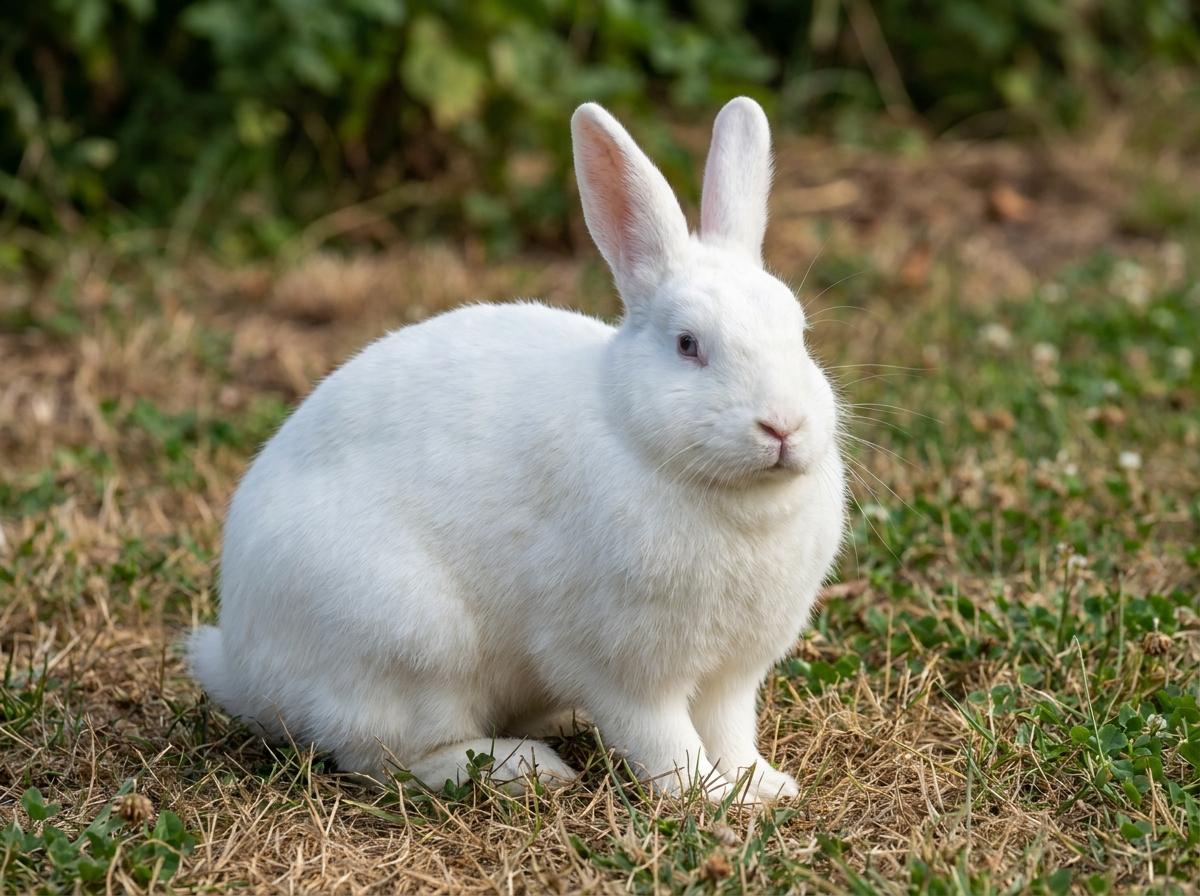
Picture a solid, rounded, all-white rabbit with a broad body, then add a neat black outline around each dark eye and nothing else. That is the Blanc de Hotot. The coat is pure white from nose to tail, with no colored patches on the ears, nose, feet, or body. Any color anywhere other than the eye bands is a fault against the standard, and stray spots of color are one of the things breeders work hardest to breed out.
The body is the commercial type: a wide chest, well-filled and muscular hindquarters, and a substantial frame that reflects the breed’s meat-and-fur origins. The ears are medium length and carried upright. The fur carries a heavy complement of guard hairs, which is what produces the “frosty” or glossy quality that distinguishes a good Hotot coat from a plain white one.
The eye bands and the “spectacle” standard
The eye band is the whole point of the breed, and the standard for it is precise. ARBA calls for a band of black that is narrow and even, not more than about one eighth of an inch wide. Breed references describe the ideal as fine “spectacles,” a clean, sharply defined ring rather than a smudge or a large black patch. European standards hold to a similarly narrow band of only a few millimeters.
That precision is exactly why the breed is difficult to raise well. A band that is too wide, broken, incomplete, smudged into the surrounding fur, or accompanied by any other stray colored hairs will lose points on the show table or disqualify an animal from competition. Genetically the marking sits between a fully marked rabbit and a fully white one, so litters can throw kits that are too heavily marked, too lightly marked, or spotted elsewhere. Producing a rabbit with two clean, matched, correctly sized bands and an otherwise flawless white coat takes careful pairing and a lot of selection, which is a large part of the breed’s mystique among rabbit fanciers.
Blanc de Hotot vs Dwarf Hotot: not the same rabbit
This is the most common point of confusion, so it is worth being clear. The Dwarf Hotot is a separate ARBA breed, not simply a small Blanc de Hotot. It shares the signature white coat with black eye bands, but it is a true dwarf, typically around 2.5 to 3.5 pounds, a fraction of the Blanc de Hotot’s 8 to 11 pounds.
The two breeds also have different histories. The Dwarf Hotot was developed in Germany in the 1970s, when breeders working independently in East and West Germany produced a dwarf version, in at least one case by crossing a Netherland Dwarf with a Blanc de Hotot and in another by starting from entirely different stock and breeding out all markings except the eye bands. ARBA recognized the Dwarf Hotot in 1983, some years after the full-size Blanc de Hotot. So the short version is: if the rabbit is a compact, big-headed, palm-sized pet, it is almost certainly a Dwarf Hotot; if it is a large, broad, farm-scale rabbit, it is a Blanc de Hotot. This pillar is about the large breed.
Temperament
Keepers and breed references generally describe the Blanc de Hotot as docile, active, and friendly, an even-tempered rabbit that handles well when it is used to people. We flag this as the consistent practitioner and breed-club description rather than a formally studied trait, because rabbit temperament varies a great deal with the individual animal, how it was raised, and how much gentle handling it gets. As with any rabbit, a calm animal that has been socialized from a young age will be easier to live with than one that has had little human contact.
A few general rabbit truths apply here too. Rabbits are prey animals, so most dislike being picked up and restrained even when they are affectionate on the ground, and they can kick hard enough to injure their own spine if handled carelessly. A larger rabbit like the Blanc de Hotot needs to be supported properly with both hands, never lifted by the ears or scruff alone. Given that, many owners find the breed a rewarding, interactive companion.
Care and husbandry

A Blanc de Hotot has the same core needs as any domestic rabbit, scaled up for its size. None of the basics are exotic, but rabbits are more fragile than they look, and small mistakes in diet or temperature cause most of the serious problems.
Housing and space
This is a large rabbit and it needs room. A commercial-type Hotot should have an enclosure big enough to make several full hops, stand fully upright on its hind legs, and stretch out flat, plus daily time in a larger safe space to exercise. Solid, dry footing and clean bedding matter for a heavy-bodied rabbit, since wire-only floors and damp bedding contribute to sore hocks (pressure sores on the feet), a problem larger rabbits are especially prone to. If your rabbit lives indoors, rabbit-proof any space it can reach, because rabbits chew cords and baseboards.
Diet
Diet is where most rabbit health is won or lost. Veterinary and rescue guidance is consistent: the bulk of a rabbit’s diet, on the order of 80 percent or more, should be unlimited grass hay such as timothy, orchard, or meadow hay. Hay keeps the constantly growing teeth worn down and, just as importantly, keeps the gut moving. A measured amount of plain grass-hay pellets and a daily helping of leafy greens round out the diet, with sugary treats and fruit kept to a minimum. A common pellet guideline is roughly a quarter cup per five pounds of body weight per day for a non-breeding adult, so a large Hotot needs more than a dwarf but still a controlled amount, since overfeeding pellets leads to obesity and digestive trouble. Clean water must always be available.
Health and common problems
The single most important rabbit health concept for a new owner to understand is gastrointestinal stasis, a dangerous slowdown or stoppage of the gut. The University of Illinois College of Veterinary Medicine and the Merck Veterinary Manual both point to a low-fiber diet, along with stress, dehydration, pain, and inactivity, as leading contributors, which is why a hay-based diet is not optional. A rabbit that stops eating or stops passing droppings for more than about 12 hours is a veterinary emergency, not something to wait out.
Rabbits are also highly sensitive to heat. General rabbit-care guidance keeps them in a comfortable range of roughly 60 to 70 degrees Fahrenheit and stresses that they tolerate cold far better than heat; temperatures in the 80s and above can cause fatal heat stroke, so shade, ventilation, and cooling in summer are essential, especially for a densely furred breed. Other routine points include keeping the nails trimmed, watching the teeth for overgrowth or misalignment, and talking to an exotics-experienced veterinarian about whether the RHDV2 vaccine is recommended in your area, since rabbit hemorrhagic disease has spread in parts of North America. Any medical decision, including spaying or neutering, belongs with a rabbit-savvy veterinarian who can examine the animal.
Because the Blanc de Hotot is a breeding and show animal for many owners, keeping clear records of litters, weights, health events, and eye-band quality across generations makes real breeding progress possible. You can keep those records, and the animal’s care history, on its Creatures profile.
Size, weight, and lifespan
By the ARBA standard, Blanc de Hotot bucks weigh 8 to 10 pounds and does weigh 9 to 11 pounds, with 11 pounds as the maximum. That places it firmly in the large end of the medium-to-large range, well above the small pet breeds and the dwarfs, though below the giant breeds like the Flemish Giant that can reach 15 pounds or more.
On lifespan, there is no authoritative breed-specific figure, so treat the commonly cited 7-to-10-year range as the general expectation for a well-cared-for rabbit of this size rather than a promise for the breed. A rabbit’s realized lifespan depends heavily on diet, housing, whether it is spayed or neutered (which removes the high risk of uterine cancer in unspayed does), and access to veterinary care. Rabbits kept as protected companions generally live longer than those kept in production settings.
A rare heritage breed: conservation and availability

The Blanc de Hotot is genuinely rare. The Livestock Conservancy, which monitors endangered livestock and poultry breeds in the United States, lists it in the Watch category on its Conservation Priority List, and the breed has historically sat among the endangered rabbits with a small global population and only a limited number of new US registrations each year. It survived the twentieth century thanks to a handful of dedicated breeders, and its American population still traces back to a small number of imported animals.
For a prospective owner or breeder, that rarity has practical consequences. There is no large, steady supply of Blanc de Hotots the way there is for common pet breeds, so you may have to wait, travel, or join a waiting list to find one, especially show-quality stock with correct eye bands. It also means that keeping and breeding the breed responsibly is itself a small act of conservation, which is part of the appeal for many people who take it on. If you want to compare it against other uncommon or fancy white rabbits, our sister breed pages for the Polish rabbit and the Himalayan rabbit are useful reference points; the Himalayan in particular is another white rabbit whose markings are its defining feature.
Because supply is thin, a saved listing alert (below) is often the most practical way to catch a Blanc de Hotot when one is actually posted, rather than checking repeatedly and missing it.
Buying considerations
If you decide the Blanc de Hotot is the breed for you, buy on evidence and provenance rather than on the first white-with-black-eyes rabbit you find.
- Confirm it is actually a Blanc de Hotot, not a Dwarf Hotot or a mixed white rabbit. Weight is the quick tell: a mature Blanc de Hotot is a large rabbit of 8 to 11 pounds, not a 3-pound dwarf. Ask about the parents and the eye bands.
- Look closely at the eye bands and coat. For a show or breeding animal, you want two clean, even, correctly sized black bands and a coat that is white everywhere else, with no stray colored spots. Ask to see the rabbit in good light.
- Ask for records. With a breed this uncommon, pedigree, litter history, weights, and any health treatments tell you far more than looks alone. A serious breeder will have them.
- Check general health in person. Bright eyes, clean nose and ears, a clean back end, well-worn front teeth that meet correctly, and sound feet free of sores. A rabbit that is not eating or is sitting hunched is a rabbit to walk away from until a vet has seen it.
- Ask about the RHDV2 vaccine and any regional disease concerns, and about whether the animal has been handled and socialized.
You can browse current rabbit listings on the Creatures marketplace and look for trusted breeders in the Creatures directory. Given how scarce genuine stock is, setting a listing alert is usually the smart move.
Frequently asked questions
Why does the Blanc de Hotot have black rings around its eyes?
That black ring is simply a band of dark fur, the trait Eugenie Bernhard selected the breed for. The eyes themselves are dark brown. A correct band is narrow and even, around an eighth of an inch wide, giving the “spectacle” look. It is not a sign of illness and it is not related to albinism.
Is the Blanc de Hotot the same as the Dwarf Hotot?
No. They share the white coat and black eye bands but are separate breeds. The Blanc de Hotot is a large rabbit of 8 to 11 pounds; the Dwarf Hotot is a true dwarf of roughly 2.5 to 3.5 pounds, developed later in Germany and recognized by ARBA in 1983.
How big does a Blanc de Hotot get?
Bucks reach 8 to 10 pounds and does 9 to 11 pounds under the ARBA standard, with 11 pounds the maximum. It is a large, broad, commercial-type rabbit.
Are Blanc de Hotots good pets?
They are generally described as docile and friendly and can make rewarding companions, especially when socialized young and handled gently. They need a large enclosure, a hay-based diet, protection from heat, and an owner comfortable with a big rabbit. Their rarity makes them harder to find than common pet breeds.
How long do Blanc de Hotots live?
There is no breed-specific figure, but a well-kept rabbit of this size commonly lives around 7 to 10 years. Diet, housing, spaying or neutering, and veterinary care all affect that.
Why are Blanc de Hotots so hard to find?
The breed is rare worldwide and nearly disappeared in the twentieth century. The Livestock Conservancy tracks it as an endangered heritage breed, and only a limited number are registered in the US each year, so buyers often join waiting lists.
Do this next on Creatures
Whether you are researching the breed, hunting for genuine stock, or already keeping Blanc de Hotots, Creatures is the records, marketplace, and directory layer to do it in one place.
Compare the breed. See how it stacks up against other rabbits on the Creatures rabbit species page, or read our guides to the Polish rabbit and the Himalayan rabbit for other distinctive small and white breeds.
Find stock. Browse Blanc de Hotot listings on the marketplace and search trusted breeders in the Creatures directory. New to it? See saving searches and using your watchlist.
Get alerted. Genuine Blanc de Hotot stock is scarce, so set a free Blanc de Hotot listing alert and we will tell you when one is posted. No account needed to start.
Add your rabbit. Already keeping one? Create a free animal profile in a few minutes, no account needed to start. The walkthrough is in adding an animal to Creatures, and the profile page tabs shows what each part of the profile does.
Track health and litters. Add a health or breeding record. The record sheet opens for any visitor to look around, and a free account saves what you enter. See adding a record and health and medical records for the full how-to.
Breeding or showing? Run a rabbitry? Add your breeder profile so buyers searching for this hard-to-find breed can reach you, and read getting listed in the breeder directory.
Keeping a heat-sensitive breed with a hay-first diet means staying on top of care, and a reminder helps. See reminders and upcoming care for how to set them up.