

Super Red
The super red is the deep red colour strain of the Asian arowana, Scleropages formosus, and the most important fact about it is legal rather than biological. The species sits on Appendix I of CITES, the treaty’s strictest category, and in the United States it has been listed as endangered under the Endangered Species Act since 1976. Under that listing it is unlawful to import or export the fish, unlawful to sell or offer it for sale in interstate or foreign commerce, and unlawful to ship it across state lines in the course of a commercial activity. No permit category exists for keeping one as an ornamental fish. So if you arrived here asking how to buy a super red arowana in the US, the honest answer is that the routes a buyer would use are closed: importing one is prohibited, and so is selling, offering or commercially shipping one across state lines. This page will not point you at a way around that.

That is not the end of the subject. Asian arowanas are farmed and kept legally across much of Asia and in the European Union, under a permit and certificate system built specifically for this fish. The super red is one of the colour strains listed under the Asian arowana species page on Creatures, alongside the golden and green lines, and the story behind the name is worth knowing: it points at one shrinking wild population in Indonesian Borneo, and the species is regulated because collection for the aquarium trade, habitat change and pollution pushed it into decline.
Below is what the strain is, how to recognise the fish, where the red came from, why it ended up on Appendix I, what lawful ownership actually requires, and what the size and lifespan commitment looks like for anyone who can legally take it on.
Browse listings, public profiles, breeders, or add your animal.
Is it legal to keep a super red arowana?
This is the question the search results around this fish handle worst, so it goes first and in detail. The answer splits cleanly by country, and the two halves have almost nothing to do with each other.
In the United States: no lawful import; interstate and foreign trade are prohibited
Scleropages formosus appears in the federal list of endangered and threatened wildlife at 50 CFR 17.11 under the common name “Bonytongue, Asian”, with the status code E for endangered, the range “Wherever found”, and the listing citation 41 FR 24062, dated 14 June 1976. The US Fish and Wildlife Service maintains a species profile for the Asian bonytongue under the same name.
An endangered listing carries a fixed set of prohibitions at 50 CFR 17.21. Four of them decide this question:
- Import and export. “It is unlawful to import or to export any endangered wildlife.” A shipment merely passing through the United States counts as both an import and an export.
- Sale. “It is unlawful to sell or to offer for sale in interstate or foreign commerce any endangered wildlife.”
- Commercial transport. It is unlawful to deliver, receive, carry, transport or ship endangered wildlife in interstate or foreign commerce in the course of a commercial activity.
- Possession. The possession prohibition at 50 CFR 17.21(d) attaches to endangered wildlife that was taken unlawfully, rather than to possession in itself. That is the distinction the rest of this section turns on.
Permits do exist, but not for this purpose. 50 CFR 17.22 allows the Director to authorise an otherwise prohibited activity “for scientific purposes, for enhancing the propagation or survival, or for the incidental taking of endangered wildlife.” An ornamental fish for a living room is none of those things, and there is no further category that covers it.
Two follow-up questions come up constantly, so here they are answered directly.
Does captive breeding change the answer? No. The listing is on the species, and the import prohibition has no carve-out for farmed stock. There is a separate captive-bred wildlife registration at 50 CFR 17.21(g), and it is worth understanding precisely because it is often misread: it applies to endangered wildlife “that is bred in captivity in the United States”, it requires the purpose of the activity to be enhancing the propagation or survival of the species, and the acts it authorises are take, export, re-import, interstate commerce and sale. Import is not among them. It is not a route for bringing farmed arowanas into the country.
Has the rule changed recently? You will find confident claims online that the US position has softened for farm-bred fish. Check them against the regulation rather than against a seller. The listing at 50 CFR 17.11 and the prohibitions at 50 CFR 17.21 are both published in full on the eCFR, with dates, so a claim that the law has moved is a claim you can verify in about a minute.
The practical consequence is blunt. There is no lawful ornamental-import route into the United States, and federal law prohibits selling or offering the fish in interstate or foreign commerce and shipping it across state lines in the course of a commercial activity. What federal law does not do is make mere possession categorically illegal. Whether a fish already in the country is lawfully held turns on its provenance, on any permits that apply to it, and on state law, which is a separate layer with its own restrictions. Anyone in that position should get the answer in writing from the US Fish and Wildlife Service and their state wildlife agency, rather than from a seller or a forum.
None of that changes the advice on this page: do not set out to acquire one in the United States. We are not going to name sellers, quote US prices, or point you at a marketplace filter for this species, because the routes a buyer would ordinarily use are the routes federal law closes.
If you came here wanting a striking, large-finned aquarium fish and you are in the US, the hobby has unrestricted, well-documented alternatives with real breeding records behind them. Two colour lines with pages on Creatures are a reasonable starting point: the cambodian betta and the super delta betta, both domestic Betta splendens lines with no trade restrictions at all.
Where the fish is legally kept, and what that involves
Outside the United States, Asian arowanas move through a system that CITES built for exactly this situation. Article VII(4) of the Convention provides that Appendix-I specimens bred in captivity for commercial purposes are treated as though they were listed on Appendix II, which allows commercial trade. The mechanism is set out in the US implementing regulation at 50 CFR 23.46, which restates the international rule: a breeding operation is put forward by its own national management authority, the CITES Secretariat verifies and circulates the application, other Parties get 90 days to object, and only once the Secretariat is satisfied does the operation go into the official register with an identification number. Registered operations are monitored and can be removed. Critically, an Appendix-I specimen may not be imported to establish or augment a commercial breeding operation unless it is pre-Convention or itself captive bred, which is what stops a registered farm from quietly restocking from the wild.
That is why a legally traded arowana comes with paperwork rather than a receipt. In practice, lawful ownership in a permitting country means all of the following:
- The fish was bred at a registered operation, not caught. Farms carry a registration number issued through the Secretariat.
- It moved on CITES documents. An export permit from the country of export and, for many destinations, a matching import permit.
- It is individually and permanently marked. In the European Union this is not a courtesy, it is law: Scleropages formosus sits in Annex A of Council Regulation (EC) No 338/97, annotated as a CITES Appendix I species, and Article 66(3) of Commission Regulation (EC) No 865/2006 requires that live vertebrates other than captive-bred birds “be marked by means of a uniquely numbered unalterable microchip transponder conforming to ISO Standards 11784: 1996 (E) and 11785: 1996 (E)”, with alternative unique marks allowed only where a management authority accepts that a transponder is unsuitable. An implanted chip is the norm for this fish.
- Commercial use needs its own certificate. Article 8(1) of Regulation 338/97 prohibits purchase, acquisition for commercial purposes, display to the public for commercial purposes, use for commercial gain, sale, keeping for sale and offering for sale of Annex A specimens. Article 8(3) lets a member state management authority lift that prohibition case by case with a certificate, and captive-born and bred specimens are one of the listed grounds. Article 8(2) also allows member states to prohibit holding Annex A animals outright, so national rules vary and have to be checked locally.
None of that is trivia. The chip number, the permit numbers and the farm identification are the fish’s identity, and losing them can turn a lawfully held animal into an animal you cannot prove is lawful. Keepers who take this seriously record those numbers somewhere durable the day the fish arrives.
What “super red” actually means
“Super red” is a strain name, not a species name and not a formal breed standard. It refers to Asian arowanas whose flanks, gill covers and fins develop deep red rather than the green, silver or golden colouring of the other strains.

The name was attached to a specific wild population. When Laurent Pouyaud, Sudarto and Guy Teugels described the red form in Cybium in 2003, they wrote that it “is known as the Super Red arowana in the aquarium trade” and also as the chili or blood Indonesian arowana. Their holotype was a 620 mm male cultured in Bogor, West Java, “originating from the area of the Sentarum Lake (West Borneo, Indonesia)”, and their paratypes came from a farm at Semitau on the same lake system, one generation removed from wild broodstock, plus private strains at Pontianak. They recorded the fish as confined to tannin stained blackwater streams with a pH below 5.5, in small forested lakes.
So the strain traces to the blackwater lakes and streams of the upper Kapuas basin in West Kalimantan, on the Indonesian side of Borneo. That geographic tie is the whole reason the name carries a premium, and it is also why provenance claims about a particular fish are worth so little without documents behind them: nearly every super red sold today is farm bred, several generations from any wild lake.
The species argument, and why it is unresolved
The 2003 paper did more than name a strain. Working from cytochrome b sequences and biometrics on 36 specimens, Pouyaud and colleagues concluded that the colour varieties were distinct species, and they described three new ones: S. macrocephalus for the silver form, S. aureus for the red tail golden, and S. legendrei for the super red, leaving S. formosus as the green form.
That split has not been generally adopted. Major reference works still treat all Southeast Asian Scleropages as one species: FishBase follows Kottelat’s 2013 catalogue of Southeast Asian inland fishes and lists S. formosus alone, and the GBIF backbone records Scleropages formosus (Müller and Schlegel, 1840) as the accepted name. The practical position for a reader is simple. You will see “Scleropages legendrei” on farm literature and in older aquarium writing, it refers to the super red, and it is not currently the accepted scientific name. It also makes no legal difference: CITES and the US listing both attach to S. formosus, which covers the red form either way.
One detail from that paper matters commercially. The authors observed first generation hybrids in some Indonesian farms, mainly between the super red and the silver form, and noted that such fish are distinguishable by intermediate morphological and molecular characters. Cross-strain fish exist, they are sold, and the difference is not always obvious to a buyer looking at a young animal.
Red is not something a young fish already has
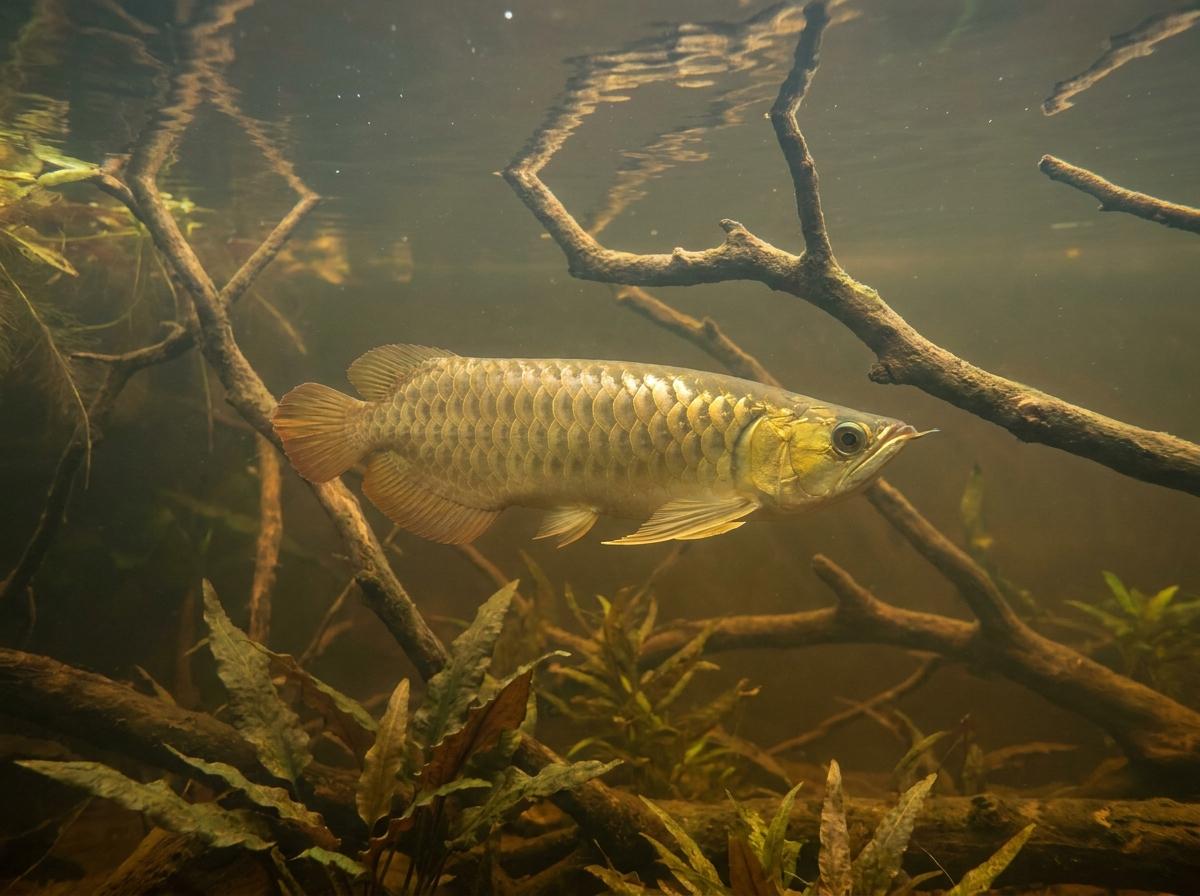
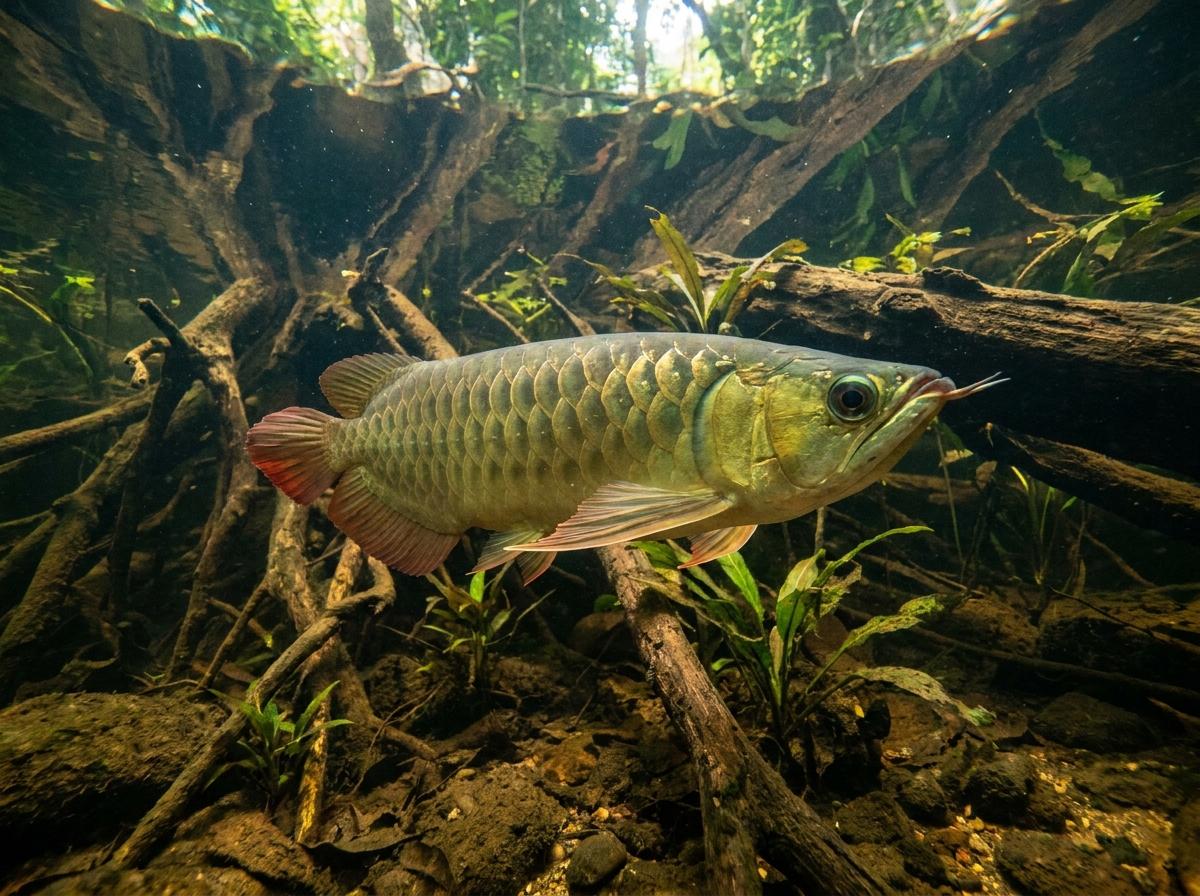
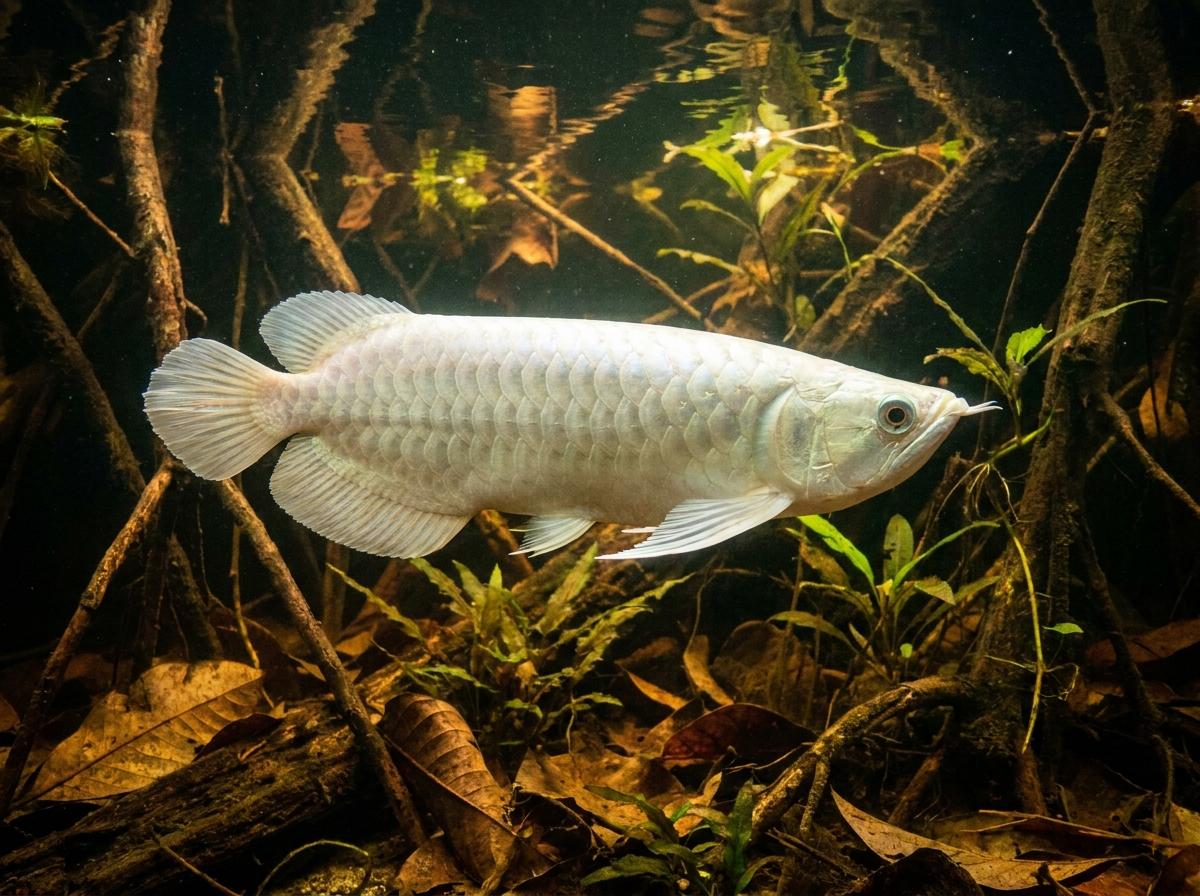
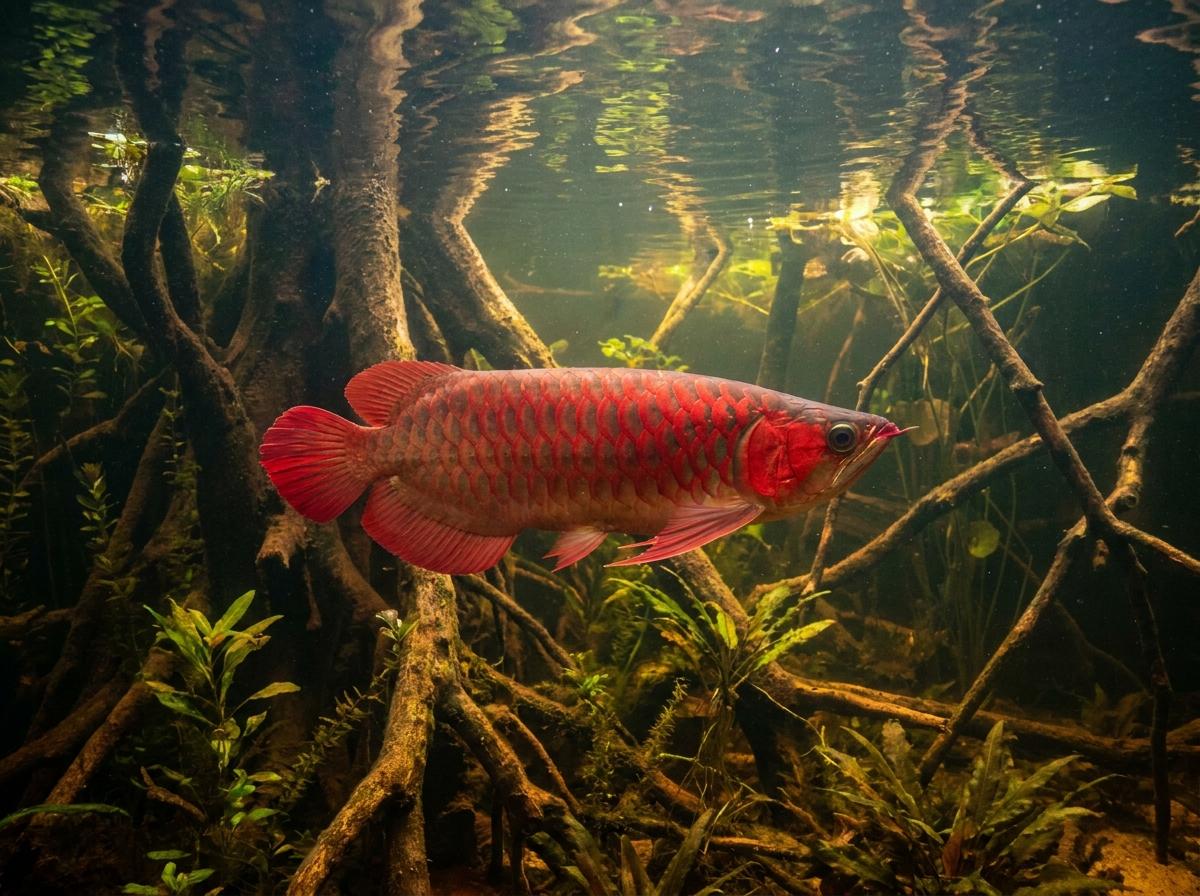
Colour develops. The 2003 description is explicit that the dorsal region of the fish is dark brown, the lips are reddish, and the flanks, operculum and fins range from goldish red to deep red, while on immature specimens “the red coloration is less intense and the ventral surface is whitish”. The mature fish photographed on this page show exactly that pattern: bright red scale rims and gill covers over a darker back, not a uniformly scarlet animal.
That is the single most common source of disappointment in this strain. A small juvenile sold as a super red is being sold on a promise about what it will become, and how far it gets depends on genetics, age, diet, lighting and water quality. Farms grade and price fish partly on how much colour has already come through, which is a reasonable practice and also a reminder that colour at sale is evidence and colour later is a forecast.
How to recognise an Asian arowana
The species is unmistakable once you know what to look for, and most of the diagnostic features are visible in a photograph.
- A long, laterally compressed body. The 2003 description notes that the body is elongated and slender in immature fish and becomes deeper with age, so a heavy-bodied adult and a slim juvenile can be the same animal at different ages.
- Very large scales in neat overlapping rows. FishBase’s short description of the species is blunt about this: one pair of barbels, scales large. In red fish each scale carries a bright metallic rim, which is what produces the mosaic effect.
- A strongly oblique, upturned mouth. The gape points upward and the lower jaw projects well beyond the upper. This is a surface feeder’s mouth.
- Two fleshy barbels on the chin. A single pair, projecting forward and upward from the tip of the lower jaw. In wild fish the 2003 description puts their length at up to the eye diameter.
- Long dorsal and anal fins set far back. Both sit close to the tail rather than mid-body, which gives the fish its distinctive rear-weighted outline. The description records 17 to 19 dorsal rays, 25 to 27 anal rays, and 23 to 25 scales along the lateral line.
- The bony tongue. The family name Osteoglossidae means bony tongue, after the toothed bone in the floor of the mouth that works against teeth on the roof.
Where it comes from, and why it is endangered
The species ranges across Southeast Asia, from southern Myanmar through the Malay Peninsula to Indonesia, and east into Thailand as far as the Cardamom range. It lives in tannin stained blackwater streams and forest-covered waters including peat swamp margins, at roughly 24 to 30 degrees Celsius. Young fish feed on insects at the water surface; adults take fish and other small vertebrates. It is a paternal mouthbrooder: the male takes the eggs into his mouth, and the larvae stay there for weeks after hatching, until the yolk sac is absorbed.

The Asian arowana is assessed as Endangered on the IUCN Red List, a status FishBase records as the 2019 assessment under criteria A2cd and A4cd, which is the shorthand for a population reduction driven by declining habitat quality and by actual or potential exploitation. A 2016 review of arowana aquaculture in the Journal of Environmental Biology describes the species as highly valued in the aquarium trade and highly endangered, and attributes serious decline to overexploitation, habitat change and pollution, using the Malaysian golden strain, endemic to the Krian river system, as its worked example. A 2025 methods paper developing an environmental DNA marker for the species describes the same picture from the enforcement side, framing eDNA as a way to monitor wild populations without handling a protected fish.
For the super red specifically, the 2003 authors reported field work at Sentarum Lake in 2000 and reached an uncomfortable conclusion. The strain appeared to be gone from the southern part of the lake system and survived only in a more protected eastern range of small forested lakes, each under one square kilometre. Fishermen, local fisheries officials and farmers attributed the collapse to logging and the water quality changes it brought, a rise in pH and turbidity, rather than to fishing pressure, and dated the southern disappearance to roughly a decade earlier, in step with intensive logging. The authors argued the red form should be treated as critically endangered.
That is a more interesting story than the usual one. Collection for the aquarium trade is a real pressure on this species, and it drove the original Appendix I listing. For the super red’s home waters, the authors who described it pointed at chainsaws.
The listing itself has a documented date. A 1995 US Fish and Wildlife Service rule updating the CITES appendices lists Scleropages formosus, common name Asian bonytongue, in Appendix I with an effective date of 1 July 1975, the day the Convention itself came into force. The fish has been on the treaty’s strictest list since the treaty existed, and the captive-breeding registration route described above was the compromise that let a legal trade grow up alongside it.
Size, tank, and the length of the commitment
This is a big fish. FishBase records a maximum of 90 cm total length, roughly 35 inches, and the body deepens as the animal matures. The commonest husbandry mistake with the species is planning around the size it is at purchase rather than the size it reaches.

There is no authoritative published minimum tank size for the species, and we are not going to invent one. The useful test is geometric rather than volumetric: an adult needs enough length and width to turn around and to cruise without meeting glass, which for a fish approaching a metre means an aquarium measured in body lengths, not in litres. Depth matters least. Length and front-to-back width matter most, because this is a surface-oriented fish that patrols horizontally.
A few things follow from the biology and are not optional.
A secure cover. Arowanas hunt at and above the waterline; the species takes insects at the surface as a juvenile and larger prey as an adult. A startled or hunting fish leaves the water, and an uncovered tank is how keepers lose them. The aquarium in the photograph above has a full glass cover panel sitting over the top, which is the standard arrangement and the reason it is standard.
Warm, clean, stable water. The species occupies water at roughly 24 to 30 degrees Celsius, soft and acidic in the wild. A large predatory fish on a meaty diet loads a filter heavily, so filtration and water changes have to be sized to the animal rather than to the tank label.
Space of its own. Arowanas are territorial predators. Housing decisions, tankmates and any attempt at group housing are exactly the sort of thing to discuss with an aquatic veterinarian or an experienced keeper before the fish arrives, not after.
Keepers and farms routinely check the same short list on a live fish: eye position, barbel condition, scale alignment, fin condition, and swimming posture. Those checks are practitioner practice rather than published clinical criteria, and they exist because problems in this species tend to show up in exactly those places. Any suspicion of injury, deformity or disease is a veterinary question, and a vet with fish experience is worth finding before you need one.
On lifespan, be careful with the numbers you will read. There is no authoritative published longevity figure for Scleropages formosus, and the confident ranges circulating online do not trace to one. What is safe to say is that this is a slow-maturing, long-lived animal, that the colour a buyer is paying for takes years to arrive, and that anyone taking one on in a permitting country should plan on a commitment measured in many years rather than a few seasons.
Buying considerations where the trade is legal
Everything in this section applies only in countries where the trade is permitted, and it is about documents at least as much as about the fish.
- Start with the paperwork, not the colour. Ask for the exporting farm’s CITES registration, the permit numbers on the consignment, and the unique mark, normally a transponder number. Then confirm the mark actually reads. Article 65(4) of the EU implementing regulation says an export permit for a live Annex A vertebrate is issued only once the applicant has satisfied the management authority that the marking requirements have been met, which tells you how central the mark is to the whole system.
- Match the chip to the certificate to the fish. A number on a document that does not correspond to the animal in front of you is the failure mode the marking rules exist to prevent.
- Treat a young fish’s colour as a forecast. Grade language varies between farms and is not governed by any registry or written standard. The only honest read on a juvenile is how much colour has developed so far, at what age.
- Ask directly about cross-strain parentage. Hybrids between the red and silver forms have been documented in Indonesian farms since at least 2003. A seller who can speak clearly about broodstock is telling you something useful.
- Size the tank before you buy, not after. A fish that can reach 90 cm is not a fish to acquire while planning an upgrade, and finding it a new home later means finding someone who can lawfully hold it.
- Check your own national rules. The EU regulation lets individual member states prohibit holding Annex A animals, and other jurisdictions have their own licensing. Verify locally rather than assuming that “legal in Asia” means legal where you live.
Frequently asked questions
Is it legal to own an Asian arowana in the United States?
There is no lawful route to import one, sale and offer for sale in interstate or foreign commerce are prohibited, commercial shipment across state lines is prohibited, and no permit category covers keeping the species as an ornamental fish. Federal law does not make mere possession categorically illegal, though. Whether an individual fish already in the country is lawfully held depends on how it was obtained, on any permits that apply and on state law. The practical advice is unchanged: do not set out to acquire one in the US, and anyone who believes they already hold one lawfully should get that confirmed in writing by the US Fish and Wildlife Service and their state wildlife agency.
Does it matter that the fish was bred on a farm?
Not for the US prohibition. The ESA listing applies to the species, and neither the import prohibition nor the permit categories carve out captive-bred stock. The captive-bred wildlife registration at 50 CFR 17.21(g) covers wildlife bred in captivity inside the United States for propagation or survival purposes and does not authorise import.
What does “super red” actually refer to?
A colour strain of Scleropages formosus whose flanks, gill covers and fins develop deep red. The name traces to fish from the blackwater lakes and streams of the upper Kapuas basin around Danau Sentarum, in West Kalimantan, Indonesian Borneo. It is a trade and farm-line designation, and no registry or written standard defines it.
Are super red and green arowanas different species?
Not according to the treatments most reference works follow. A 2003 paper described the red form as Scleropages legendrei and the silver and golden forms as separate species, but that split has not been generally adopted, and Scleropages formosus remains the accepted name for all of them. Both CITES and the US listing attach to S. formosus, so the taxonomy makes no legal difference.
Why are super reds so expensive?
Several things stack. The species is on CITES Appendix I, so every legal fish carries permits, a registered farm of origin and an individual mark. Farm production is slow, since the male mouthbroods the young. Colour is graded, and grading concentrates demand on the highest grades. Prices quoted in US dollars are not meaningful, because import and interstate sale are both prohibited, so no lawful national market exists to set them.
How big does a super red arowana get?
FishBase records a maximum of about 90 cm total length, roughly 35 inches, and the body deepens with age. Assume the adult size when you plan the aquarium.
What is the microchip for?
It ties one specific fish to one specific set of CITES documents. In the European Union, live Annex A vertebrates must carry a uniquely numbered, unalterable ISO-standard microchip transponder unless the management authority accepts another unique mark, and the marking requirement is checked when export permits are issued.
I am in the US. What can I keep instead?
Plenty, without any of this. If the appeal was long fins and strong colour, domestic Betta splendens lines like the cambodian and the super delta are unrestricted, well documented, and easy to keep records for. The wider betta fish species page covers the other colour and finnage lines.
Do this next on Creatures
This page carries a deliberately short action list. Creatures is a US-based marketplace and records platform, and Asian arowana cannot lawfully be imported into the United States, sold or offered in interstate or foreign commerce, or shipped across state lines commercially, so the marketplace, listing-alert, breeder-directory and organisation actions that normally sit here have been left off on purpose. What is left is the part that is honest for this species: record keeping, for people who lawfully hold one.
Give the fish a profile. If you keep an Asian arowana in a country where the species is legally held, create a free animal profile and put the identity on it: farm of origin and its CITES registration, the export and import permit numbers, and the transponder number. No account needed to start. The walkthrough is in adding an animal to Creatures, and your animal’s profile page explains what each tab holds.
Log the things that change. Add a record for water parameters, feeding, growth measurements and any veterinary visit. The record sheet opens for any visitor to look around, and a free account is what saves what you enter. See adding a record for the full how-to.
Keep the health history in one place. A long-lived fish accumulates a history worth having, and health and medical records covers how examinations, medications and measurements are stored so a veterinarian can read them in order.
Do not rely on memory for recurring care. Reminders and upcoming care covers scheduling the routine items, which for a large predatory fish mostly means water testing, filter maintenance and weight or length checks.
Browsing rather than keeping? The Asian arowana species page lists the other colour lines, including the golden and green strains, each covered on its own page.