

Thai
The Thai is the traditional, moderate form of the Siamese: the native pointed cat of Thailand, known at home as the Wichienmaat, and registered as a breed in its own right by The International Cat Association, the World Cat Federation and the Fédération Internationale Féline. It is not a colour, a size class, or a nickname for a badly bred Siamese. It is a separate breed with its own written standard, and the whole point of that standard is restraint: a rounded, wide-cheeked head with a short wedge muzzle, a substantial medium-boned body, deep blue almond eyes, and a very short pointed coat, with nothing pushed to an extreme. If you are weighing this breed against the other pointed cats, the Creatures cat species hub is the place to compare them side by side. Below is what the registries actually say, how to tell a Thai from a modern show Siamese and from the entirely different cat the British registry calls a Thai, what the breed’s real health risks are, and what to check before you buy.

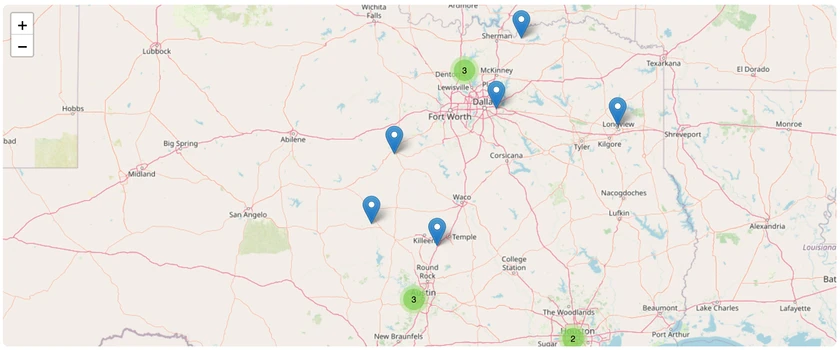
Browse listings, public profiles, breeders, or add your animal.
What a Thai cat actually is
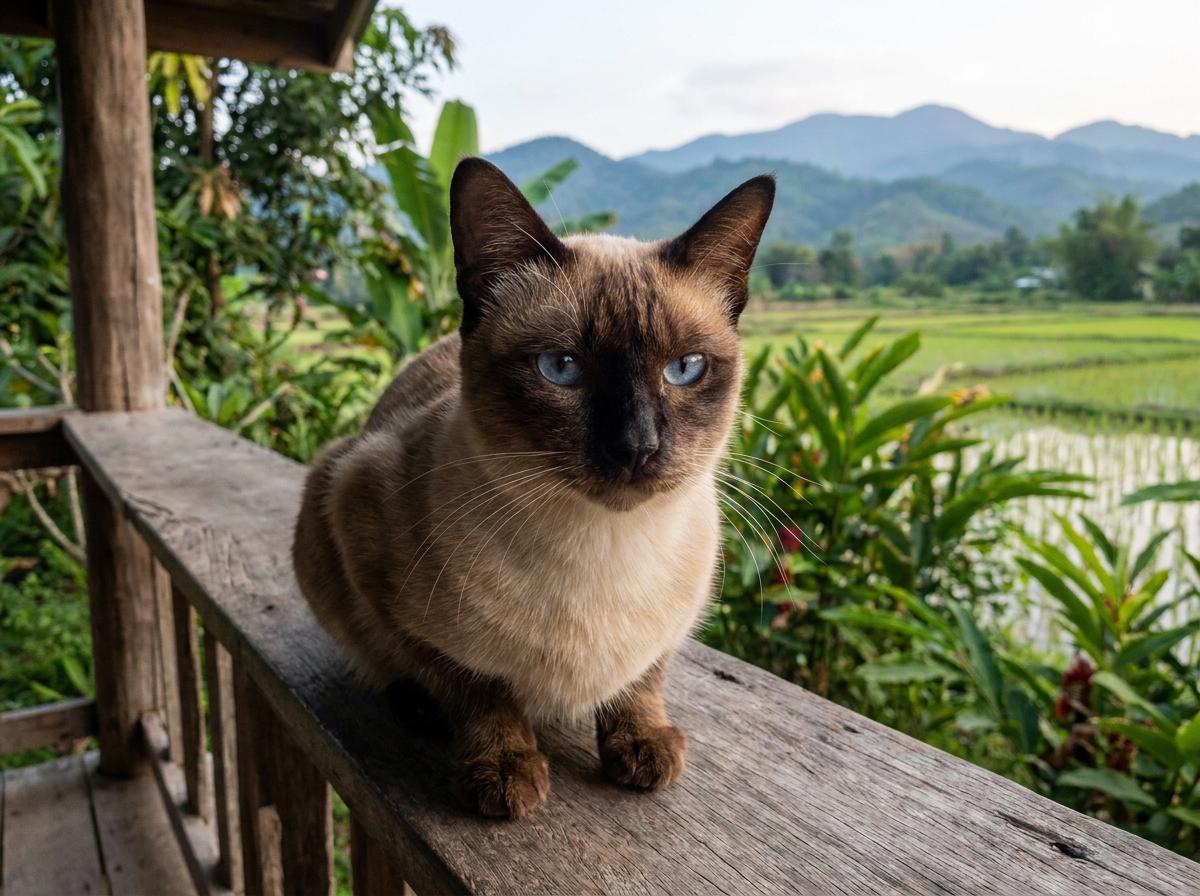
TICA puts it plainly in its breed description: “The Thai is the breed dedicated to preserving the native pointed cat of Thailand in as close to its original form as possible.” The registry notes that Thai is the official breed name in TICA and in many European registries, that the cat is called the Wichienmaat in Thailand itself, and that it is known elsewhere as the old-style Siamese. Pointed pattern, deep blue eyes, a whitish beige body, dark extremities, and, in TICA’s own words, moderate in type, never extreme.
The World Cat Federation standard for the Thai says the same thing in one line under a heading marked Remark: “The aim of breeding the Thai is the traditional type of the Siamese.” The Fédération Internationale Féline, which recognised the breed in 2017, describes a modified wedge head, longer than wide, with moderately large ears, large oval intensely blue eyes, and a body that is medium in size and bone, well muscled, and heavier than it looks.
So three registries on two continents agree on the substance. The Thai is a pointed shorthaired cat of foreign type built to a moderate pattern, and it is registered separately from the modern Siamese rather than as a variety of it.
One registry does not recognise it at all. The Cat Fanciers’ Association lists 45 breeds, and Thai is not among them. CFA registers the Siamese, the Colorpoint Shorthair, the Balinese, the Oriental, the Korat and the Khao Manee, but a cat of this type has no CFA breed of its own. That matters if you are shopping in North America, because the paperwork a seller can produce depends entirely on which registry they breed under.
Thai and modern Siamese: the differences that matter
Both breeds descend from the same imported Thai cats. They separated because the show ring moved and part of the fancy did not follow.
TICA’s own history of the breed sets out the sequence. British visitors found the Wichienmaat in Siam in the 19th century and imported it, calling it Siamese. Western breeders then set out to make it more consistent and more striking, selecting for deeper blue eyes and an increasingly stylised head and body, so that by the 1950s some show Siamese had much longer heads, finer bone and slimmer bodies than the cats of 1900. The Thai began diverging in that same decade, when breeders around the world went on producing the moderate early twentieth century type. By the 1980s those moderate cats were no longer competitive in the ring, and the first breed clubs dedicated to them appeared in Europe and North America.
The practical differences are written into the standards as faults, which is the most reliable way to read them. The TICA Thai breed standard, revised 1 May 2010, penalises a narrow upper head, extreme oriental eyes, a blunt or pointy muzzle, ears that are small or very large or set low on the sides of the head, a compact or distinctly tubular body, a whippy tail, and excess undercoat. It withholds all awards for a pronounced stop in profile, a pronounced convex forehead, distinct ear tufts, a cobby body, obesity, white lockets and buttons, white toes and feet including the paw pads, patches of white in the points, and any eye colour other than blue. Its disqualifications are a visible tail fault, crossed eyes, and a visible protrusion of the xiphoid process at the end of the sternum.
Read that list and the breed comes into focus. Nothing there is asking for an exaggeration. Every clause is a fence.
The standard says one more thing that surprises people. Under permissible outcross, it lists a single breed: Siamese. The two are close enough in ancestry that a registered Thai may legitimately have a Siamese parent, which is exactly why the type clauses above are written so tightly. Preserving a moderate cat while drawing on a gene pool selected for the opposite is only possible if the standard keeps saying no.

Point by point, on the head, TICA asks for a modified wedge of medium width with rounded cheeks and a tapering muzzle, a head longer than wide but neither extreme nor narrow, cheekbones curving inward where the muzzle begins, a muzzle wedge shaped but rounded at the end “like a tapering garden spade,” and a forehead that is flat and long. The profile is nearly straight, with a slight downhill slope beginning just above the eyes and ending just below them. Eyes are medium to slightly large and a very full almond shape, explicitly not oriental. Ears are medium to slightly large, wide at the base with oval tips, set high enough that they point outward at roughly 35 degrees from vertical.
On the body, the standard asks for a torso that is moderately long, lithe and graceful “like a small panther,” well toned but neither tubular nor compact, standing high enough on the legs for foreign type. Bone is medium, described as neither refined nor coarse. The tail is as long as the torso and tapers gradually. Musculature is firm but lithe, and TICA adds a memorable field test: when picked up, the cat should weigh about as much as, or slightly more than, you would guess by looking at it.
The modern show Siamese, by contrast, is bred toward a long fine wedge, very large flaring ears, fine bone and a tubular body. If you want to see how far the two have travelled from a common ancestor, put this page next to the Siamese breed hub and compare the heads.
Why “applehead” is the wrong word for it
“Applehead” is the term most buyers arrive with, and TICA addresses it directly: to some people the Thai is synonymous with “applehead Siamese” and to others it is not, because applehead is a colloquial American term, not an official breed name, and it means different things to different people.
It is also, taken literally, the opposite of what the standard asks for. The TICA standard wants a forehead that is flat and long. A pronounced convex forehead, which is what an apple-shaped skull means, is on the withhold-all-awards list. A genuinely domed head is a serious fault in this breed, not its defining feature. What the standard actually wants is width and lateral rounding through the cheeks and the sides of the skull, with a short wedge muzzle projecting from it and a flat plane on top.
There is a practical consequence. A listing that says “applehead Siamese” or “traditional Siamese” is describing a look, not a registration. It may be a registered Thai. It may be a moderate Siamese from a Siamese pedigree. It may be a pointed cat of no recorded ancestry at all. Those are three different purchases, and the only way to tell them apart is to ask which registry the cat is registered with and to read the pedigree.
Two different cats are both called Thai
This is the trap that catches British and Irish buyers, and it is worth being precise about because both usages are legitimate in their own registries.
In TICA, the WCF and FIFe, Thai means the old-style Siamese, and its GEMS code is THA. In the Governing Council of the Cat Fancy, the British registry, Thai means something else entirely, and its code is TAI. GCCF is explicit about the split: “There is a distinct difference between the Thais recognised by GCCF and those recognised by other registries, as is shown by the variance in GEMS coding,” adding that all TAIs are descended from Korats with no other breeds in their pedigrees, while THA are descended from Siamese.
The GCCF Thai came out of Korat breeding. Korats carry recessive genes from their Thai ancestry, and matings between Korats in the UK in the late 1980s and 1990s occasionally threw pointed and solid lilac kittens. Some breeders developed those into recognised varieties, and GCCF granted preliminary recognition to the Thai Lilac and Thai Blue Point in February 2002. In GCCF’s own summary, the Thai can best be described as a Korat in a different coloured coat, and its standard asks for Korat type: a heart-shaped face viewed from the front, large round eyes, and a semi-cobby body. If that sounds unfamiliar, the Korat breed hub explains the parent breed.
So a GCCF Thai Blue Point and a TICA Thai are both correctly called Thai, and they are not the same cat. Ask for the registry and the code before you ask anything else.
History, from Wichienmaat to Thai
TICA’s account runs like this. For at least 700 years the Thai people have kept a pointed cat called the Wichienmaat, recorded in the Thai cat poems known as the Tamra Maew, bred in the kingdom of Ayudhia, then through the kingdom of Siam, and still bred in Thailand today. In the 19th century British visitors found the cat in Siam, could find it nowhere else, and imported it under the name Siamese.
The TICA standard adds a specific historical marker for the coat: the breed’s very short coat was first clearly described in the West by Harrison Weir in 1889, in the era when the modern cat fancy was being invented. The standard also gives the breed a dual target, describing the ideal Thai as both the living equivalent of the original Wichien-maat of ancient Siam and of the “marten-faced” Siamese of early twentieth century America and Europe.
The modern breed’s milestones are well documented. Breed clubs for the old-style cats formed in the United States and Europe in the 1980s. The World Cat Federation granted the breed championship status in Europe in 1990 and adopted the name Thai to separate it from the show-style Siamese. In 2001, breeders began importing indigenous pointed cats directly from Thailand, a deliberate effort both to widen the gene pool and to capture Southeast Asia’s native cats while they remain genetically distinct from Western cats. TICA granted Preliminary New Breed status in 2007 and advanced the Thai to Advanced New Breed in 2009, which let North American and European breeders show under a single standard. The current TICA standard is dated 1 May 2010, and the Thai now sits on TICA’s main list of recognised breeds rather than in its new-breed classes. FIFe recognised the breed in 2017.
That 2001 detail is the one worth holding onto. A breed whose entire premise is preservation went back to the source population to get it, which is unusual and which is why Thai pedigrees sometimes carry recent Thailand-born ancestors.
Colours, and how pointing actually works
Every Thai is pointed. The pattern comes from a single recessive change in the tyrosinase gene, the enzyme that makes melanin. Lyons and colleagues at UC Davis identified it in 2005: the Siamese pattern is associated with a G to A change in exon 2 of TYR that swaps glycine for arginine at position 302, and every pointed cat in that study was homozygous for it. The resulting enzyme works at the cooler surface temperatures of the ears, mask, legs, paws and tail, and fails on the warm core of the body. The pale body and dark extremities are a thermometer reading, not a coat pattern in the usual sense.
Three practical consequences follow from that, and all three are written into the standards.
Kittens are born pale and fill in slowly, because a kitten that has developed at its mother’s body temperature has not been cool anywhere yet. TICA’s standard allows for incomplete point colour and mask in kittens and young adults up to 12 months of age. You cannot judge final point colour on a small kitten.

Adults darken. Body shading deepens with age, and a cat kept in a cool house will shade more heavily than the same cat kept warm. Both standards make room for it: TICA allows darker body shading in older cats as long as a distinct contrast between body and points survives, and the WCF standard tolerates darker body colour and patching on the flanks in older cats while refusing coloured spots in the point colour or belly spots.
And the pale body is preferred but not prized above contrast. TICA asks for a body colour “preferably a very pale off-white” while stating that evenness of body colour and contrast with the points matter more than extreme whiteness.
On colours themselves, TICA places the Thai in the Pointed category with Solid, Tabby and Tortie divisions and accepts all colours. The WCF standard is more granular, listing seal, blue, chocolate, lilac, cinnamon, fawn, red and cream points, with tortie point, tabby point and tortie tabby point variants, and it recognises the breed only in pointed colours without white. Golden and silver variants are not recognised. The eyes are blue in every variety.

There is one more thing white is not allowed to do, and it is worth saying because buyers ask about it. TICA withholds all awards for white lockets and buttons, white toes and feet including the paw pads, and patches of white in the points. So a pointed cat with white mittens is not a rare Thai variety worth paying extra for. Under this standard it is a serious fault, and in other cats it is the signature of an entirely different breed.
Temperament, honestly
The registries and the breeders who wrote their descriptions are unanimous, and unusually blunt, about what this cat is like to live with.
TICA describes a highly intelligent, people-loving, active and curious cat that will follow you around and try to help with whatever you are doing, that is a great talker without necessarily being loud, and that communicates with taps of the paw or by putting its face in yours. Then comes the sentence most breed pages leave out: physically these cats are easy to maintain, but emotionally they are high maintenance, they need a response and daily attention, and without it they will suffer and act out.
Take that at face value. This is a bad choice for a household that is empty twelve hours a day and wants a self-contained cat. It is a very good choice for someone who wants a cat in the middle of everything and is prepared to answer it. Many keepers of the Siamese group deliberately keep two, so there is company when the people are out.
The TICA standard also carries a temperament clause that applies in the show ring: temperament must be unchallenging, and any sign of definite challenge disqualifies. A cat may exhibit fear or complain aloud, but must not threaten to harm. That tells you what judges expect a sound cat of this breed to be like when handled by a stranger.
Health, lifespan and what to test for
TICA’s breed page says the Thai is generally a very healthy breed as long as it stays within its ideal weight, and that regular dental care and veterinary visits will carry it into an advanced age. That is fair as far as it goes, but the Thai draws on the Siamese gene pool, and the Siamese group carries a small number of well documented problems that are worth naming. None of this is a reason to avoid the breed. All of it is a reason to ask specific questions. Every medical decision here belongs to a veterinarian who can examine the cat.
Progressive retinal atrophy (rdAc). A recessive variant in the CEP290 gene causes a late-onset retinal degeneration that ends in blindness. In a survey of 846 cats across dozens of breeds, Menotti-Raymond and colleagues found the rdAc allele in 16 of 43 breeds, reaching an allele frequency of about 33 percent in North American and European Siamese populations, which the authors called a significant health risk particularly in the Siamese breed group. Because it is recessive, carriers look normal and only kittens that inherit two copies are affected. A commercial DNA test exists, which makes this the single most answerable health question you can put to a breeder. Ask for the rdAc result on both parents in writing.
AA amyloidosis. In this condition, amyloid protein accumulates in the organs, most often the liver and thyroid, and the outcome is fatal. A Utrecht University post-mortem series of 194 Siamese and Oriental cats found amyloidosis in 12 of them, identified a form of amyloid A protein specific to the Siamese, and found that the pedigrees of affected cats suggested a familial trait. Twelve in 194 is not a population prevalence, because these were cats sent for post-mortem rather than a random sample of living cats, but it is enough to put the condition on the list of things to ask about. A later complex segregation analysis in Oriental shorthairs estimated heritability at 0.56 and found that signs typically become apparent between one and seven years of age. There is no DNA test, so the only tool available to a buyer is the family history. Ask whether any related cat has died young of liver failure.
The vision that comes with the pointing gene. The tyrosinase variant that makes the points sits in the albino series, and in cats carrying it an abnormally large share of optic nerve fibres cross to the wrong side of the brain. The Webvision review of visual anomalies associated with albinism reports that Siamese cats have few binocular cells in visual cortical areas, disturbing the anatomical basis for stereo vision. In practice most pointed cats function perfectly well. Visibly crossed eyes were common in older Siamese lines and are now selected against: TICA disqualifies crossed eyes outright, as it does a visible tail fault, which is the modern treatment of the old kinked Siamese tail.
Wool sucking and pica. Compulsive sucking and eating of fabric is reported disproportionately in this group of breeds. A case-control study of 204 Siamese and Birman cats found an abnormally intense appetite in all affected cats and identified early weaning and small litter size as risk factors in Birmans and the presence of a medical condition as a risk factor in Siamese. It matters beyond the laundry, because swallowed fabric can cause an intestinal obstruction. If your cat starts eating wool, that is a veterinary conversation, not a training problem.
Weight. The most useful number in feline longevity research is not breed-specific at all. The 2024 VetCompass life tables for UK cats, built from 7,936 confirmed deaths, found that being entire, being purebred and carrying a non-ideal body weight were each significantly linked to a shortened lifespan. TICA’s own health note for the Thai says the same thing in plainer language.
On lifespan, be careful with any number you see quoted for this breed. There is no published life table for the Thai. The closest real figure is for the Siamese: in that same 2024 VetCompass study, life expectancy at birth for UK Siamese cats was 11.69 years, with a 95 percent confidence interval of 10.56 to 12.82, against 11.74 years for UK cats overall. Treat that as the neighbourhood, not as a promise about an individual cat.
Whatever you are told about a cat’s health history, write it down where you can find it again. A free animal profile on Creatures with the vaccination dates, the rdAc result and the weight trend in it is worth more at year six than a folder of paper, and the health and medical records guide shows how the records tab works.
Day-to-day care
Grooming is close to nothing. TICA describes a shorthaired, sleek breed that maintains and bathes its own coat unless it gets into something harmful. The registry suggests trimming nail tips about every two weeks, cleaning the ears regularly, and brushing teeth twice a week, with dental care becoming a real priority by middle age. The very short, close-lying coat with little undercoat sheds, but there is no mat risk and no clipping.
Feeding needs a plan, not a full bowl. TICA advises three meals a day for kittens between three and eight months and twice daily for adults, and specifically discourages leaving dry food out all day, on the grounds that free feeding tends to suppress water intake on a mostly dry diet. It also passes on a practical tip from cat behaviourists: put the water bowl at least three feet from the food, because a strong food smell can put a cat off drinking. Confirm the amounts with your veterinarian, since a growing kitten, a neutered adult and a senior are three different problems.
Enrichment is the real workload. A cat this active and this attached needs vertical space, daily interactive play, and something to do when nobody is home. Puzzle feeders, window perches and a second cat all help. The behaviour problems people report in this group of breeds are usually boredom problems wearing a costume.
Keep the calendar somewhere it will nag you. Vaccination boosters, parasite treatment, dental checks and weight checks are the four things that quietly slip. You can set reminders on Creatures so they do not, and the reminders and upcoming care guide explains how they are triggered.
What a Thai cat costs, and where they come from
There is no authoritative published price series for pedigreed cats, and anyone quoting you a precise national average for this breed has made it up. What can be said honestly is what moves the number.
A kitten from a registered breeder who health tests, registers litters with TICA, the WCF or FIFe, raises kittens underfoot, and sends them home neutered with a written contract costs several times what an unregistered pointed kitten from a local advertisement costs. The gap is not markup. It is DNA testing, registration fees, veterinary care, and a much smaller number of kittens per year. Imported stock and cats with recent Thailand-born ancestors sit at the top of the range, because importing a cat is expensive and slow.
Availability is the harder constraint, and the registry picture explains why. Two of the three bodies that recognise the breed are European, the third is international, and the largest North American registry has no Thai breed at all. A North American buyer is therefore working from a small pool and should expect a search measured in months, and expect to travel or ship. A saved search that emails you when a listing appears is more use than checking a page every week.
Two warnings on the buying side. First, “traditional Siamese” and “applehead Siamese” are marketing descriptions, not registrations, so a cat sold under those words may have no registered pedigree at all. Second, be sceptical of any seller who cannot say which registry a cat is registered with, because as this page has already covered, THA and TAI are two different breeds and SIA is a third.
You can browse current listings on the Creatures marketplace and look for breeders and catteries in the Creatures directory.
What to check before you buy
- Ask which registry, and which code. THA at TICA, the WCF or FIFe is the old-style Siamese. TAI at GCCF is the Korat-derived cat. SIA is a Siamese. Get the answer before you get attached to a photograph.
- Read the pedigree, not the advertisement. A registered Thai has registered parents. Ask to see the certificate and check that the breed on it matches the breed in the listing.
- Get the rdAc PRA result on both parents, in writing. It is a straightforward DNA test with an unambiguous result, and the allele is common in this gene pool. A breeder who has not heard of it is telling you something.
- Ask about amyloidosis in the line. There is no test, so the family history is the whole answer. Any young related cat that died of liver failure is a red flag worth pressing on.
- Look at the cat, not just the colour. Eyes level and not crossed, a tail with no kink or bend along its length, a firm chin, a clean bite, and clean ears. In this breed the standard treats crossed eyes and tail faults as disqualifications, so a serious breeder is already selecting against them.
- Judge type by the standard, not by the word applehead. Width through the cheeks and a short rounded wedge muzzle with a flat forehead is correct. A domed skull is a fault.
- Do not judge point colour on a young kitten. Colour is still filling in up to about a year.
- Expect questions back. Breeders of a demanding, people-focused breed generally want to know how much of the day the cat will be alone.
Frequently asked questions
Is a Thai cat the same as a Siamese?
They share ancestry and split in the twentieth century. Today they are separate registered breeds with separate standards. The Thai is bred to the moderate early twentieth century type; the modern show Siamese is bred to a much more extreme wedge. TICA, the WCF and FIFe register them separately.
Is a Thai cat the same as an “applehead” Siamese?
Not reliably. TICA notes that applehead is a colloquial American term rather than a breed name and that it means different things to different people. It is also a poor description of the standard, which calls for a long flat forehead and treats a pronounced convex forehead as a withhold-all-awards fault.
Why do British listings describe a blue or lilac cat as Thai?
Because GCCF uses the name for a different breed. GCCF Thais, code TAI, descend from Korats and appear as Thai Blue Point, Thai Lilac Point and solid Thai Lilac. Cats registered as THA in other registries descend from Siamese. Both names are correct in their own registry.
What colours do Thai cats come in?
Pointed colours only, with no white. TICA places the breed in the Pointed category with Solid, Tabby and Tortie divisions and accepts all colours. The WCF lists seal, blue, chocolate, lilac, cinnamon, fawn, red and cream points plus tortie and tabby point variants, and does not recognise golden or silver.
Why is my Thai getting darker?
Because the pointing gene is temperature sensitive. The tyrosinase variant behind the pattern makes pigment on cooler skin and not on the warm core, so body shading deepens with age and in a cool house. Both the TICA and WCF standards explicitly allow for darker body colour in older cats.
Are Thai cats cross-eyed?
Some pointed cats historically were, because the same albino-series mutation that produces the points also misroutes optic nerve fibres at the chiasm. It has been selected against for decades, and the TICA standard disqualifies crossed eyes.
How long do Thai cats live?
There is no published life table for the breed. The nearest published figure is for Siamese cats in the UK, at 11.69 years of life expectancy at birth in the 2024 VetCompass study, against 11.74 years for UK cats overall. Keeping a cat neutered and at an ideal weight was associated with a longer life in that same study.
Are Thai cats good for a first-time owner?
Yes, if the household suits them. They are hardy, easy to groom and easy to feed. What they are not is low-contact. TICA’s own description calls them emotionally high maintenance and warns that without daily attention they will act out.
Do this next on Creatures
Whether you are still deciding between the pointed breeds, hunting for a registered kitten, or already living with one, Creatures is the records, marketplace and directory layer that keeps it all in one place.
Add your cat. Already living with a Thai? Create a free animal profile in a few minutes and keep the pedigree, the registry number and the photos together. No account needed to start, and the walkthrough is in adding an animal to Creatures.
Track health and weight. Log a vaccination, a weight or a vet visit. The record sheet opens for any visitor to look around, and you will need a free account to save what you enter. See adding a record for the full how-to, and your animal’s profile page for what each tab holds.
Get alerted when one is listed. Registered Thai kittens are hard to find in North America, where the largest registry has no Thai breed at all, so set a free Thai cat listing alert and we will tell you when one is posted. No account needed to start. See saving searches and using your watchlist.
Find stock and breeders. Browse Thai cats on the marketplace and search trusted breeders and catteries in the Creatures directory. When you are ready to talk to a seller, read making an offer on a listing first.
List your cattery. Breeding Thais? Create a free breeder profile, then get listed in the breeder directory so buyers searching for a scarce breed can reach you. If you run the cattery with a partner, see creating an organization and adding your team.
Still choosing a name? The cat name generator is free and needs no account.
Browse more cat breed hubs. Creatures builds the same kind of profile for every breed this page names. The Khao Manee is another shorthaired cat native to Thailand, and the Balinese and Oriental hubs cover the rest of the Siamese family this page keeps referring to.