

Zalawadi
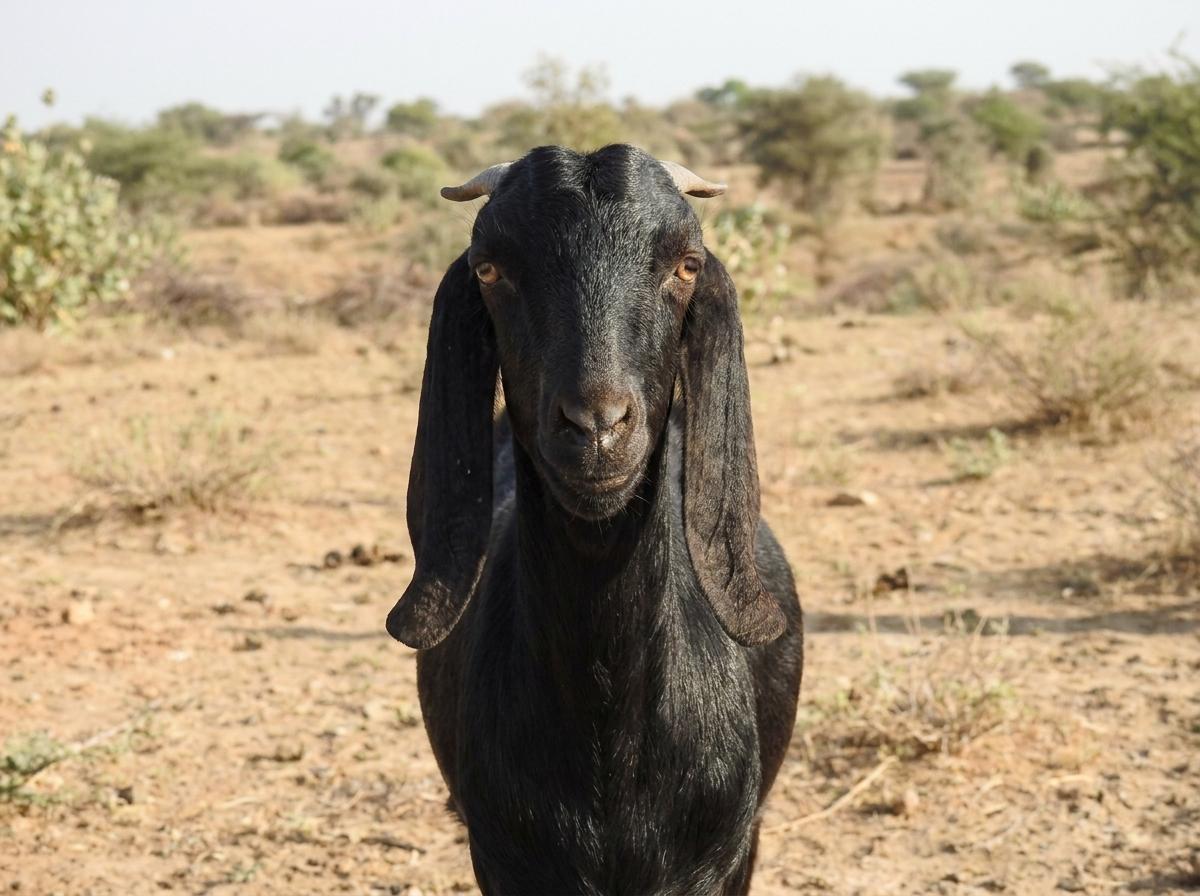
The Zalawadi is a large black goat from the Zalawad tract of Saurashtra in Gujarat, India, kept for milk and meat and recognised on sight by its horns: both sexes carry long horns twisted into an upright corkscrew, over ears that are long, wide and leaf shaped and usually flecked with white. India’s National Bureau of Animal Genetic Resources registers it as a distinct breed under accession number INDIA_GOAT_0400_ZALAWADI_06021, with Gujarat as its home tract. Below is what the breed actually is, what the published measurements and yields say, how to tell it apart from the Surti, Gohilwadi, Mehsana and Kutchi goats it gets confused with, and what a keeper or buyer should check. If you are comparing breeds, the Creatures goat species page is a good place to start.

Browse listings, public profiles, breeders, or add your animal.
What is a Zalawadi goat?
The Zalawadi is one of the indigenous goat breeds of Gujarat, formally registered by the ICAR-National Bureau of Animal Genetic Resources, the body that maintains India’s register of native farm animal breeds. Its entry in the NBAGR registered goat list gives Gujarat as the home tract and the accession number INDIA_GOAT_0400_ZALAWADI_06021. That registration matters more than it might sound: it means the breed has a published descriptor behind it rather than a name that a seller applies to any black goat with big ears.
The name is geographic. Zalawad was a tract of the Kathiawad peninsula, the region now more often called Saurashtra, and the area it covered corresponds to today’s Surendranagar district with a part of Rajkot. Herders in the region know the breed as Tara Bakari, a local name recorded in the ICAR breed descriptor published by Singh and colleagues in the Indian Journal of Animal Sciences in 2007.
It is a dual purpose animal. Milk and meat are the products that keep it in flocks, and it also yields a small quantity of coarse hair each year. The Department of Animal Husbandry and Dairying describes it in the government’s Pashupedia breed reference as a black, glossy coated goat with cork-screw horns that move straight upwards, backwards and slightly outward with pointed tips, long wide leaf like drooping ears, and a well developed udder with large conical teats.
How to identify a Zalawadi
The breed is easy to recognise once you know which two features to look at, because the horns and the ears do most of the work.
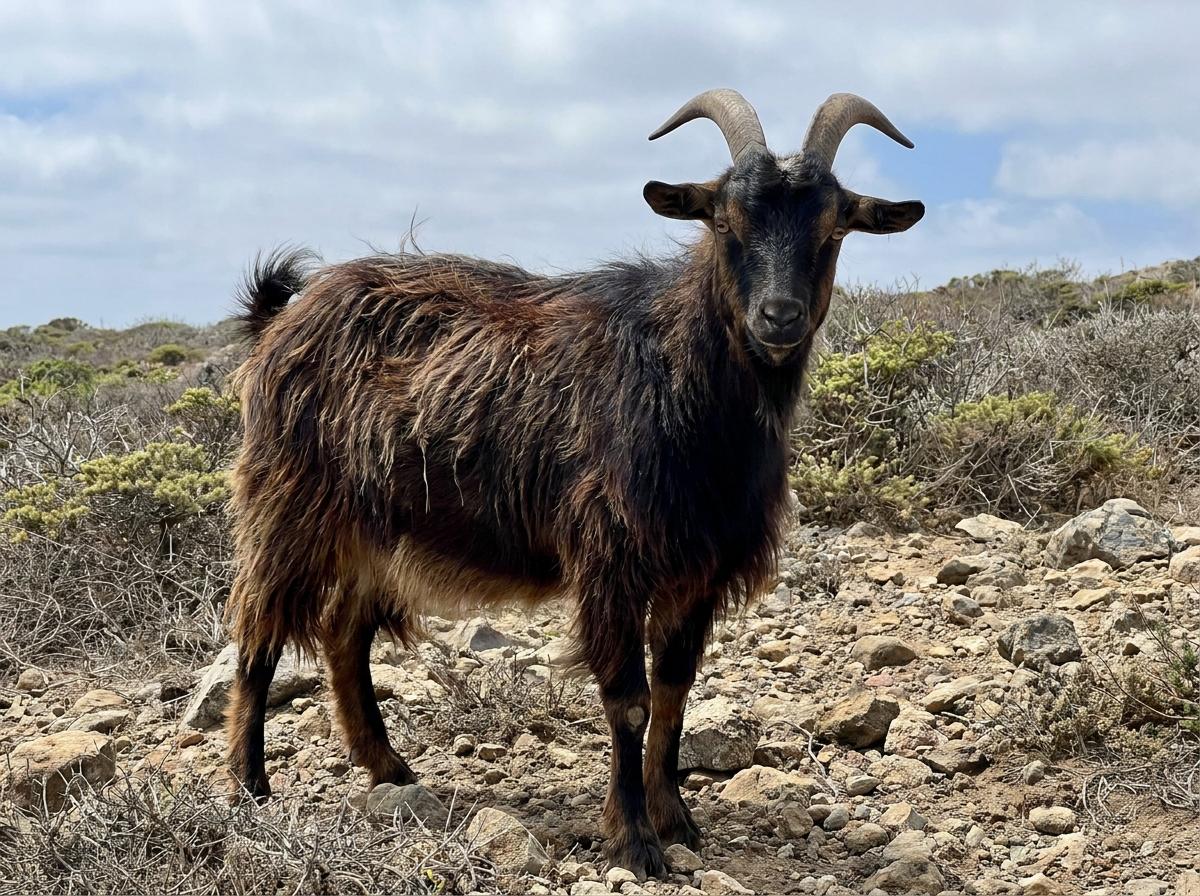
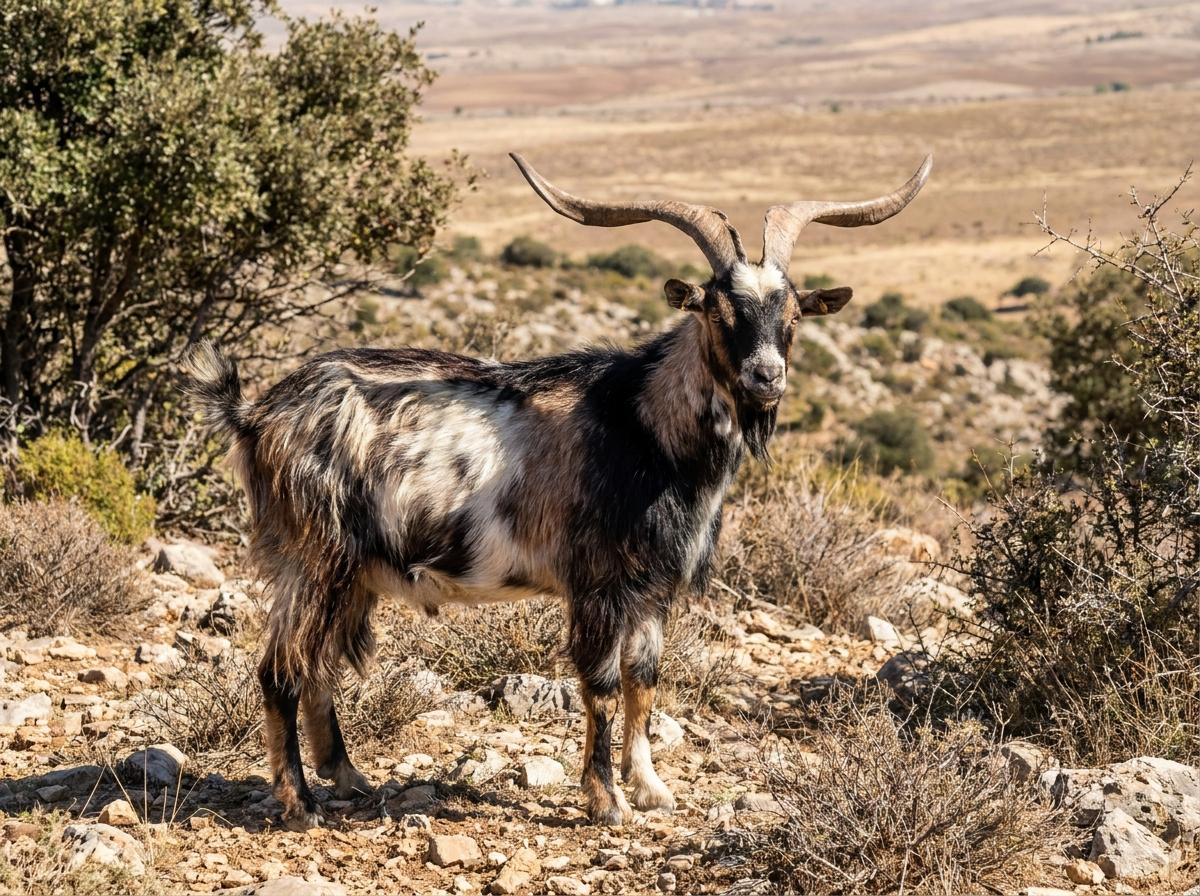
- Horns twisted into an upright corkscrew. Both sexes carry them, and they are long. The FAO breed survey of Indian sheep and goats measured a mean horn length of 16.3 cm across 202 animals and described them as long twisted horns pointed upward. This is the single most useful field mark, because every neighbouring Gujarat goat breed has shorter horns and a different direction of twist.
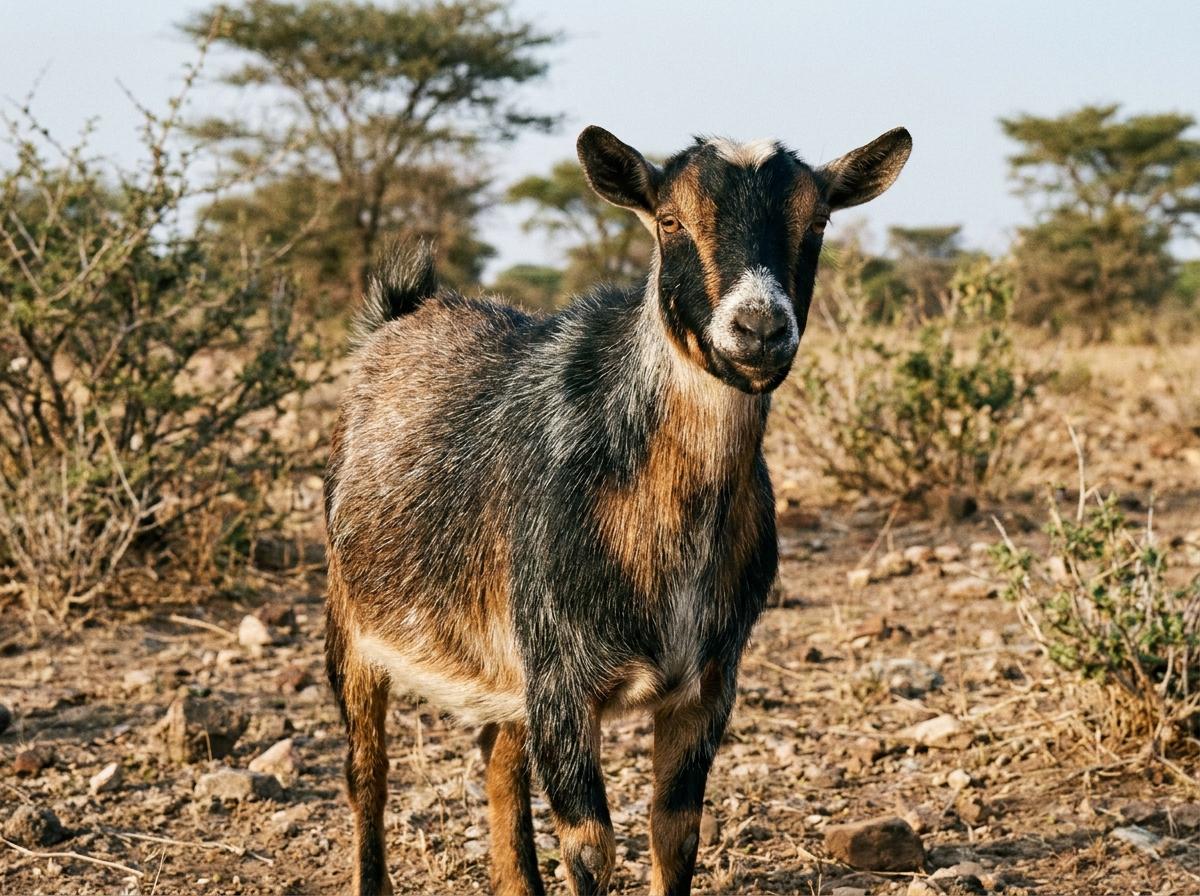
- Long, wide, leaf shaped, drooping ears. Mean ear length in the same survey was 19.0 cm across 163 animals. The ears hang well below the jawline. In many animals they carry white flecks or spots on the black base, which is how the breed usually reads at a distance: a black goat with pale speckled ears.
- A black coat of long, coarse hair. The FAO description is direct about it, and the government descriptor adds that some animals carry white or brown hairs. This is not a multicoloured breed, and a two tone or predominantly brown animal is very unlikely to be a Zalawadi.
- A long head with a broad, slightly bulging forehead. The ICAR descriptor records a gently convex face profile and broad nostrils, on a relatively long and slender neck suited to browsing.
- A capacious, well attached udder. The FAO survey and the ICAR descriptor both note a well developed udder with large conical teats, which is what you would expect in a goat kept partly for milk.

Size is worth setting out plainly, because a lot of writing about Indian goat breeds describes the Zalawadi as large without saying what large means. The FAO survey measured adult bucks at 38.84 kg and adult does at 32.99 kg, with heights at the withers of 83.3 cm and 78.5 cm respectively. Body lengths were 75.6 cm and 71.8 cm, chest girths 76.8 cm and 74.2 cm. Those figures come from 19 males and 186 females, so the doe measurements rest on a much larger sample than the buck ones.
Zalawadi compared with the other Gujarat goats
Conflating the Saurashtra and Gujarat breeds is the most common factual error made about the Zalawadi, and it is avoidable. The FAO survey of Indian sheep and goat breeds characterised all of them on the same protocol, which makes it the fairest side by side comparison available.
Compare the horns first and most identifications settle themselves. The Zalawadi’s are the longest in the group by a wide margin, and they are the only ones that both twist strongly and point up. Gohilwadi horns turn backward. Kutchi horns point up but are short and thick. Mehsana and Surti horns are short.
Two more distinctions are worth stating outright:
Surti is not a black goat at all. It is a medium sized, generally white dairy goat from Surat and Baroda in southern Gujarat, and the FAO survey recorded adult bucks at 29.5 kg, lighter than a Zalawadi doe, though that figure rests on only two animals. It is also a stall fed animal rather than a migratory one. If someone offers you a “Surti or Zalawadi” as though the two were interchangeable, they are not describing either breed accurately.
Mehsana is the black goat most easily mistaken for a Zalawadi, and the tell is the ears. Mehsana ears are white and the coat carries white spots at the base of the ear, while a Zalawadi is a black goat with white flecking scattered over long black ears. The Mehsana’s nose line is straight where the Zalawadi’s is slightly convex, and its horns are short and curve backward.
What about “Kathiawari” goats?
Kathiawar, also written Kathiawad, is the peninsula itself, an older name for the region now generally called Saurashtra, and Zalawad sits inside it. So a Zalawadi is a Kathiawad goat in the plain geographic sense, which is why the label gets used loosely in listings and articles. It is not a breed name. NBAGR’s register has no goat breed called Kathiawari. The Gujarat goats on that register are Gohilwadi, Kutchi, Mehsana, Surti, Zalawadi and, added more recently, Kahmi, which carries its own accession number, INDIA_GOAT_0400_KAHMI_06029. An animal presented to you as Kahmi is therefore a separate registered breed, not a colour variety of the Zalawadi.
Where the breed lives and how it is kept
The Zalawadi belongs to a semi-arid landscape. The FAO survey recorded its home tract as averaging a monthly maximum of 33.9 degrees Celsius across the year, with the hottest month averaging 40.5, on annual rainfall of about 67 cm. Feed availability in that climate is seasonal rather than steady, and the management system follows from that.
A 2009 ICAR study of 166 Zalawadi flocks in Surendranagar district is the most detailed published picture of how the breed is actually run. Between a quarter and a half of the flocks surveyed migrated seasonally, moving for five to eight months towards north and south Gujarat through the spring and summer and returning as the rains arrived. Breeding is timed to that cycle: 87 percent of matings recorded in the study fell in summer, so that does entered late pregnancy and kidding as the July rains put biomass back on the ground.
That same study found a management gap worth naming. Breeding bucks were present in only 48 percent of the flocks surveyed, at a ratio of roughly one buck to 71 breedable females. Selection of those bucks was informed rather than casual, starting from high yielding dams and then weighing growth and libido, and most were retained from within the flock. But a herd that keeps no buck of its own depends on someone else’s, and a flock that runs one buck across seventy does has very little margin if that animal is subfertile or injured. The average flock in the earlier FAO survey held about 42 animals, in a range of 10 to 60.
What a Zalawadi produces
Milk
Two credible surveys give two different numbers, and the honest answer is to show both with their conditions attached.
The FAO breed survey recorded an average daily yield of 2.02 kg over a lactation of about 197 days, from a sample of 16 animals. The 2009 ICAR study, recording milk at fortnightly intervals across a much larger set of village flocks under range conditions, found an average of 1.17 litres a day over 120 days, rising from 1.09 litres in first parity does to 1.42 litres by the fourth. Lactation length in that study averaged 6.57 months.
The practical reading is that a Zalawadi doe in an ordinary grazing flock gives somewhere a little over a litre a day, and that yield climbs with parity. The higher figure rests on a much smaller sample, and unlike the neighbouring breeds in the same FAO survey its milk line is not labelled as coming from farmers’ flocks, so it may not describe village conditions at all. Both are real measurements. Neither is a promise about any particular animal.
Daily figures of 1.5 to 2 kg circulate widely on livestock trading pages without any stated sample, recording method or year. Treat those as marketing until someone shows you the flock’s own records.
Meat
The breed is registered and described as dual purpose, and meat is the second half of that. It is a large framed animal, taller at the withers and a little heavier than either the Mehsana or the Gohilwadi on the same FAO survey, which is part of why it holds its place in Saurashtra flocks. It is not the heaviest goat in Gujarat: the Kutchi, from the district next door, was measured heavier in both sexes.
Hair
The Zalawadi grows long, coarse hair, and the FAO survey recorded an average annual yield of about 245 g per animal. For scale, the neighbouring Gohilwadi yielded about 317 g and the Mehsana about 210 g on the same survey. This is coarse outer hair, a minor by-product rather than cashmere. If fine fibre is what you are researching, the Chyangra goat of Nepal is the breed built around a combed cashmere undercoat, and the contrast between the two is instructive: a fibre breed is selected on micron and down weight, while the Zalawadi’s hair is a by-product of a milk and meat animal.
Kidding, prolificacy and the twinning question
This is where published sources disagree most sharply, and a page that quietly picks one number is not being straight with you.
The FAO survey recorded a kidding percentage of 71.2 and a litter size of 82.1 percent singles to 17.9 percent twins, from 15 flocks. The 2009 ICAR study of 166 flocks recorded a multiple birth rate of 57 percent. Those are not small differences of measurement. They are different pictures of the same breed, roughly a generation apart, on different sample sizes and probably different flock types.
Several things could explain the gap: sampling, selection pressure applied by herders in the intervening decades, feeding, or simply which flocks each survey reached. Nothing in the published record settles it. What a buyer should take from it is that breed level twinning claims for the Zalawadi are unreliable, and that the number that matters is the one from the flock in front of you.
The 2009 study is more consistent on the rest of the reproductive picture. Age at first kidding averaged 22.17 months, kidding interval 11.28 months, and productive herd life about 91 months, or roughly seven and a half years. Mortality ran at about 10 percent in kids and 5 percent in adults, well below the 22 percent kid mortality the FAO survey recorded decades earlier, although two separate surveys cannot on their own prove a trend.

Keeping Zalawadi goats
The breed evolved under extensive grazing in a hot, dry landscape, and it does well there. That does not make it low maintenance, and a few things deserve deliberate attention.
Water and shade
A lactating doe in a place that runs past 40 degrees Celsius in summer needs clean water available at all times, not water offered twice a day, and shade she can reach without competing for it. This is the most common way an otherwise well run flock loses production quietly. Shade structures should be open sided so air moves through them.
Feed through the dry months
The migration pattern in the Surendranagar study exists because the home tract cannot feed the flocks year round. If you are keeping Zalawadis without migrating, you are taking on the job the migration used to do, which means planning stored or purchased feed for the pinch months rather than discovering the gap when body condition drops. Does in late pregnancy and early lactation are the ones that pay for a shortfall first.
Parasites
Internal parasites are the dominant health problem for goats in warm climates. The Merck Veterinary Manual describes Haemonchus contortus, the barber pole worm, as usually the biggest disease problem of sheep and goats throughout the warm regions of the world. It is a blood feeder, so the damage shows as anaemia rather than as scouring, and it can kill an animal that looked fine a fortnight earlier.
Blanket dosing on a calendar drives anthelmintic resistance, which is now widespread. The alternative used across the tropics is to treat individuals rather than the whole flock, guided by regular checks of eye membrane colour under a system such as FAMACHA, backed by faecal egg counts. Which products still work in your area is a local question, and dosing decisions belong with a veterinarian who can see the animals and knows the local resistance picture.
Horns, feet and udders
Long upright horns need pens, gates and feeders without gaps that can trap a head, and enough space that animals are not forced into contact. Feet need routine checking and trimming, particularly on damp ground, on an animal of this frame. In a goat kept for milk, udder attachment and teat placement decide how many useful lactations you get, so they are worth inspecting rather than assuming.
Keep the records as you go. Kidding dates, litter sizes, treatments and milk weights are what let you cull and select on evidence, and they are also what a serious buyer will ask to see. Defer every medical decision to a veterinarian who has examined the animal.
Buying a Zalawadi
Genuine stock is concentrated in Saurashtra, and there is no established Zalawadi population outside India. Live small ruminant imports are tightly restricted on animal health grounds in most countries, so anyone outside India considering the breed should start with their own national veterinary authority rather than with a seller. Inside Gujarat the breed is traded as ordinary working farm stock.
We are not going to quote a price. There is no reliable published market figure for a Zalawadi goat, and the livestock trading pages that do quote one give no methodology, no date and no location, which makes the number worse than useless. Price in this market tracks the individual animal: milk record, kidding history, age, frame and condition.
What to check before you buy:
- The horns and ears against the descriptor. Long upward twisted horns and long leaf shaped drooping ears, on a black coat. Short backward horns or white ears point at a different Gujarat breed.
- The flock’s own kidding records. Given how far published twinning figures disagree, this is the only number that tells you anything. Ask for litter sizes across several seasons, not a headline claim.
- Milk recorded, not described. A daily figure with dates behind it is worth something. An adjective is not.
- Udder, feet and legs, in person. On a heavy framed milking doe these determine working life.
- Age and stage. Age at first kidding averaged nearly two years in the surveyed population, so a young doe is a longer wait than a first time buyer often expects.
- Who the buck is. With bucks absent from half the surveyed flocks, ask what sired the animal in front of you and whether that sire is related to the rest of your herd.
You can watch for listings on the Creatures marketplace and look for farms and breeders in the Creatures directory. Because the breed is regionally concentrated, a saved listing alert is usually more practical than checking back.
Frequently asked questions
Why does the Zalawadi have corkscrew horns?
It is a fixed breed characteristic present in both sexes rather than a sign of sex or age, and it is recorded in both the government breed descriptor and the FAO survey. Kids start with short, straight horn buds, and the spiral develops as the horn grows out.
Is the Zalawadi a milk goat or a meat goat?
Both. It is registered and described as dual purpose. Village flocks in the surveyed population averaged a little over a litre of milk a day, and the breed is also a large framed meat animal.
How much milk does a Zalawadi goat give?
About 1.2 litres a day in the largest published field study, rising to roughly 1.4 litres in older does, over a lactation of about six and a half months. An earlier and much smaller survey recorded about 2 kg a day. Higher daily figures quoted on trading pages carry no stated sample or method.
Do Zalawadi goats have twins?
Published surveys disagree badly, from about 18 percent twins in the FAO survey to a 57 percent multiple birth rate in the 2009 study of 166 flocks. Ask the seller for the flock’s own kidding history rather than relying on a breed average.
What is the difference between a Zalawadi and a Gohilwadi goat?
Both are large black Gujarat goats with long coarse hair, and they come from adjoining parts of Saurashtra. The horns settle it: Zalawadi horns are long, twisted and point upward, averaging about 16 cm, while Gohilwadi horns are slightly twisted, turn backward and average about 12.5 cm. Gohilwadi ears are tubular rather than leaf shaped.
Is the Zalawadi a fibre breed?
No. It grows about 245 g of coarse hair a year, which is a minor by-product rather than a reason to keep it. Cashmere comes from breeds with a fine down undercoat, which the Zalawadi does not have.
Can I buy a Zalawadi outside India?
Realistically, no. There is no established population outside India and live small ruminant imports are heavily restricted in most countries. Check with your national veterinary authority before you plan around it.
Do this next on Creatures
Whether you are identifying a goat, running a Saurashtra flock, or selling breeding stock, Creatures is the records, marketplace and directory layer to do it in one place.
Compare the breed. Start at the Creatures goat species page, then look at how a dual purpose village breed differs from a fibre goat like the Chyangra or a small dairy breed like the Mini Alpine.
Find stock. Browse goats on the marketplace and search trusted breeders and farms in the Creatures directory. If the marketplace is new to you, read saving searches and using your watchlist.
Get alerted. The breed is regionally concentrated and rarely listed, so set a free Zalawadi listing alert and we will tell you when one is posted. No account needed to start.
Add your goats. Already keeping them? Create a free animal profile in a few minutes. The walkthrough is in adding an animal to Creatures.
Record kiddings and milk, not impressions. Litter size and daily yield per doe are the numbers this page keeps saying you should ask a seller for, and they are the numbers you owe your own buyers. Track kidding and milk records on Creatures. The record sheet opens for any visitor to look around, and you will need a free account to save what you enter. See adding a record for the how-to, and health and medical records for treatment and parasite history.
Stay on top of the parasite calendar. Membrane checks and faecal egg counts only work if they actually happen on schedule, so put them in reminders and upcoming care.
List your farm. Running a flock? Get listed in the breeder directory so buyers looking for the breed can reach you, and read creating an organization and adding your team if you run the operation with other people.
Sell with confidence. Planning to sell breeding stock? Learn how seller payout works before you list.
If you run goats or a farm, you can also list your operation in the Creatures directory so buyers searching for regional Indian breeds can find you.