




Beveren
Author: Elliott Garber, DVM · Published
The Beveren is a large Belgian fur rabbit with a long, arched body and a dense, glossy coat, named for the town of Beveren near Antwerp. In the United States the American Rabbit Breeders Association (ARBA) recognizes it in three colors, blue, black and blue-eyed white, with senior bucks shown at 8 to 11 pounds and senior does at 9 to 12. Blue is the original color, and the Beveren’s blue is meant to be a clean, light lavender shade carried right down to the skin. In Britain, where the Beveren was once the most popular fur breed, the British Rabbit Council also standardizes it in brown and lilac.
It is also a rare breed. ARBA’s Beveren page calls it rare in the United States, and the Livestock Conservancy currently lists it in the Watch category of its conservation list. This guide covers how to recognize a Beveren and tell it from its look-alikes, where the breed came from, what each color should look like, and what a 10-pound rabbit needs at home. If you are still comparing breeds, the Creatures rabbit species guide covers the care every rabbit shares, and the Creatures breeder directory for Beverens shows the rabbitries listed for the breed.

| Origin | Beveren, near Antwerp, Belgium; developed in the 19th century as a fur breed |
|---|---|
| US registry | ARBA recognized breed; the national specialty club is the American Beveren Rabbit Club |
| ARBA colors | Blue (light lavender blue), black, and blue-eyed white |
| Weight | Senior bucks 8 to 11 lb, senior does 9 to 12 lb; ARBA maximum 12 lb |
| Body and coat | Mandolin-shaped body with an arched back; dense, glossy rollback fur about 1 1/4 to 1 1/2 inches long |
| UK standard | British Rabbit Council fur breed in blue, white, black, brown and lilac, minimum 8 lb |
| Conservation status | Watch, on the Livestock Conservancy’s 2026 Conservation Priority List |
| Lifespan | No breed-specific figure; pet rabbits typically live about 8 to 12 years, and larger rabbits tend to live shorter lives than small ones |
Browse listings, public profiles, breeders, or add your animal.
What is a Beveren rabbit?
Three things identify a Beveren: its size, its outline and its coat.
- Size. At 8 to 12 pounds it is a big rabbit, but it is not a giant breed. The Flemish Giant, its much larger Belgian neighbor, has no maximum weight under ARBA and often tops 20 pounds, according to ARBA’s own breed page.
- Outline. Seen from the side, a Beveren’s back rises in a smooth arch from behind the shoulders and curves down over the hips. Breed descriptions call this a mandolin shape.
- Coat. Dense, glossy and, in the Livestock Conservancy’s words, rather long. It is rollback fur: stroke it from tail to head and it returns gently to place instead of snapping straight back.
The Beveren was developed as a fur rabbit, and the Livestock Conservancy lists its uses today as meat, fur and pet. People often search for it as “Beveran,” and early American standards printed the name as “Beverin.” All three spellings point to the same breed.
Where the Beveren came from
ARBA’s breed page says the Beveren was first developed in Beveren, Belgium, during the 19th century, from crosses of the Brabanconne, the St. Nicolas Blue and the Blue Vienna. The Livestock Conservancy’s breed history puts the weight on the blue St. Nicholas rabbit, describing the original color as a blue that came mostly from selecting that self-blue stock, and dates the breed’s recognition to 1898. Early Blue Beverens varied in depth of color, and the furriers who bought the pelts preferred a light lavender blue, which is still the shade the standards ask for. The early breed also split by size into a standard Beveren and a giant form.
Blue Beverens reached Britain through a breeder named Mrs. A. M. Martin and were first shown at Norwich in 1905. Judges did not care for them at first, but that changed quickly. On May 29, 1918, seventeen fanciers met in Birmingham and founded the Beveren Club, and the Beveren became the most popular fur breed in the United Kingdom. The club went on to adopt other fur breeds and in 1925 renamed itself the British Fur Rabbit Society, and the Livestock Conservancy traces today’s British Rabbit Council back to it.
Both the standard and the giant Beveren reached the United States around 1915. By 1919 American fanciers were keeping a crowd of all-blue breeds, among them the American Blue, the Blue Beveren, the Giant Blue Beveren, the Blue Imperial, the Blue Vienna and the Blue Flemish Giant. The other colors came later. Blue-eyed whites had appeared as sports (spontaneous mutations) among British Beverens in 1916, and Edward H. Stahl of Missouri imported them in 1933. The black traces to a black breed called the Sitka, already in the country, which became the Black Beveren. The Livestock Conservancy notes that the breed never became very popular in America, and ARBA describes it today as rare but with a devoted following.
Size, body and coat: what the standard asks for
ARBA’s breed page gives one number, a maximum weight of 12 pounds. The full ARBA standard, as summarized in the Ohio 4-H rabbit breed profiles and by the Livestock Conservancy, sets senior bucks at 8 to 11 pounds and senior does at 9 to 12, so the does are the larger sex. The Beveren is a six-class breed, which means that at ARBA shows it is entered as juniors, intermediates and seniors of each sex.

The rest of the standard, as the Ohio 4-H breed profiles summarize it:
- Body. Medium length with a mandolin profile, a broad, meaty back and a deep, firm loin.
- Head. Full from top to bottom with a well-filled face and jaw, and a distinct curve in the profile.
- Ears. Well furred and carried in a V.
- Legs. Straight and medium-boned.
- Fur. Rollback, glossy and very dense, with an ideal length between 1 1/4 and 1 1/2 inches.
The British Rabbit Council’s 2021-2025 breed standards book, the latest edition we could check, describes the same rabbit: a long, broad back in a mandolin shape, a bold head with a markedly bent profile, and ears carried erect in a V. It sets a minimum weight of 8 lb (3.62 kg), wants a silky, intensely dense coat 1 to 1 1/2 inches long with density and texture ranking above length, and disqualifies a decidedly woolly coat.
Those are show weights. A pet Beveren can land a little outside them, so treat the range as a guide to a well-grown adult, not a promise. The rabbit weights by breed guide explains how to judge body condition as well as the number on the scale.
Beveren colors: blue, black and blue-eyed white
ARBA recognizes three varieties, and each has its own eye color, which makes eyes one of the quickest checks on a rabbit’s variety.

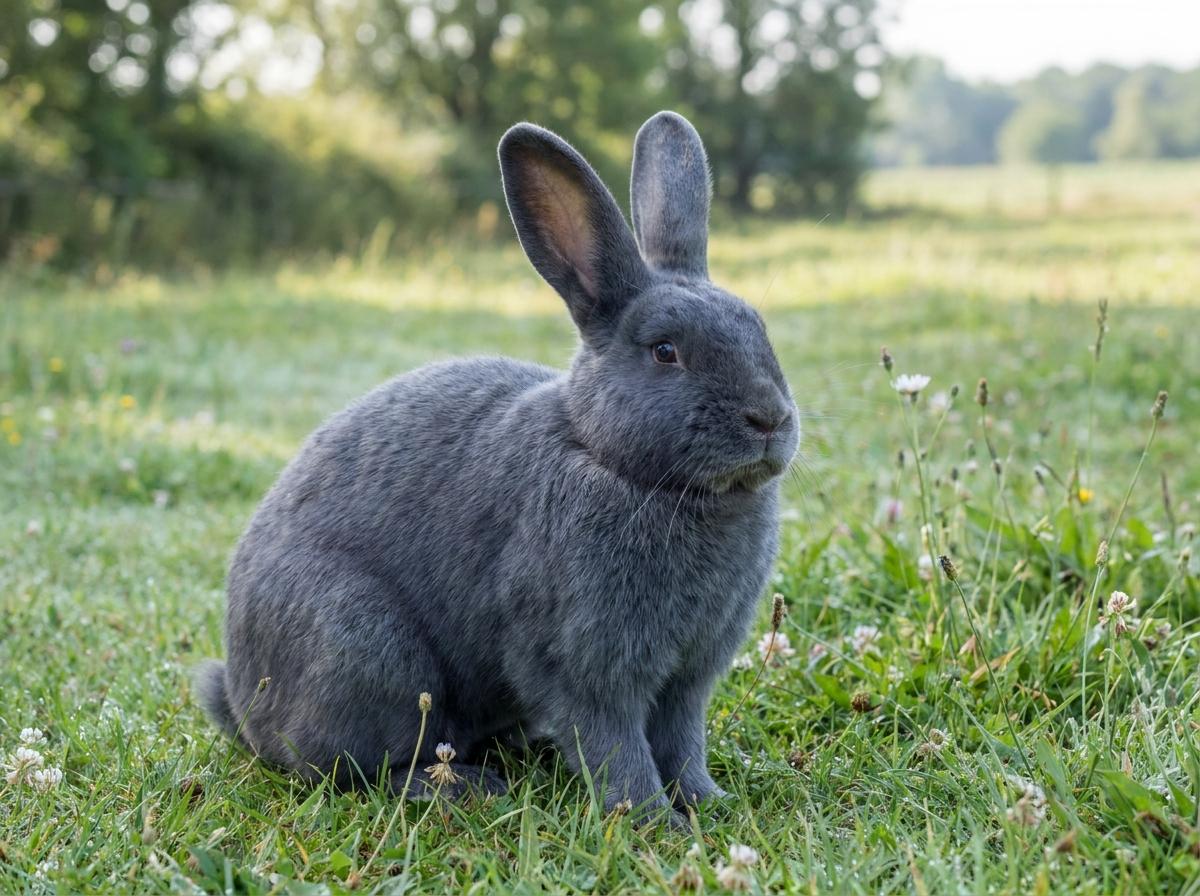
- Blue. The original Beveren color and the one most people search for. The British standard and published summaries of the ARBA standard both ask for a clean, clear shade of light lavender blue carried down to the skin and free of silvering. Published summaries of the ARBA standard give blue-gray eyes.
- Black. A deep, lustrous black carried well down into a dark blue undercolor. Summaries of the ARBA standard give dark brown eyes.
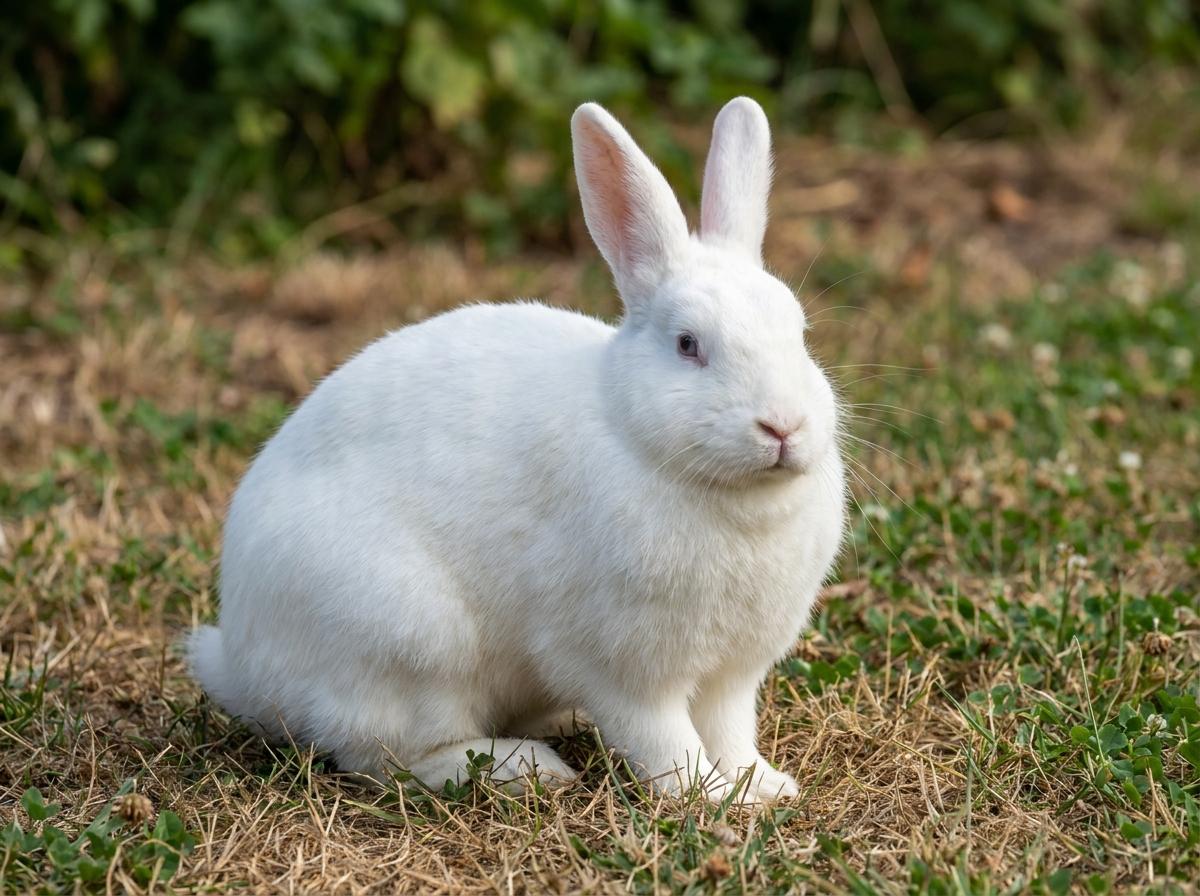
- White. Pure white throughout, with brilliant blue eyes. This is the blue-eyed white, often shortened to BEW. The ARBA standard, as summarized in published breed references, disqualifies a white Beveren with any other eye color, so a pink-eyed (albino) white rabbit is not a Beveren white.
The British Rabbit Council adds two colors ARBA does not recognize: brown, an even medium brown, and lilac, an even pinkish dove color whose eyes carry a ruby glow. In the British standard every variety’s eyes match its body color except the white, whose eyes are blue.
Britain also has a separate breed called the Pointed Beveren, which the BRC lists as a rare variety. It is a black rabbit ticked all over with white-tipped hairs (blue, brown and lilac versions are also recognized), built like a Beveren and weighing 7 lb or more. It is not one of the ARBA Beveren varieties.
Those British colors matter if you import. ARBA’s guide to registering a rabbit says a rabbit must be an accepted variety in the Standard of Perfection to be registered, so a brown or lilac Beveren can be kept and bred in the United States but not registered or shown as a Beveren there.
How the blue-eyed white is inherited. In rabbits, blue-eyed white is attributed to a recessive gene at what geneticists call the Vienna locus. A genetic study of blue-eyed white rex rabbits by Pang and Xu traced the trait to a recessive mutation there and found that a rabbit with two copies is white with blue eyes, whatever its other color genes are. In practice, two blue or black Beverens can each carry one hidden copy and still produce a blue-eyed white kit. If you breed Beverens, write down which pairs have thrown whites; that history is part of the pedigree a buyer of your colored stock will want to see.
Beveren or American? Telling the look-alikes apart
One breed easily confused with the Beveren is the American, a breed developed in the United States that also comes in blue and white, also has a mandolin-shaped body, and also tops out at 12 pounds under ARBA. The easiest way to tell them apart is the coat. The Ohio 4-H breed profiles describe the American’s fur as flyback, the kind that snaps quickly back into place when you stroke it from tail to head, while the Beveren’s longer coat rolls back gently. The American’s weight range also starts a pound higher, with senior bucks at 9 to 11 pounds and senior does at 10 to 12. Both breeds are on the Livestock Conservancy’s Watch list, so a buyer looking for either one should ask for a pedigree rather than judge by color.
Size is the other quick check. A blue rabbit well over 12 pounds is outside the Beveren standard and may be a giant breed, such as a blue Flemish Giant, or a cross.
Temperament and handling
ARBA’s breed page describes the Beveren as active and energetic, and the Livestock Conservancy lists its temperament as docile, friendly and curious and calls the does good mothers. Both can be true of one rabbit: alert and busy, but settled with people who handle it calmly. These are breed tendencies, not guarantees; early handling, neutering and rabbit company shape any individual.
Size matters most when you have to pick one up. The Merck Veterinary Manual warns that rabbits have powerful hind legs that can kick out and cause serious injury, and its section on rabbit diseases notes that fractures of the lower spine are common in pet and commercial rabbits, which is why proper restraint matters. Lift a Beveren close to your body with the hindquarters fully supported, keep the time off the ground short, and if it struggles, set it down gently instead of fighting it. Most rabbits do not enjoy being carried, so let a large rabbit come to you at floor level. The technique is in the guide to handling and bonding with your rabbit.
Rabbits are social animals. The RSPCA says one rabbit needs at least one other, and the Rabbit Welfare Association and Fund says they should always be kept at least in friendly pairs; the RSPCA’s one exception is a rabbit that a vet or qualified animal behaviourist advises should live alone. Breeding rabbitries are the practical exception: intact adults are penned separately (Merck notes that adult rabbits can fight severely, and says the doe should always be taken to the buck’s cage for breeding), so single-penned breeding stock needs daily exercise and handling. For a pet Beveren, that means planning, and budgeting space, for two large rabbits from the start; bonding rabbits explains how to introduce them.
How rare is the Beveren?
The Livestock Conservancy tracks heritage breeds on its Conservation Priority List. The Beveren graduated from Watch to Recovering in 2020, dropped back to Watch in 2024, and is listed as Watch on the 2026 Conservation Priority List. For rabbits, the Watch category means fewer than 200 annual registrations in the United States, an estimated global population under 2,000, fewer than 500 rabbits recorded at shows over the previous five years, and 31 to 60 breeders.
In practice, a small number of breeders produce the litters, so a buyer may have to wait or travel. A breeder working with the Beveren benefits from careful pedigree records, because in a small population it is easy to pair two rabbits that share ancestors without realizing it. Other rabbits on the same 2026 list include the Belgian Hare (Recovering), the Blanc de Hotot (Watch) and the Silver Marten (Recovering).
Housing a large rabbit
A Beveren is a big, active rabbit, and welfare guidance written for average-sized rabbits is the minimum for it, not the target.

- Space. The Rabbit Welfare Association and Fund recommends a single enclosed area of at least 3 m by 2 m and 1 m high (about 9 ft 10 in by 6 ft 7 in, and 3 ft 3 in high) for two average-sized rabbits, available at all times, so they can run rather than just hop, and says a hutch should never be the sole or main accommodation. The RSPCA’s rabbit housing guidance gives the same minimum for two medium-sized rabbits (“the bigger the better”), with room to stand up without the ears touching the roof and to lie fully stretched out. A pair of 10-pound Beverens should get more than the minimum: a large pen, a rabbit-proofed room or a secure shed with a run attached.
- Solid floors. The RSPCA says rabbit housing floors should be solid, not wired or barred, because wire floors can give rabbits sore feet and hocks, and that slippery laminate or tile is stressful too, so add rugs or mats. Merck’s section on noninfectious diseases of rabbits links ulcerative pododermatitis (sore hocks) to bearing weight on wire-floored cages, lists heavy breeds such as the Flemish Giant among the susceptible ones, and says an affected rabbit needs a solid floor to rest on. Some breed descriptions, including the Livestock Conservancy’s current breed page, praise the Beveren as easy to raise in all-wire hutches; current welfare guidance points the other way, and a heavy rabbit is the last one to keep on wire.
- Inside the space. Hides big enough for a large rabbit to turn around in, a hay rack, a large litter tray with hay, heavy water bowls, and things to chew and dig. Litter training makes a free-roam setup far easier to live with.
- Heat. That dense coat helps in cold weather (the Livestock Conservancy notes the breed’s good cold tolerance), but Merck says rabbits are sensitive to heat. Keep the space out of direct sun, keep air moving, and read up on keeping rabbits cool before the first hot spell.
Indoor and outdoor setups are compared in our rabbit housing guide.
Feeding and coat care
A Beveren eats like any rabbit, only more of it: grass hay offered without limit, modest daily portions of leafy greens, a small measured amount of plain pellets and clean water, with fruit only as an occasional treat. The guide to what to feed a rabbit lists safe greens and portion sizes. Merck’s owner guide to digestive disorders of rabbits names unlimited hay, regular brushing, weight control, a low-stress home, safe things to chew and time out of the cage as the best ways to prevent both gastrointestinal stasis and hairballs.
Two habits matter more for a Beveren than for a small breed:
- Brushing. Rabbits swallow loose hair while grooming, and a coat this dense sheds a lot of it during a molt. Brush at least twice a week, the Merck Veterinary Manual’s minimum for short-haired rabbits, and more often during a molt, when Merck advises extra brushing to cut the risk of swallowed hair blocking the gut.
- Weighing. A large rabbit can gain or lose a pound before anyone notices. Weigh monthly and write it down. Logged on a rabbit’s profile, the weights become a chart, so a slow change shows up long before you would see it by eye.
Health and lifespan
None of the sources we checked documents a health problem specific to the Beveren. It shares the risks every pet rabbit faces, covered in the rabbit species guide, and its size adds a few practical points. Find a rabbit-experienced vet before you need one (our guide to finding a rabbit vet explains what to look for), and let the vet make every medical decision for your rabbit.
- Teeth. Merck calls malocclusion probably the most common inherited disease in rabbits, and says overgrown cheek teeth usually come from diet and husbandry mistakes, one more reason the hay matters. It lists drooling, tooth grinding and going off food among the signs of dental disease. A rabbit with malocclusion should not be bred. Rabbit nail trimming and dental care covers the checks you can do at home.
- Gut. A rabbit that stops eating or passes fewer droppings needs a vet promptly, Merck’s owner guide says; learn the signs of GI stasis in rabbits before you need them.
- Feet. Check the undersides of the hind feet every week or two for bare, red or scabbed patches, especially on a heavy rabbit, and tell your vet early.
- Spaying. Merck calls uterine cancer the main reason to spay does that will not be bred; ask your vet about timing for a large breed, and see spaying and neutering rabbits for the details.
- Rabbit hemorrhagic disease. RHDV2 has spread to numerous states since 2020, according to the USDA’s Animal and Plant Health Inspection Service; ask your vet about vaccination where you live.
There is no published lifespan for the Beveren in particular. The RSPCA says rabbits typically live around 8 to 12 years, sometimes longer, and that smaller rabbits tend to live longer than larger ones, so plan for roughly a decade with a large breed and hope for more. The guides to how long rabbits live and common rabbit illnesses are worth reading early, and the rabbit health record template shows what to track between vet visits.
Finding a Beveren: price and where to look
There is no reliable national price survey for Beverens; with so few breeders, each rabbitry sets its own prices, which depend on variety, pedigree and show quality. For most owners the purchase price is the smaller part of the budget; the pen, hay, neutering and vet care are the larger, ongoing costs, broken down in what pet rabbits cost.
Good places to start:
- ARBA shows. Exhibitors with Beverens are the most direct way to see adults of the breed and meet the people who raise them. How rabbit shows work explains ARBA-sanctioned shows.
- The breed club. The American Beveren Rabbit Club is the breed’s national specialty club and appears on ARBA’s list of national clubs, which carries its current contact details.
- The Creatures directory and marketplace. The breeder directory lists rabbitries by breed, and Beveren listings on the Creatures marketplace appear as breeders post them.
Before you commit, read where to buy a rabbit, which also covers rescues. When you talk to a breeder, ask:
- Which variety the rabbit is, and whether blue-eyed whites have turned up in its line.
- Whether it comes with a pedigree, and how much the parents weigh as adults.
- How the rabbits are housed and what the floors are.
- How old the rabbit is and whether it is fully weaned and eating hay well.
- What health records come with it.
Then look at the rabbit itself: clean bright eyes, clean ears, teeth that meet, a clean rear end, and hind feet with full fur on the undersides.
Once a Beveren is on its way home, the rabbit name generator is a quick way to settle on a name before you set up its profile.
Breeding and showing Beverens
The Beveren has a small but committed show following in the United States. The American Beveren Rabbit Club sanctions Beveren classes at ARBA shows, and judging rewards the arched mandolin body, the full, curved head, correct V ear carriage, a dense, glossy rollback coat and clean color within the weight limits. If you show, keeping rabbit show records explains how to keep results and certificates straight.
For breeders, the Livestock Conservancy describes Beveren litters as large, the young as fairly fast-growing, and the does as typically docile and good mothers. Pregnancy is short: Merck gives the rabbit gestation period as about 31 to 33 days. Enter the breeding date in the rabbit gestation calculator to get the due date and the nest-box window, and read up on how long rabbits are pregnant and caring for baby rabbits. On age, Merck says medium breeds reach sexual maturity at about 4 to 4.5 months and giant breeds at 6 to 9 months; a large breed like the Beveren falls between the two, so ask an experienced breeder and your vet before a doe’s first litter. How to breed rabbits covers pairing, the nest box and kindling.
Three things deserve emphasis in a rare breed:
- Breed only sound rabbits. Malocclusion is commonly inherited, and sore hocks, poor condition or a nervous temperament are not things to pass on.
- Track the white gene. Because the blue-eyed white is recessive, record every white kit and both of its parents, so you and your buyers know which colored rabbits carry it.
- Keep the pedigree complete. In a small population the pedigree is how you avoid pairing close relatives, and it is what ARBA registration rests on: a complete three-generation pedigree in which every ancestor is the same breed and shows its name, ear number, variety and weight. Keep those details for every rabbit you breed or buy (linking sire and dam on each rabbit’s Creatures profile builds the family tree as you go), and check the paperwork against ARBA’s registration guide before you see a registrar. Rabbit pedigrees explains what ARBA expects.
Is a Beveren right for you?
Before you go looking, make sure that:
- You have room for two large rabbits. Not a hutch with an hour out, but a pen, room or shed and run they can use all day, with solid floors.
- You can keep them cool. A dense-coated rabbit needs shade, airflow and a plan for hot weather.
- You can lift a 10-pound rabbit safely, and are happy to spend most of your time with them at floor level instead.
- You will keep up the routine. Hay, twice-weekly brushing, monthly weights, teeth and feet checks, and a same-day vet call if eating stops.
- You are patient. With so few breeders, finding the right Beveren can take time.
If most of that fits, a Beveren is a hardy rabbit (the Livestock Conservancy’s word) with a long history, and good homes and careful breeders are what keep a rare breed going. If you would rather have something much smaller, the Holland Lop sits at the other end of the scale, with an ARBA maximum of 4 pounds, though a small rabbit still needs the same space and company.
Frequently asked questions
How big does a Beveren rabbit get?
Under the ARBA standard, senior bucks weigh 8 to 11 pounds and senior does 9 to 12, with 12 pounds as the maximum. The British standard sets a minimum of 8 lb (3.62 kg). It is a large breed, but well short of giants such as the Flemish Giant.
What colors do Beveren rabbits come in?
ARBA recognizes blue, black and blue-eyed white. The blue is the original color and should be a light lavender blue. The British Rabbit Council also recognizes brown and lilac.
Do Beveren rabbits have blue eyes?
The white variety does: a Beveren white is a blue-eyed white, and a white rabbit with pink eyes is not a Beveren white. Summaries of the ARBA standard give blue Beverens blue-gray eyes and black Beverens dark brown eyes.
Is it spelled Beveren or Beveran?
Beveren, after the Belgian town the breed is named for. “Beveran” is a common misspelling, and early American standards printed it as “Beverin.”
Are Beverens good pets?
They can be, in a home with space for two large rabbits. ARBA calls the breed active and energetic, and the Livestock Conservancy calls it docile, friendly and curious. Like most rabbits, they prefer company at floor level to being carried.
Is the Beveren rare?
Yes. ARBA calls it rare in the United States, and it is in the Watch category of the Livestock Conservancy’s 2026 Conservation Priority List (for rabbits, fewer than 200 annual US registrations and 31 to 60 breeders).
What is a Pointed Beveren?
A separate British breed (see the Pointed Beveren page), listed by the British Rabbit Council as a rare variety. It is built like a Beveren but its black, blue, brown or lilac coat is ticked all over with white-tipped hairs. It is not one of the ARBA Beveren varieties.
Do this next on Creatures
Creatures keeps the Beveren alert, the breeder list and your rabbit’s records together, so the next step is a click away whichever stage you are at.
Get alerted first. Set a free Beveren listing alert and we will email you when a new Beveren is posted. No account needed to start. See saving searches and using your watchlist.
Find a breeder. Look up Beveren rabbitries in the Creatures breeder directory, and check Beveren listings on the marketplace for any that are listed now.
Add your rabbit. Already have a Beveren? Create a free profile for your Beveren in a few minutes, no account needed to start. The walkthrough is in adding an animal to Creatures.
Keep the records. Add weights, foot and tooth checks, and vet visits so changes show up as a trend. The record sheet opens for any visitor, and a free account saves what you enter. See adding a record and health and medical records, and set the monthly weigh-in as a repeating reminder with reminders and upcoming care.
Breed Beverens? Create your rabbitry’s profile, no account needed to start, then get listed in the breeder directory so buyers looking for Beverens can find you. Still naming the rabbitry? Try the rabbitry name generator.
Compare breeds. The rabbit species guide covers care for every breed, and the Holland Lop page profiles a small lop breed with a 4-pound maximum.