




English Trumpeter
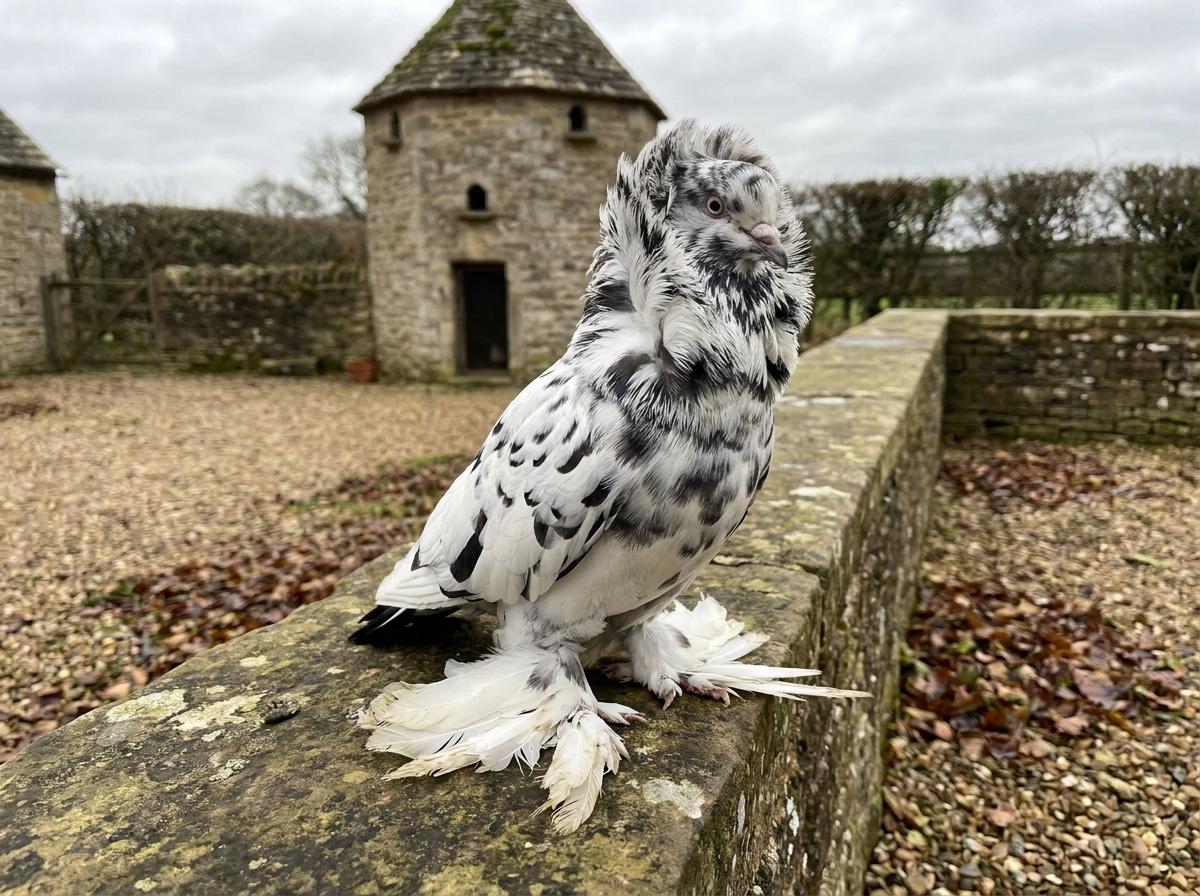
The English Trumpeter is a heavily feathered ornamental pigeon best known for two things: a booming, laughing coo that gives the whole Trumpeter family its name, and an extravagant coat of decoration. Picture a compact, low-slung bird almost buried in feather work, a rose-shaped crest spreading across its forehead, a shell crest and mane rising at the back of the head, and long feathered “muffs” fanning out over its feet like slippers. Despite the “English” in its name, the bird most fanciers picture today was refined largely by American breeders, and it is now one of the most popular show pigeons in the United States. This page covers what the breed is, where it came from, that distinctive trumpeting sound, how to read its crest and muffs, its color groups, and what to check before you buy one.

Browse listings, public profiles, breeders, or add your animal.
What is an English Trumpeter pigeon?
The English Trumpeter is a breed of fancy, or ornamental, pigeon. Like all domestic pigeons it descends from the wild rock pigeon (Columba livia), but centuries of selective breeding have taken it a long way from that plain wild ancestor. Fanciers keep it to be looked at, shown, and heard, not to fly races or carry messages. Breed references consistently describe it as one of the most popular and most ornamental fancy pigeons in the United States, which fits a bird whose entire appeal is decoration and voice.
Two features define it. The first is the sound, the trumpeting coo shared across the Trumpeter family that we cover in its own section below. The second is the feathering: a rose-shaped crest across the forehead, a shell crest and mane at the back of the head, and large muffs of feathers on the feet. Getting all of those features correct on one bird, at the same time, is the central challenge of breeding the English Trumpeter, and it is why good examples take real skill to produce.
If you are still comparing breeds, the broader Creatures pigeon species page is a good place to see the English Trumpeter alongside other fancy pigeons, from the crested Nun to the frilled Chinese Owl.
The trumpeting sound, explained
The word “Trumpeter” describes a voice, not a shape. The Trumpeter breeds of pigeon are named for a distinctive vocalization that Wendell Levi, in his standard reference work The Pigeon, describes as sounding “vaguely like low laughter.” Different traditions have their own name for it: fanciers in the United Kingdom and the United States call it trumpeting, while breeders in Germany and the Low Countries call it drumming.
In plain terms, it is not the short, familiar “coo” of a city pigeon. It is a longer, deeper, rolling call, a repeated rumbling or drumming that rises and falls and can carry on for many seconds at a time. To a first-time listener it can genuinely sound like a soft, chuckling laugh coming from the loft. The trait is inherited, which is why it runs true within the Trumpeter breeds rather than appearing at random. The English Trumpeter’s version tends to be one of the fuller, more prolonged voices in the group.
A word of honesty here, because it matters if the sound is what drew you to the breed. Not every individual trumpets to the same degree, and the vocalization varies from bird to bird. If a strong, sustained call is important to you, it is fair to ask a breeder about the voice of the specific bird and its parents, and to listen in person if you can, rather than assuming every English Trumpeter will perform on cue.

Origin and history
The history behind the “English” name is more tangled than it looks, and it is worth getting straight.
Trumpeter pigeons as a group are old, and several regions have been suggested as the original home of the earliest trumpeting birds, including areas of Russia, Central Asia, and the Near East. The Bokhara Trumpeter, named for the city of Bukhara (Bokhara) in Central Asia, is one of the heavily muffed and crested ancestral forms, and superior Bokhara-type stock imported into England by way of Russia in the mid to late 1800s is generally credited with improving the feathering and crest of the English birds.
England developed its own Trumpeter line from that foundation through the 1700s and 1800s, in the same Victorian fancy-pigeon culture that produced so many ornamental breeds. Here is the twist, though: the breed known today as the English Trumpeter has been much altered by fanciers in the United States, to the point that it is often described as effectively an American creation. In other words, the name points back to an English origin, but the polished modern show bird was shaped in large part by American breeders and is now most strongly associated with the United States show scene. That is why you will sometimes see the breed called an American creation despite the “English” label.
The practical takeaway for a buyer is simple. The modern English Trumpeter is a purpose-bred exhibition pigeon with a well-established standard, not a rediscovered antique flying breed. When you read about its long history, remember that the bird in front of you reflects generations of recent selection for crest, muffs, and type.
What an English Trumpeter looks like
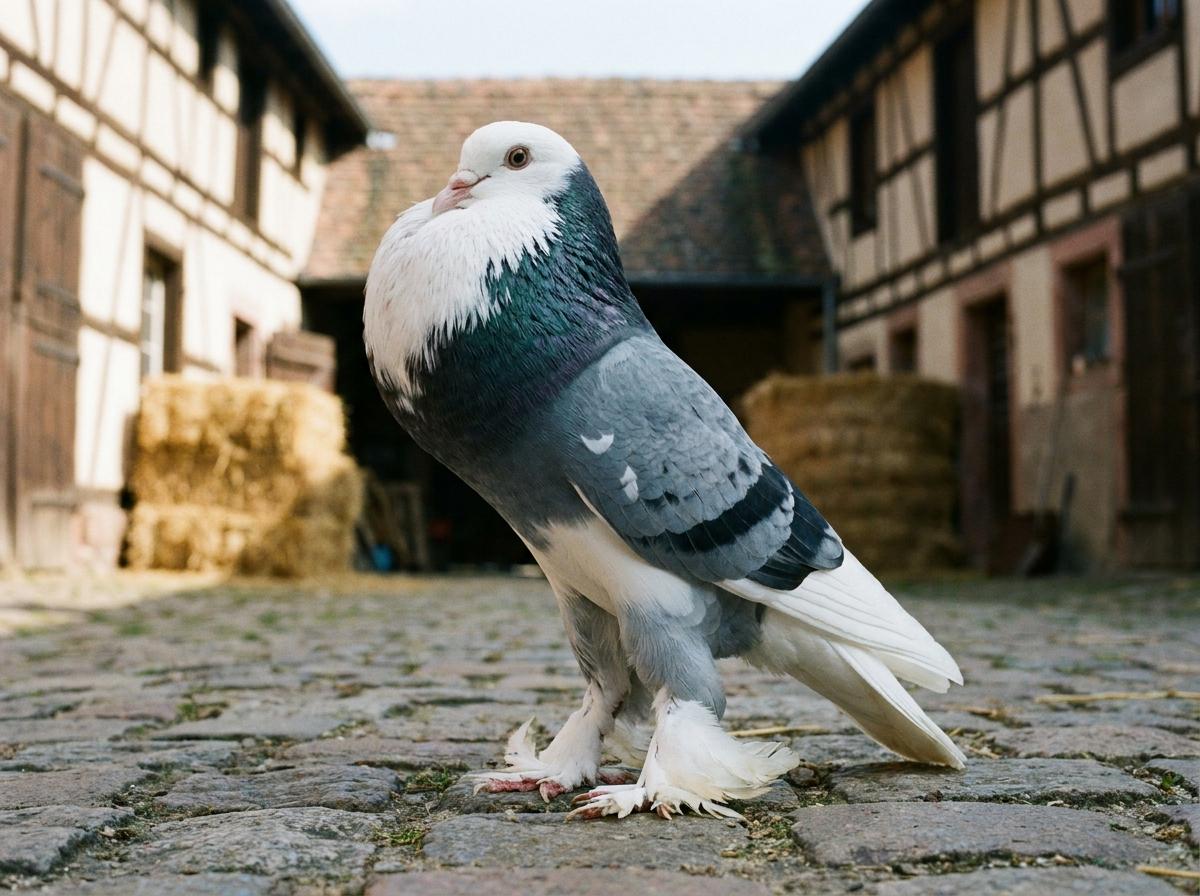
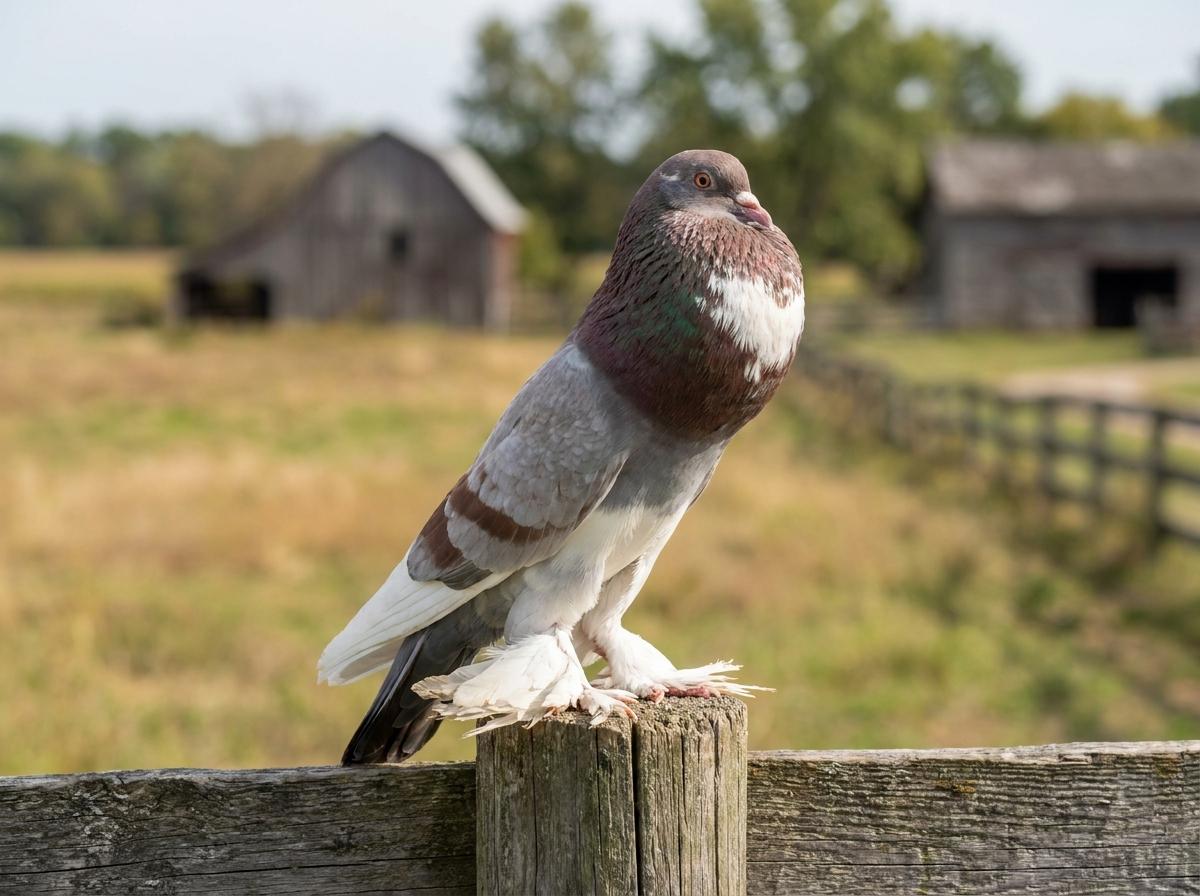
Strip away the color and the English Trumpeter is defined by its silhouette and its feather ornaments. The breed standard maintained by the National Pigeon Association describes a medium-sized bird, similar in size to a Show Racer, standing roughly nine inches tall, carried low with a proud, alert stance and a rounded, heart-shaped outline. The diagnostic features are the decoration:
- Rose crest on the forehead. A rose, or rosette, is a spray of feathers that radiates outward in a flower-like or carnation-like pattern across the front of the head. On a good English Trumpeter this frontal rose is full and symmetrical and is one of the first things a judge looks at.
- Shell crest and mane behind the head. At the back of the head the feathers rise into a shell-shaped crest, and the neck carries a full mane. Together with the frontal rose, this frames the head in feather work from front to back.
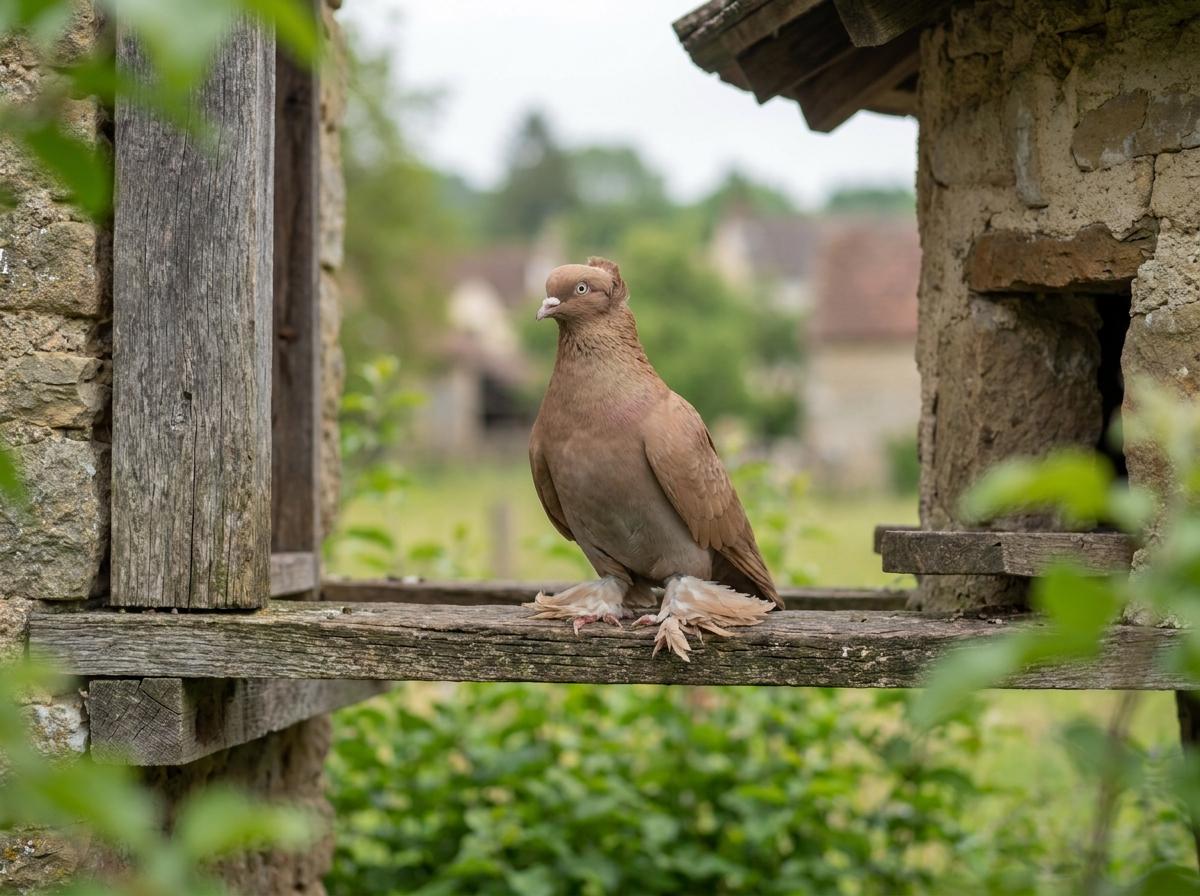
- Large feathered muffs on the feet. The muffs, also called boots, are long feathers growing from the feet and hocks. On this breed they are very large, sometimes described as approaching the length of the flight feathers, and they fan out to cover the toes and lower legs. Well-grown muffs are dense, even, and slipper-like.
- A tuft as well. Many descriptions note that the breed combines a tuft, a crest, and heavy muffs, and it is that combination on one bird that makes the English Trumpeter genuinely difficult to breed to a high standard.
Because the whole bird is built around symmetry, the ideal is a balanced package: a full even rose, a matching shell crest, and large well-shaped muffs on a compact, correctly typed body. A bird strong in one feature but weak in another is a common sight, which is exactly why type and balance are judged so carefully.

Colors and pattern groups
The English Trumpeter comes in a wide range of colors, and the standard organizes them into recognized pattern groups. The three most commonly cited are:
- Self. A self bird is a single solid color over the whole body, such as black, red, yellow, blue, or white, with no contrasting pattern.
- Splash. A splash is a mostly white bird flecked or splashed irregularly with a colored pattern, giving a mottled look.
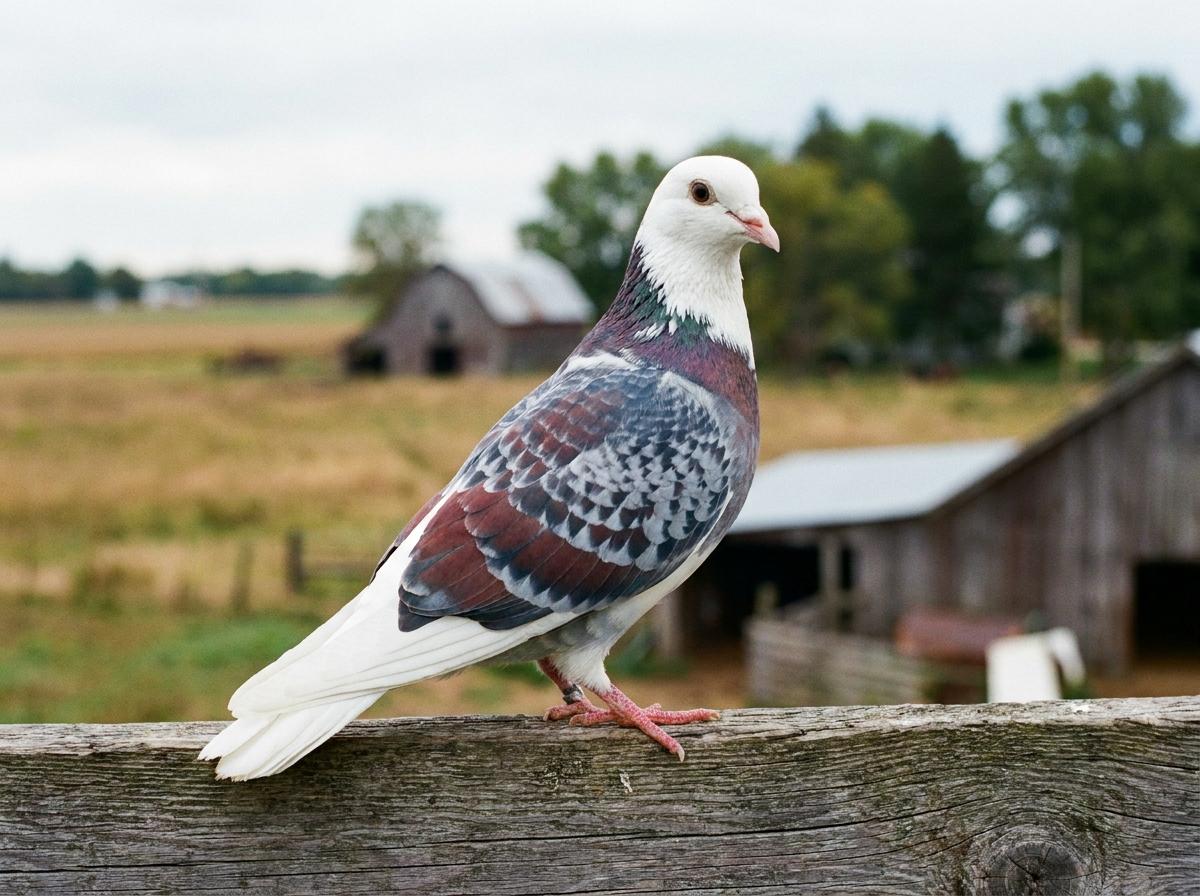
- Baldhead. A baldhead is a marked pattern in which the body carries color while specific areas, classically the head, stay white, producing the crisp “bald” contrast the name describes.
Colors seen across these groups include black, blue, red, yellow, white, and patterned varieties such as almond. As with many exhibition breeds, the practical point for a buyer is that “English Trumpeter” is a shape and a voice, not a color. Decide which color and pattern group you want, then judge the bird on its type, crest, and muffs first and its exact shade second. A striking color on a poorly feathered or poorly typed bird will not win and will not breed reliably toward the standard.
Temperament and keeping
English Trumpeters are generally described by keepers as calm, gentle, and easy to handle, which fits a breed that lives its life being housed, shown, and bred rather than flown hard. We flag that as fancier observation rather than a formally studied trait, since temperament varies with handling and how much regular, quiet contact the birds get. Defer any health concern to an avian veterinarian.
Day to day, the breed is kept much like other heavily feathered fancy pigeons, with one important wrinkle: the muffs. The English Trumpeter is not built to fly and is kept in the loft and aviary rather than let out to range, so clean, dry housing is essential. Those long foot feathers pick up dirt, droppings, and moisture and can be damaged or broken, so many keepers pay particular attention to dry flooring and clean nest boxes, and some trim or manage the muffs for breeding birds so that mating and egg care are not hindered. Beyond that, the basics are standard pigeon care: a dry, draft-free, predator-proof loft with enough perches and nest boxes, clean water, a good pigeon grain mix supplemented with grit and minerals, and a sensible parasite-control routine. Keeping clear records of each bird’s pedigree, pairings, color, crest and muff quality, and any health events is genuinely useful for breeding to the standard and for selling birds honestly later.
Cost and availability
The English Trumpeter is one of the more widely kept ornamental pigeons in the United States, so it is more available there than many rare exhibition breeds, particularly through Trumpeter clubs and pigeon shows. Even so, there is no single reliable public price for the breed, and we will not invent one. Price depends heavily on the quality of the rose crest, shell crest, mane, and muffs, how closely the bird matches the standard, its color and pattern, and the reputation of the loft.
In broad terms, pet-quality or surplus young birds tend to be inexpensive, while top exhibition birds with correct, balanced feathering from winning lofts command considerably more. Rather than chase a headline number, judge value on type, crest, muffs, health, and the breeder’s records. Because so much of the breed’s quality lives in feather detail that is hard to read from a single photo, the most practical way to buy well is to connect with breeders through clubs and shows and to see or hear the specific bird you are considering.
You can browse current English Trumpeter listings on the Creatures marketplace and look for breeders and lofts in the Creatures directory. If the exact color or feather type you want is not listed yet, a saved listing alert (below) is the simplest way to catch one when it is posted.
Buying considerations
Because the breed is all about balanced feathering and a compact type, buy on specifics, not on a single flattering picture.
- Read the whole feather package. Look at the frontal rose, the shell crest and mane, and the muffs together. A bird that is excellent in one area but weak in another is common. Balance across all three is what makes a good English Trumpeter.
- Check muff condition, not just size. Long muffs are the goal, but they must be clean, dense, and undamaged. Broken, dirty, or thin muffs tell you about the bird and about how the loft is kept.
- Ask about the voice. If the trumpeting call is part of why you want the breed, ask the breeder about the bird’s voice and its parents, and listen in person where you can.
- Confirm health and condition in person where possible. Look for clean, bright eyes, smooth body plumage, good weight, and steady breathing, and ask about the loft’s parasite and health management.
- Ask for records. Pedigree, color, pairings, crest and muff quality, and any show results tell you far more than appearance alone, and a serious breeder will have them.
Frequently asked questions
Why is it called a Trumpeter pigeon?
For its voice. The Trumpeter breeds are named for a distinctive vocalization that has been described as sounding vaguely like low laughter, a deep rolling coo that fanciers in the UK and US call trumpeting and breeders on the Continent call drumming. It is longer and deeper than an ordinary pigeon’s coo.
Is the English Trumpeter actually English or American?
Both, in a sense. The breed was developed in England from imported Trumpeter stock in the 1700s and 1800s, but the polished modern show bird was much altered by American fanciers and is often described as effectively an American creation. The name points to the English origin, while the modern breed is most associated with the United States show scene.
What are the feathers on its feet called?
Muffs, sometimes called boots. They are long feathers growing from the feet and hocks, and on the English Trumpeter they are very large, sometimes approaching the length of the flight feathers, fanning out to cover the toes and lower legs.
What is the crest on its head?
The English Trumpeter carries a rose crest, a flower-like spray of feathers across the forehead, plus a shell crest and mane at the back of the head. Combining the rose, the crest, and the heavy muffs on one balanced bird is the main challenge of breeding the breed.
Can English Trumpeters fly?
Not really as a working ability. Generations of selection for a heavy, ornamental, low-slung body and large foot muffs have made the breed a poor flyer, so it is kept as a show and pet bird in the loft and aviary rather than flown.
How long do English Trumpeters live?
There is no authoritative breed-specific figure, so treat the general domestic-pigeon expectation of roughly 10 to 15 years in good care as a guide rather than a guarantee. Individual birds can live longer with excellent care and veterinary attention.
Do this next on Creatures
Whether you are researching the breed, hunting for a particular color or feather type, or already keeping English Trumpeters, Creatures is the records, marketplace, and directory layer to do it in one place.
Compare the breed. See the English Trumpeter alongside other fancy pigeons on the Creatures pigeon species page, and explore related breeds such as the King, the Nun, the Archangel, and the Damascus.
Find birds. Browse English Trumpeters on the marketplace and search trusted breeders and lofts in the Creatures directory. New to the marketplace? See saving searches and using your watchlist.
Get alerted. Looking for a specific color or feather type? Set a free English Trumpeter listing alert and we will tell you when one is posted. No account needed to start.
Add your pigeon. Already keeping English Trumpeters? Create a free animal profile in a few minutes, no account needed to start. The walkthrough is in adding an animal to Creatures, and you can see how each profile section works in your animal’s profile page.
Track color, pairings, and health. Keep records on Creatures. The record sheet opens for any visitor to look around, and you will need a free account to save what you enter. See adding a record for the full how-to.
List your loft. Breed and show English Trumpeters? Create a loft or breeder profile, no account needed to start, and get listed in the breeder directory so buyers searching for a specific color or line can reach you.
If you keep a loft, you can also cross-reference related crested and muffed breeds like the Modena and the French Mondain while you decide what to add to your collection.